
High-Pressure Cleaning Drones in Europe: Applications for Buildings, Solar Panels and Renewable Energy Infrastructure

Europe is undergoing continuous development and upgrading across its buildings, energy systems, and infrastructure. As high-rise buildings, glass façades, commercial facilities, and large-scale renewable energy projects continue to expand, maintaining these assets efficiently has become an important challenge for property managers, professional cleaning companies, and renewable energy O&M providers.
At the same time, drone technology is moving beyond aerial photography, surveying, and inspection into professional operational applications. High-Pressure Cleaning Drones are one of the emerging applications. By combining a drone platform with a high-pressure water cleaning system, these specialized drones can approach high-rise building façades, glass curtain walls, and other hard-to-reach surfaces from the air, providing an alternative approach to traditional high-altitude cleaning.
From a European market perspective, this trend is driven not only by building maintenance requirements, but also by the rapid development of renewable energy infrastructure such as solar and wind power.
Table of Contents
Why Does Europe Need New High-Altitude Cleaning Methods?
European buildings and infrastructure are becoming increasingly complex.
From high-rise office buildings, hotels, and commercial complexes to glass-façade buildings, large industrial facilities, and renewable energy projects, more and more assets require regular cleaning, maintenance, and appearance management.
Traditional high-altitude cleaning methods may include:
- Aerial work platforms
- Suspended platforms
- Lifting equipment
- Scaffolding
- Rope access
- Ground-based high-pressure cleaning equipment
These methods remain suitable for many projects. However, for buildings that are particularly tall, have complex façades, or contain areas that are difficult for conventional equipment to access, equipment deployment and personnel organization can become important operational considerations.
This raises an increasingly relevant question: Can drones be used for high-rise building cleaning? High-pressure cleaning drones have emerged as one potential solution to this challenge.
Europe’s Solar Market Is Creating New Cleaning and Maintenance Demand
To understand why high-pressure cleaning drones are attracting attention in the European market, solar power is an important part of the picture.
According to SolarPower Europe’s EU Solar Market Outlook 2025–2030, the European Union added 65.1 GW of solar PV capacity in 2025, bringing total installed solar capacity to approximately 406 GW by the end of 2025. The EU’s 2030 solar target is 750 GW DC, equivalent to 600 GW AC.
This means Europe will continue to have a substantial installed base of solar facilities in the coming years.
For solar projects, construction is only one stage of the asset lifecycle. As the number and scale of solar installations increase, ongoing:
Inspection → Maintenance → Cleaning → Performance Management will also require long-term investment.
Dust, dirt, and other contaminants can accumulate on solar panels, making cleaning an important part of solar O&M activities.
For large ground-mounted solar farms, commercial rooftop PV systems, and certain solar installations that are difficult for personnel to access, operators may need to consider more flexible cleaning methods.
This makes the Solar Panel Cleaning Drone an application worth exploring for high-pressure cleaning drone technology.
Europe’s Wind Power Infrastructure Also Creates High-Altitude Maintenance Needs
Other than solar power, wind power is one of the other sources of energy that forms an essential part of Europe’s renewable energy network.
As per the recent statistics reported by WindEurope in September 2026, Europe currently possesses more than 311 GW of installed wind energy capacity which includes about 270.5 GW of onshore wind and 40.9 GW of offshore wind. WindEurope anticipates around 148 GW of wind energy capacity addition in Europe by 2030.
It is important to note that not every wind energy facility is suitable for direct high-pressure drone cleaning.
However, from a broader infrastructure maintenance perspective, these figures indicate that Europe is developing an increasing number of:
- High-altitude energy facilities
- Large industrial facilities
- Structures that are difficult to access directly
- Infrastructure requiring long-term maintenance
This creates further opportunities for drones in areas such as inspection, cleaning, and maintenance support.
What Is a High-Pressure Cleaning Drone?
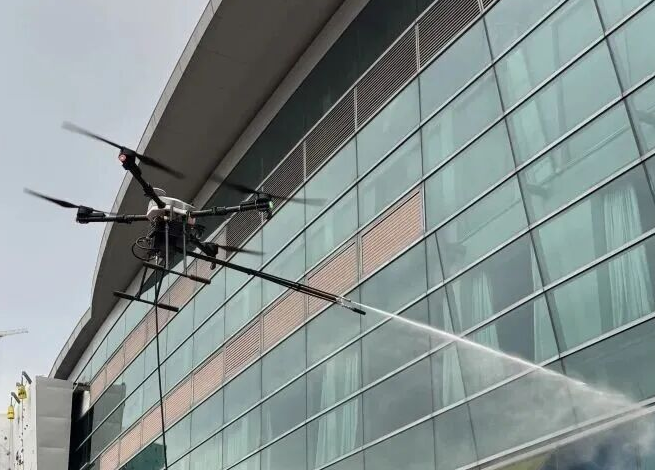
The High-Pressure Cleaning Drone refers to a professional system that integrates an aerial drone with a high-pressure water cleaner.
It is unlike the regular camera drones since it does not have an aim of photography but rather has the core purpose of carrying out high-pressure water cleaning in areas that are hard to access.
A typical system may include:
| System | Main Function |
| Cleaning Drone | Provides aerial flight and positioning |
| High-Pressure Pump | Generates the required water pressure |
| Ground Water Supply | Provides a continuous water source |
| High-Pressure Hose | Delivers water from the ground system to the drone |
| Cleaning Nozzle | Directs high-pressure water onto the target surface |
| Remote Control System | Controls the flight and cleaning process |
One key characteristic of this system is that the high-pressure water equipment is primarily installed on the ground, while the drone carries the cleaning components to elevated areas.
In other words, the drone is not simply expected to carry a large amount of water in the air. Instead, the system works as an integrated solution:
Ground-Based Water System + Hose + Aerial Cleaning Platform
This configuration allows the drone to perform aerial cleaning while the main water supply and high-pressure equipment remain on the ground.
Which European Applications Are Suitable for High-Pressure Cleaning Drones?
Europe has a diverse set of tall buildings, glass facades, solar power plants, hotels, and business establishments that require varying degrees of cleaning at a higher altitude.
With advancements in drone cleaning technology, high-pressure cleaning drones are offering a novel solution to this problem.
So, which European applications are particularly relevant to high-pressure cleaning drones? Several areas are worth considering.
1. High-Rise Building Cleaning
European office buildings, hotels, residential towers, and public buildings include a large number of high-rise façades.
A high-pressure cleaning drone can approach building surfaces from the air, providing an alternative to traditional suspended platforms, aerial work platforms, and rope-access systems for certain high-rise cleaning projects.
2. Glass Façade Cleaning
Glass façades are widely used in European commercial buildings and hotels.
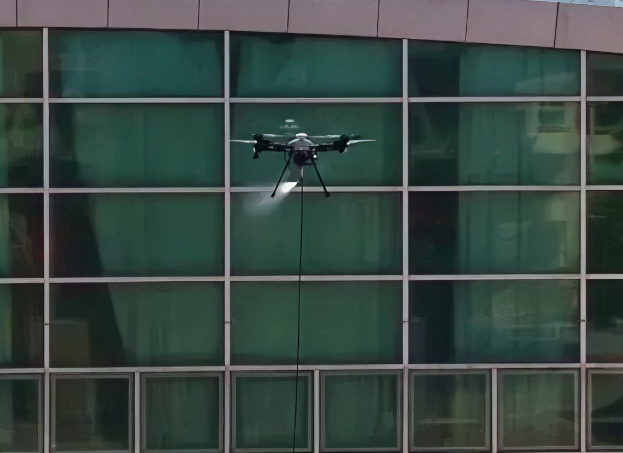
A Glass Façade Cleaning Drone can use high-pressure water to clean glass surfaces and may be suitable for certain high-rise buildings and large-area glass façades where conventional access methods require significant equipment deployment.
3. Solar Panel Cleaning
As Europe’s solar infrastructure continues to expand, solar panel cleaning is becoming another application worth considering.
For large-scale solar projects, operators can evaluate the suitability of a Solar Panel Cleaning Drone based on the site layout, panel configuration, accessibility, cleaning requirements, and local operating conditions.
4. Hotels and Commercial Buildings
Hotels, shopping centers, and commercial complexes often require regular façade maintenance.
For large glass façades, high-rise buildings, and exterior areas that are difficult to access, high-pressure cleaning drones can provide another cleaning option alongside conventional equipment.
5. Industrial Facilities
Factories, warehouses, and certain energy facilities may have high-level walls, steel structures, and other elevated surfaces that require cleaning.
For areas that are difficult to access using conventional equipment, a drone-based high-pressure cleaning solution can be evaluated according to the specific site conditions.
How Are High-Pressure Cleaning Drones Different from Traditional Methods?
Drone high-pressure cleaning machines are not merely substitutes for high-altitude cleaning techniques. They transform the method through which access is gained to the surface being cleaned.
In the conventional method, suspended platforms, aerial work platforms, and rope access techniques are frequently used. On the other hand, with the drone approach, an aerial platform and a high-pressure water jet at ground level form a part of the cleaning machine.
| Operational Factor | Traditional High-Altitude Cleaning | High-Pressure Cleaning Drone |
| Access to Work Surface | Suspended platforms, aerial work platforms, rope access, etc. | Aerial access using a drone |
| Personnel Location | Some operations require personnel to work at height | Operators primarily remain on the ground |
| Equipment Deployment | Requires deployment of high-altitude access equipment | Primarily uses ground-based water and pressure equipment |
| Position Adjustment | Affected by equipment movement and building structure | Working position can be adjusted through flight |
This method would be quite beneficial in cases of high-rise buildings, big glass facades, and some areas where ordinary cleaning equipment cannot reach.
But there must always be an assessment of the real-life projects according to the building height, wind speed, facade material, obstacles, cleaning pressure, and drone laws in the area.
Thus, the high-pressure cleaning drones should be considered as a special technique in specific high-altitude cleaning tasks, not a substitute for the ordinary cleaning process.
What Regulations Apply to High-Pressure Cleaning Drones in Europe?
Drone cleaning businesses in Europe must meet EASA (European Union Aviation Safety Agency) standards and the corresponding European Union drone regulation system.
The requirements depend not only on the drone, but also on other criteria such as Maximum Take-Off Mass (MTOM), the class of the drone, the height of the flight, VLOS/BVLOS flight, the operating environment, the proximity to people, and the overall risk of the activity.
When all the criteria of the Open Category are met, for instance, when the drone flights in the VLOS, at the altitude no higher than 120 m, and follows the requirements of the appropriate subcategory A1, A2, or A3, then the corresponding Open Category can be used for the operation.
However, different drone classes and weights are subject to different operating restrictions. Particular attention may be required when operating in urban environments or near people.
For certain high-pressure cleaning operations that exceed the conditions of the Open Category, such as operations involving BVLOS, applicable weight limitations, flights above 120 m, or certain higher-risk operations in urban environments, the operation may fall under the Specific Category.
Such operations may require a risk assessment and compliance with an applicable operational authorization, Standard Scenario (STS), or another regulatory pathway.
It would be wise for operators to take into consideration the geographical zones designated by the nation’s aviation regulatory bodies, operator registration, the requirement of competency of remote pilots, and the specific requirements pertaining to the operating zone.
In this regard, even when the model of a drone satisfies all the requirements needed for its usage in the European market, this does not mean that it could be applied to high-pressure cleaning in all the European cities.
For businesses which plan on carrying out commercial cleaning using drones in France, Germany, Spain, Italy, Luxembourg, and other countries in Europe, the best strategy is to specify the type of drone model to be used, operating height, operating zone, flight technique, and environment of people around.
How to Choose a High-Pressure Cleaning Drone for the European Market?
For commercial cleaning companies, selecting a high-pressure cleaning drone should not be based solely on flight time. Instead, operators should evaluate the cleaning performance, operational efficiency, and stability of the complete system.
Cleaning Pressure
Cleaning pressure needs to match the target surface and level of contamination.
Different building façades, glass curtain walls, and solar panels may have different pressure requirements. Insufficient pressure may reduce cleaning effectiveness, while excessive pressure requires careful consideration of potential effects on surface materials.
Cleaning Efficiency
For commercial cleaning projects, the amount of actual surface area that can be cleaned per unit of time may be more useful than flight time alone.
Operators can evaluate cleaning width, flight speed, and actual operational efficiency to determine whether a system is suitable for a particular project.
Flight Time
Flight time directly affects the duration of individual cleaning operations and the frequency of operational interruptions.
For large buildings or solar projects, longer effective operating time can help reduce unnecessary interruptions.
Hose Management
One important difference between high-pressure cleaning drones and conventional drones is the hose system.
In addition to the drone itself, operators need to consider hose weight, hose length, drag resistance, and coordination with the ground-based high-pressure equipment. These factors can affect flight stability and actual cleaning efficiency.
Flight Stability
The reaction force generated by high-pressure water and the drag from the hose can make flight control more demanding.
Therefore, when evaluating equipment, operators should consider hovering stability, wind resistance, and flight control performance during continuous water spraying, rather than looking only at standard flight specifications.
VastArrive D15R: A Professional Drone for High-Altitude Cleaning Applications in Europe
For high-rise buildings, glass façades, and other elevated surfaces in Europe, the VastArrive D15R is a professional drone designed specifically for high-altitude cleaning applications.
Its main technical specification includes 12 to 15 MPa of cleaning pressure, cleaning speed of 400 to 500 square meters per hour, and flying time of 40 to 50 minutes, which serves as a benchmark for the selection of equipment for various high-altitude cleaning operations.
D15R may be utilized for cleaning the surfaces of buildings, including building facades and glass curtain walls.
For European customers, actual equipment selection should still take into account building height, cleaning target, local wind conditions, obstacles, and applicable drone operating requirements.
Real-World Application: D15R in Luxembourg
Real-world applications can provide a clearer understanding of how high-pressure cleaning drones can be integrated into commercial cleaning operations than product specifications alone.
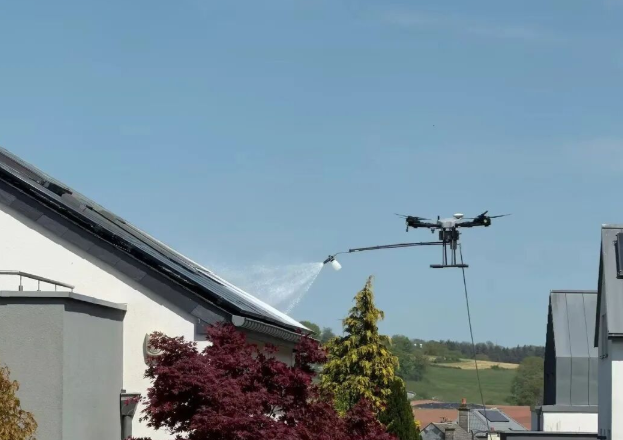
The VastArrive D15R has been used in an actual high-altitude cleaning project in Luxembourg, providing a real-world application example for the European market.
In this project, a ground-based cleaning system was connected to a high-pressure hose, while an operator controlled the D15R from the ground and guided it toward the elevated working area.
The project demonstrates how a high-pressure cleaning drone can work together with a ground-based water supply system, high-pressure hose, and ground operator to create an integrated high-altitude cleaning workflow.
To learn more about the actual operating environment, equipment deployment, and cleaning process, read the full case study:
Read the Full Luxembourg Case Study →
Where Is the Market Opportunity for High-Pressure Cleaning Drones in Europe?
The potential market for high-pressure cleaning drones in Europe extends beyond high-rise buildings and commercial facilities. It is also connected to the continued expansion of renewable energy infrastructure.
The construction of façades, glass curtain walls, solar panel setups, and any other similar elevated facilities always need to be regularly inspected, cleaned, and maintained.
As per the statistics of 2025, the cumulative solar PV capacity in Europe is estimated at about 406 GW. As per the estimates provided by SolarPower Europe under the medium scenario of its forecast, the total solar PV capacity can amount to about 718 GW in 2030.
The wind power capacity of Europe is also estimated at about 304 GW, with about 265 GW comprising the onshore wind power capacity.
The numbers presented above regarding the capacity of solar panels and wind energy do not necessarily indicate that each solar panel and wind energy facility is ready to be cleaned using drones. Nonetheless, they show the trend which exists in Europe now.
For professional cleaning companies, facility management providers, and renewable energy O&M companies, high-pressure cleaning drones can serve as an additional technology option alongside traditional high-altitude cleaning equipment.
They may be particularly relevant for projects where operators need to evaluate access to elevated surfaces, cleaning efficiency, and methods for reducing the need for personnel to work at height.
Conclusion
As Europe’s building stock, solar infrastructure, and wind energy capacity continue to expand, the long-term maintenance requirements for elevated facilities will also remain an important consideration.
For certain high-rise buildings, glass facade cleaning, commercial cleaning services, and solar cleaning that are appropriate for the use of drones, the High-Pressure Cleaning Drones are a solution in relation to regular high-altitude cleaning techniques.
The VastArrive D15R is developed for high-altitude cleaning projects with 12-15 MPa of cleaning pressure, 400-500 m²/h cleaning productivity, and 40-50 minutes of flight time.
In case you are seeking a solution in relation to building facade cleaning, glass curtain wall cleaning, or any other kind of high-altitude cleaning tasks in Europe, please get in touch with the VastArrive team or find out more about the D15R.