
Drone Exterior Surface Cleaning: How It Makes Building Cleaning Easier
In the daily maintenance of commercial real estate and large industrial facilities, building facade cleaning has long been a major headache for property managers and facility directors. Traditional rope-access (“spider-man”) operations not only carry extremely high fall risks and insurance costs, but also easily leave blind spots when dealing with complex curtain wall structures. Meanwhile, erecting scaffolding or renting aerial work platforms often means weeks of construction timelines, high equipment rental fees, and severe disruptions to normal commercial building operations and surrounding traffic.
Today, with the maturation of heavy-lift tethered drones and specialized soft washing technologies, Drone Exterior Surface Cleaning is rapidly reshaping the commercial building maintenance industry. This article provides a detailed introduction to Drone Exterior Surface Cleaning from the perspectives of technical principles, application scenarios, and equipment selection.
Table of Contents
What Is Drone Exterior Surface Cleaning? How Does It Work?
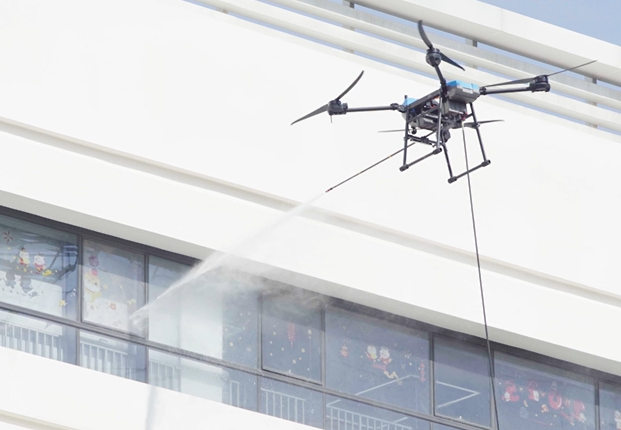
Drone Exterior Surface Cleaning refers to the operational method of using industrial drones equipped with professional cleaning devices to wash the exterior surfaces of buildings and other outdoor facilities.
Unlike standard aerial photography drones, cleaning drones are typically outfitted with spraying assemblies, cleaning nozzles, and corresponding water supply systems. Depending on the specific cleaning task, they can spray water or suitable cleaning solutions onto target surfaces to remove dust, stains, and environmental deposits.
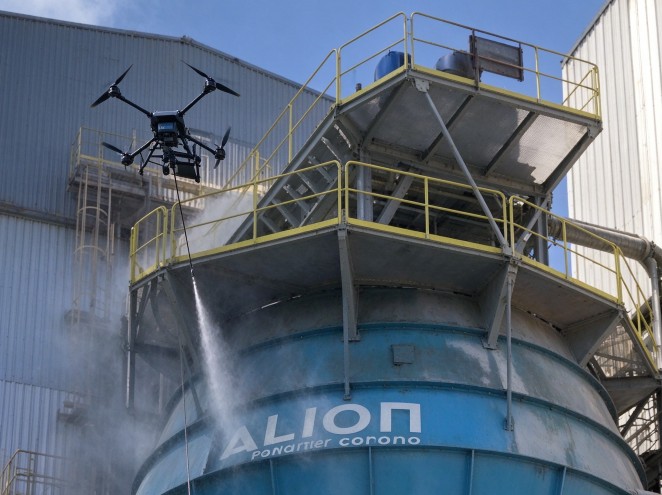
In actual operations, the drone is remotely controlled by ground operators and works in coordination with ground water supply equipment. Some systems continuously deliver cleaning water via a supply hose, enabling the drone to perform continuous facade cleaning tasks without relying solely on an onboard water tank.
Which Building Exterior Surfaces Are Suitable for Drone Cleaning?
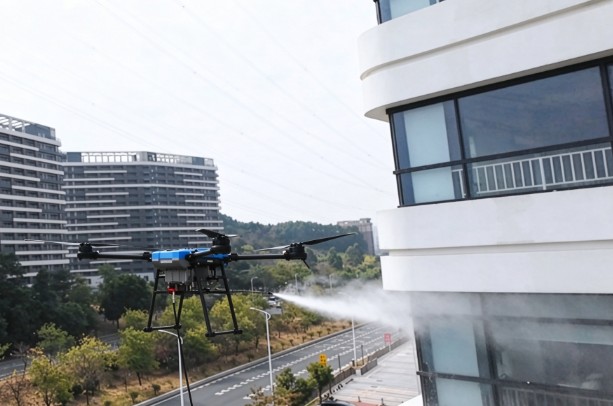
Many property managers are concerned that the high-pressure water may cause damage to the glass and walls. In fact due to the variable pressure systems and the deionised water system used by drones, they can be used in a much wider range of situations than traditional cleaning methods.
Commercial Office Building Glass Curtain Walls
The biggest concern after cleaning for all-glass curtain wall buildings is leaving water spots and streaks behind. Professional drone cleaning teams finish the job with a multi-stage filtered Deionized Water rinse. Deionized water has no minerals such as calcium and magnesium in it. When air-dried naturally it leaves no water marks and therefore provides a crystal clear finish without the need for manual squeegeeing.
Paint, Real Stone Paint, Brick, and Concrete Facades (Stucco, Brick & Concrete)
In damp areas, green algae, black mildew and lichen can develop on facades. Using drones, targeted eco-friendly soft cleaning products can be used to clean the buildings. These solutions can penetrate the small pores within the material to remove the root of the mildew. It will immediately return the colour of the walls, and prevent any re-growth of mildew for between 12-18 months.
Aluminum Composite Panels and Industrial Plant Steel Structures (Metal Cladding & Warehouses)
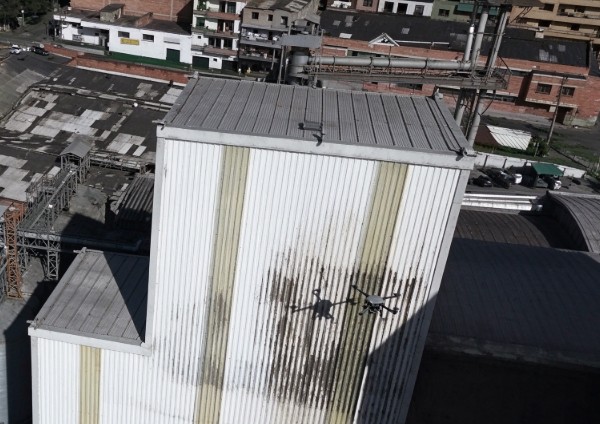
High overhead costs of scaffolding make it expensive to clean metal cladding and corrugated steel walling on large distribution centres, production units and airport terminals. With the use of drones, rapid removal of surface contaminants (such as dust, greasy deposits and acid rain oxidation) can protect and prolong the life of the metallic coating.
Commercial Solar Panel Arrays
Dust, bird droppings and pollen can reduce the power generation efficiency of commercial rooftop photovoltaic power stations by 15% to 25%. Drones can clean large-scale solar arrays quickly and without streaks, eliminating the need for personnel to walk on the panels (thus preventing micro-cracks in the solar cells) and directly increasing green energy revenue.
Complex Irregular Structures and Ultra-High Hard-to-Reach Areas
Including church spires, stadium domes, large sculptures, bridge stay cables, and wind turbine blades, blind spots where rope-access technicians struggle to anchor and aerial lifts cannot reach, drones can cover them effortlessly.
Drone Exterior Surface Cleaning vs. Traditional Cleaning Methods: Full-Dimensional Comparison
To more intuitively demonstrate the commercial value of drone exterior surface cleaning, we conducted a multi-dimensional comparison against mainstream rope-access (“spider-man”) operations and scaffolding/suspended platform solutions currently on the market:
| Evaluation Dimension | Drone Exterior Surface Cleaning | Rope Access (“Spider-Man”) | Scaffolding / Aerial Lifts |
| Construction Efficiency | Extremely Fast (A single drone can clean 3,000–5,000 sqm per day, shortening project timelines by over 60%) | Relatively Slow (Limited by single-person descent and lateral movement speeds; heavily affected by weather) | Extremely Slow (Scaffolding assembly and dismantling alone take days to weeks) |
| Safety Risk | Zero High-Altitude Fall Risk (Pilots operate remotely from a safe ground zone throughout) | Extremely High Risk (Personnel suspended at height; hazards include rope wear and anchor failure) | Medium-to-High Risk (High-altitude work hazards plus ground tipping/collision risks from heavy machinery) |
| Overall Maintenance Cost | Saves 30%–50% (Eliminates heavy machinery rentals, site closures, and high specialized labor fees) | Medium-to-High (High daily wages for specialized high-altitude workers, plus required safety officers) | Extremely High (Compounded equipment rentals, mobilization/transport fees, and road-occupation permits) |
| Surface Protection | Excellent (100% non-contact cleaning eliminates heavy impacts and scratches) | Average (Worker shoe soles, tool buckets, and safety ropes easily rub against glass or aluminum panels) | Poor (Scaffolding couplers or lift boom operator errors easily dent or scratch facades) |
| Environmental & Operational Disruption | Minimal (Requires only a small ground safety cordon directly beneath the drone; does not affect building access) | Moderate (Requires closing off rooftop terraces and pedestrian walkways below) | Severe (Large-scale hoarding occupies parking lots or commercial street walkways, heavily impacting foot traffic) |
How to Choose the Right Facade Cleaning Drone?
For building cleaning companies, industrial facility maintenance teams, and professional cleaning service providers, selecting the right cleaning drone requires focusing on actual operational needs rather than simply comparing flight specs. The following aspects deserve key attention:
Cleaning Efficiency
Cleaning efficiency is a critical metric for evaluating a drone’s commercial value. Focus on the area the equipment can clean per hour and its actual cleaning performance across different surfaces and levels of contamination. For large commercial buildings and industrial plants, higher cleaning efficiency helps shorten project timelines and improve equipment utilization.
Flight Endurance
A drone’s endurance determines how long a single operation can last. For projects requiring the cleaning of expansive building facades, longer flight endurance reduces frequent battery swaps and operational interruptions. However, keep in mind that actual endurance is affected by payload, flight environment, weather, and operating methods, focus on the equipment’s performance under actual cleaning loads.
Cleaning Pressure
Different building surfaces have varying requirements for cleaning pressure. For example, glass curtain walls, concrete facades, and metal panels may require different spray pressures and cleaning methods. Therefore, when choosing a drone, confirm that its cleaning system can meet the target surface’s requirements while offering appropriate pressure adjustability.
Payload Capacity
Cleaning drones must carry spraying assemblies and other necessary gear, so payload capacity directly impacts the configuration of the cleaning system. Determine whether the drone has sufficient load-bearing capacity based on the actual weight of the cleaning equipment, hose connection methods, and flight requirements.
Control System and Flight Stability
Facade cleaning typically requires precise drone maneuvers near buildings, making flight stability and control accuracy crucial. Especially when using high-pressure spraying systems, the reactive force of the water jet on the drone’s position must be accounted for. Additionally, the equipment should feature proper safety protection mechanisms to handle flight anomalies, environmental changes, and emergencies.
Why Choose VastArrive Cleaning Drones?
For professional service providers conducting building facade cleaning, industrial facility cleaning, and large outdoor surface maintenance, choosing an industrial drone with stable flight performance and specialized cleaning capabilities is vital.
VastArrive specializes in industrial-grade drone solutions, providing professional cleaning service providers and industrial clients with drone equipment tailored to diverse operating environments. By integrating flight platforms, cleaning spray systems, and professional operational workflows, VastArrive helps clients tackle the cleaning demands of high-rise buildings and large facilities.
For instance, the VastArrive D15R Cleaning Drone is built for professional cleaning operations, combining cleaning pressure, operational endurance, and hourly cleaning coverage to meet the equipment demands of various cleaning tasks.
Key Features of VastArrive D15R Cleaning Drone:
- Extended Flight Endurance: Approximately 40–50 minutes of flight time, supporting continuous cleaning operations.
- High Cleaning Efficiency: Approximately 400–500 square meters/hour, ideal for large-area cleaning tasks.
- High-Pressure Cleaning Performance: Cleaning pressure of 12–15 MPa, suitable for corresponding building facade and industrial surface cleaning scenarios.
- Industrial Cleaning Applications: Designed for building facades, glass curtain walls, and other applicable industrial and commercial cleaning tasks.
In addition to the D15R, VastArrive offers other industrial drone models, including the VA-B100P and VA-XK05, to accommodate different project requirements and operational environments. These models expand the available options for professional users seeking industrial drone solutions for specialized outdoor operations. Depending on the project scope, payload requirements, and application scenarios, businesses can explore different VastArrive drone platforms to identify suitable equipment for their operations.
FAQs
Can drones use high-pressure water jets to clean building facades?
Yes. Some professional cleaning drones are equipped with high-pressure spraying systems capable of removing surface dust and dirt via water jets. However, appropriate water pressure, flow rate, and spraying distance must be selected based on the building material to avoid damaging exterior coatings, glass seals, or other components.
How much area can a cleaning drone cover per hour?
The cleaned area depends on the drone model, cleaning pressure, nozzle configuration, surface contamination level, and operating method. Taking the VastArrive D15R as an example, its cleaning efficiency is approximately 400–500 square meters per hour. Actual operational efficiency may vary depending on on-site conditions.
Is it safe to use drones for building facade cleaning?
Risks to people working at heights are reduced by correctly setting-up equipment, professional operation and good site safety control. Considerations must still be made to weather conditions, aircraft stability, backwash, water supply lines and site worker safety, and local regulations must be strictly followed.
Will the chemical agents used in cleaning harm surrounding greenery or pedestrians?
No. Reputable drone cleaning service providers use 100% biodegradable, phosphate-free, eco-friendly surfactants free of strong acids or alkalis. Furthermore, before spraying any cleaning agents, the ground team thoroughly pre-wets flowerbeds and shrubs at the base of the building with clean water, and rinses the vegetation again after cleaning is completed to ensure zero damage to the surrounding ecosystem.
Does the building need to shut off water/electricity or close its main entrances during the cleaning process?
No. The water used by the cleaning drones is either taken from separate on site tanks or from the local fire/watering system. Electricity is taken from silent generators on site or separate electrical supplies. Office work, lift usage and normal walking in/out of building will be largely unaffected.
Conclusion
With the advancement of industrial drone technology, Drone Exterior Surface Cleaning is offering new operational options for the building maintenance and professional cleaning industries. For service providers looking to adopt industrial drones to optimize their facade cleaning workflows, selecting equipment suited to actual cleaning tasks is essential.
If you are looking for drone equipment suitable for building facades, glass curtain walls, and other large outdoor surfaces, contact VastArrive to learn more about our products.