
How Much Weight Can a Drone Carry?

With the rapid development of industrial drone technology, “How Much Weight Can a Drone Carry” has become a highly discussed topic in industries such as agriculture, logistics, surveying and mapping, firefighting, and engineering inspection.
So, how much weight can a drone actually carry? This article will systematically explain the technical principles behind drone payload capacity, while also exploring the payload ranges of different drone types, their industry applications, and the core design concepts behind commercial heavy-lift drone solutions.
Table of Contents
What is Drone Payload Capacity?
Drone payload capacity refers to the maximum additional weight a drone can safely carry during flight under stable operating conditions.
Here are several important concepts that need to be clearly distinguished:
| Term | Meaning |
| Payload | Additional equipment or cargo carried by the drone |
| Maximum Payload | Theoretical maximum carrying capacity |
| Takeoff Weight | Total weight of the drone, including the frame, batteries, and payload |
Most drone owners tend to confuse the concept of “maximum payload” with the actual maximum carrying capacity.
In real life, the fact of the matter is that much of the drone weight is taken up by the necessary components like battery packs, gimbals, cameras, LiDARs, spraying mechanisms, sensor units, and other control modules.
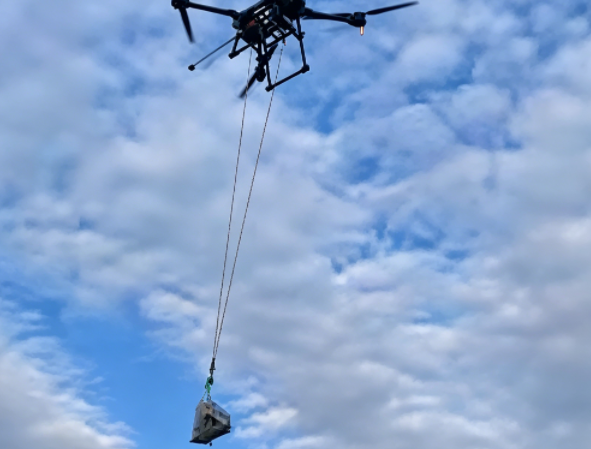
How Much Weight Can Different Types of Drones Carry?
Different drones are designed for different purposes, so their payload capacities vary significantly.
| Drone Type | Typical Payload Range |
| Toy Drones | 50–200 g |
| Consumer Drones | 200 g–2 kg |
| FPV Drones | 500 g–5 kg |
| Agricultural Drones | 10–50 kg |
| Delivery Drones | 2–30 kg |
| Heavy-Lift Industrial Drones | 20–200+ kg |
For instance, imaging drones are made mainly for imaging purposes; thus, they emphasize the importance of light construction and flight stabilization. Agriculture drones have to be equipped with tanks that contain liquid pesticides; hence, their engines have to be much more powerful. The cargo drones should take into account the need to optimize the load and flight time in addition to being efficient in movement.
Some heavy-duty industrial drones today can carry loads in excess of 100 kilograms, showing huge prospects in terms of emergency rescue missions, delivery services in mountainous regions, and autonomous logistics systems.
Why Can Drones Carry Heavy Payloads?
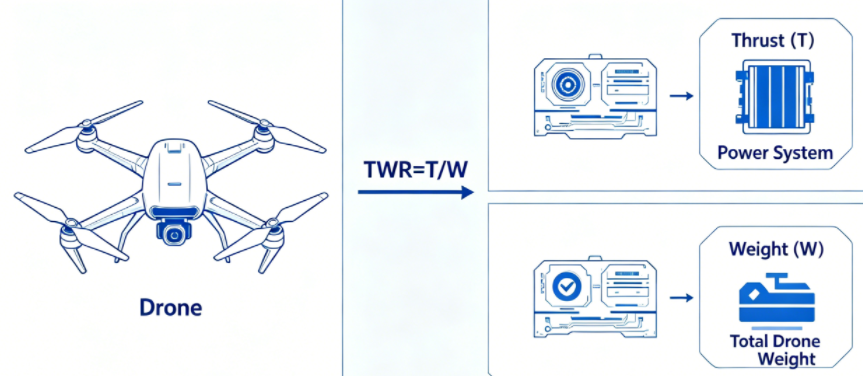
The capability of drones to fly largely hinges on the generation of sufficient thrust and lift through motors and propellers respectively. In the event where the sum of all forces produced in terms of thrust surpasses the weight of the entire airplane, then flight becomes possible.
A crucial measure that enables this is the Thrust-to-Weight Ratio (TWR).
The Thrust-to-Weight Ratio Determines Whether a Drone Can Fly
In other words, a drone can only become airborne when its TWR is higher than 1.
The average industrial drone needs a TWR of at least 2:1 to perform any kind of task, whereas certain high-end FPV drones have been known to attain ratios up to 8:1.
Why Do Industrial Drones Need a Higher TWR?
Industrial drone applications require far more than simply “getting airborne.”
In real-world operations, drones must maintain strong wind resistance, dynamic attitude correction, payload stability, and emergency braking capability. They also need sufficient power redundancy to handle sudden environmental changes and heavy-load conditions safely.
A higher thrust-to-weight ratio provides several key advantages:
- Better wind resistance
- Safer heavy-load flight performance
- More precise flight control
- Faster emergency response and braking
- Greater overall safety redundancy
What Happens If the TWR Is Too Low?
If a drone’s thrust-to-weight ratio is insufficient, it may face serious stability and safety issues during operation.
For example, the drone may struggle to maintain stable flight in strong wind conditions, experience insufficient lift during descent and braking, or become unstable under heavy payloads.
In industrial transportation, agricultural spraying, and firefighting missions, inadequate power redundancy can significantly increase operational risks.
How Do Industrial Drones Increase Payload Capacity?
To improve payload performance and flight stability, industrial drones are typically equipped with more powerful hardware systems.
Larger brushless motors provide greater output power, multi-rotor configurations increase lift and redundancy, high-capacity batteries deliver sustained energy output, and larger propellers improve aerodynamic efficiency.
It is the combination of these systems that enables modern industrial drones to achieve impressive heavy-lift capabilities.
Aerodynamic Principles Behind Drone Payload Capacity
A drone’s payload capacity is not simply increased by adding more power; it is fundamentally limited by aerodynamic efficiency.
Lift Equation
Where:
- ρ represents air density;
- v represents airflow velocity;
- A represents the propeller swept area;
- CL represents the lift coefficient.
This equation shows that the lower the air density, the more difficult it is for a drone to generate sufficient lift.
Which environments affect payload capacity?
In situations of high altitudes, high temperatures, and strong wind environments, the payload capacity of a drone will definitely drop.
This can be explained by the fact that in areas of high altitudes with thinner air, the motors have to spin faster in order to provide the required lift. More energy is consumed during the process and there is overheating.
What are the consequences?
Operating the propulsion system under a high load implies less flying time and shorter motor life along with reduced stability.
So, for industrial heavy drones, aerodynamics and redundant power supply are always more important than just motor power.

5 Key Factors Affecting Drone Payload Capacity
A drone’s payload capacity is determined by a combination of propulsion power, aerodynamic efficiency, structural design, and operating environment, rather than a single factor.
1. Motor Power
Motors serve as the power source. While industrial drones prefer high torque and low KV motors because they are capable of providing higher thrust stability, small drones need motor power with high RPM.
2. Propeller Size and Efficiency
Larger propellers generate more lift. Industrial drones often use large carbon-fiber propellers to improve aerodynamic efficiency and reduce energy loss, enabling stronger thrust at lower RPM.
3. Battery Capacity and Discharge Rate
Bigger payloads require greater power, and hence, industrial drones use high-power battery cells. But bigger batteries mean more weight; a balance is required between payload weight and endurance time.
4. Airframe Design
Carbon-fiber and modular structures help reduce weight while maintaining strength, allowing more of the generated power to be used for payload rather than supporting the drone’s own structure.
5. Flight Environment
High altitude, strong winds, extreme temperatures, and low temperatures all affect lift performance and battery efficiency, directly impacting real-world payload capacity.
Why Does Increased Payload Reduce Flight Time?
Many users are actually more concerned about one key question: how long a drone can still fly after carrying a load.
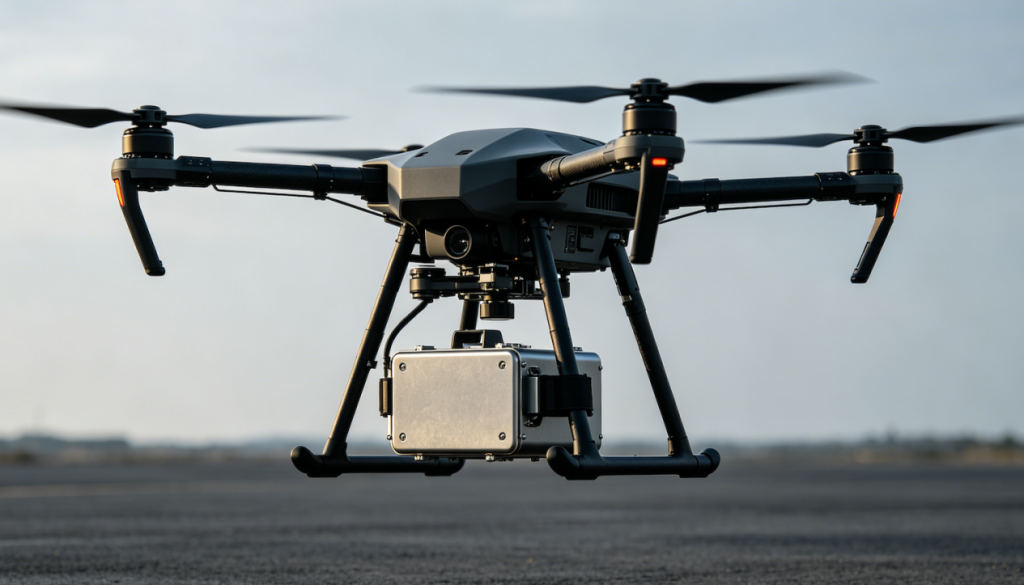
When the payload increases, the drone must generate more thrust to maintain stable flight. This directly leads to higher power consumption. At the same time, battery discharge speeds up, system heat increases, and overall energy efficiency decreases, which ultimately results in a significant reduction in flight time.
Flight Time Under Different Payloads
| Payload Weight | Flight Time |
| No payload | ~40 minutes |
| 5 kg payload | ~25 minutes |
| 20 kg payload | ~10–15 minutes |
Why Does This Happen?
When the payload becomes heavier, the quadcopter has to maintain the output of high electrical power to overcome gravitational pull. Thus, an abrupt increase in the level of current usage results in very rapid battery drainage. Additionally, under high loading conditions, motors and ESCs will consume more energy and heat up.
Design Logic of Industrial Drones
Therefore, the core goal of industrial drone design is not simply to maximize payload capacity, but to achieve the best balance between payload capability, flight time, flight stability, and operational efficiency.
How to Calculate a Drone’s Effective Payload?
A drone’s effective payload can generally be estimated using the following formula:
Payload = Maximum Takeoff Weight − Drone Weight − Battery Weight
This formula means that the theoretical payload is obtained by subtracting the drone’s own weight and the battery weight from the maximum takeoff weight.
Example Calculation
For example, if a drone has a maximum takeoff weight of 40 kg, a drone body weight of 15 kg, and a battery weight of 10 kg, then the theoretical payload is approximately 15 kg.
Difference Between Theoretical and Real-World Payload
In real-world applications, this theoretical payload cannot be fully utilized, because additional safety margins must be reserved. These include wind resistance capability, battery degradation allowance, emergency return energy, and overall flight stability requirements.
Key Insight
Therefore, the actual usable payload is usually lower than the theoretical value, as safety redundancy is an essential consideration in industrial drone design.
How to Evaluate the Commercial Value of Drone Payload Capacity?
When companies choose heavy-lift drones, they should not focus only on “maximum payload capacity.” A more important metric is cost per kilogram of payload.
Cost per kg=Total System Price / Rated Payload
Further, there are certain other parameters which have to be taken into account, such as real-flight range, coverage per flight, operational efficiency, battery change rates, and maintenance cost.
For example, if increasing the payload by 5 kg causes flight time to drop from 30 minutes to 10 minutes, then the coverage area per mission may decrease by more than 60 percent. This means that a larger payload does not necessarily translate into higher commercial efficiency.
From a business perspective, improving payload capacity is only valuable when it does not significantly reduce operational efficiency. The real value of a high-quality industrial drone lies in high energy efficiency, strong flight stability, and a high mission completion rate, rather than simply being able to carry more weight.
Summary
There is no specific answer for the question “How much weight can a drone carry?” since it relies heavily on several factors such as the power plant, aerodynamic design, energy storage, and control system design.
In today’s time, from consumer to industrial drones, the load capacity has increased from several hundred grams to more than a hundred kilograms. Yet, its importance does not rest on carrying the maximum load, but on handling it efficiently and effectively.