What Payload Is Best for Firefighting Drones?

What payload capacity is sufficient for firefighting drones is a major concern in the industry.
Does a larger payload necessarily mean stronger firefighting capabilities? So, 20L? 40L? 60L? Which one is the most suitable? These are typical questions stemming from being misled by marketing specifications.
We are a company specializing in drone exports with over a decade of experience. Based on our past clients and our data, we need to understand the following questions to make a judgment:
- Is the single-shot firefighting efficiency sufficient?
- Can it cover the target area?
- Can it reduce the number of resupply rounds?
- Can it control the spread of the fire within the golden response window?
From practical engineering experience and recent research on firefighting drone dispatch, simply pursuing a larger payload does not necessarily mean higher firefighting efficiency.
Common Misconceptions
Because of the influence of traditional firefighting equipment, many users, when making their first purchase, directly apply the old logic, believing that the more water stored, the better. However, drones and ground equipment operate on two completely different logics. A firefighting drone is a dynamic response system, and its firefighting capability is determined by multiple variables. Considering only payload and ignoring other capabilities will lead to a decrease in overall efficiency.
For example:
| Dimension | One 60L Heavy-Lift Firefighting Drone | Two 30L Medium-Lift Coordinated Drones |
| Takeoff & Response Time | Longer pre-flight preparation, slower deployment | Can be deployed in parallel; faster initial response across multiple points |
| Battery & Energy Efficiency | High energy consumption under full load, reduced endurance efficiency | Lighter payload per unit, more balanced overall energy usage |
| Flight Maneuverability | Reduced agility due to heavier airframe | Higher flexibility and better adaptability to complex flight paths |
| Refilling Efficiency | Longer downtime after each mission, creating operational gaps | Rotational operation enables near-continuous firefighting capability |
| Fire Spot Response Capability | Typically handles one primary fire zone at a time | Can engage multiple fire spots simultaneously |
| Coverage Flexibility | Concentrated coverage with limited reallocation flexibility | Dynamic zone allocation with higher operational flexibility |
| Dispatch Fault Tolerance | Single-point failure can significantly impact mission success | Higher system resilience; failure of one unit does not halt operations |
| Fire Suppression Effectiveness | Strong initial suppression but depends heavily on continuous redeployment | More effective in rapidly containing multiple spreading fire fronts |
| System-Level Efficiency (Key Metric) | Risk of “high payload, low responsiveness” bottleneck | Better aligned with “loss-minimization dispatch optimization” model |
The effectiveness of a firefighting drone does not depend on the maximum payload of a single unit, but rather on the system’s “response coverage capability + dispatch efficiency” within a limited time.
Determine Based on Needs
There is no single best-payload firefighting drone; in real-world procurement evaluations, the choice must be based on the specific application scenario.
Initial Fire Control in Industrial Parks
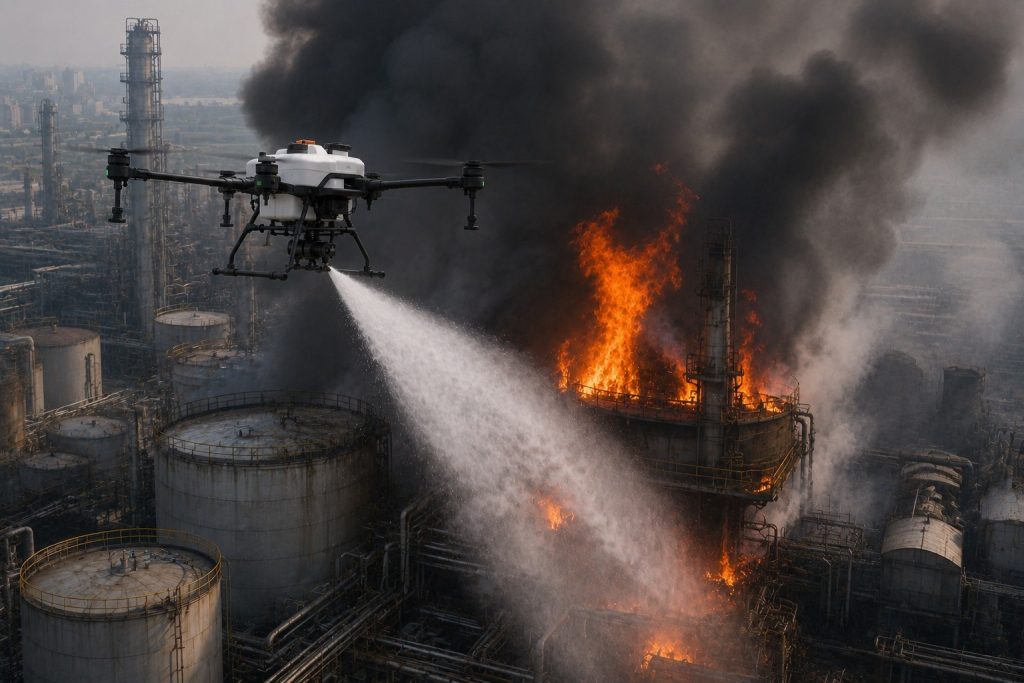
For fires reported in industrial parks such as petrochemical storage areas or logistics parks, the fire source is clearly defined, and the response window is typically within 3-8 minutes. We recommend firefighting drones with a payload capacity of 15L-30L. Drones in this range can balance rapid fire coverage with high maneuverability, fully covering initial fire points and supporting high-frequency response. They can prevent the fire from spreading immediately, turning a small fire into a major incident.
Forest and Wildfire Edge Control
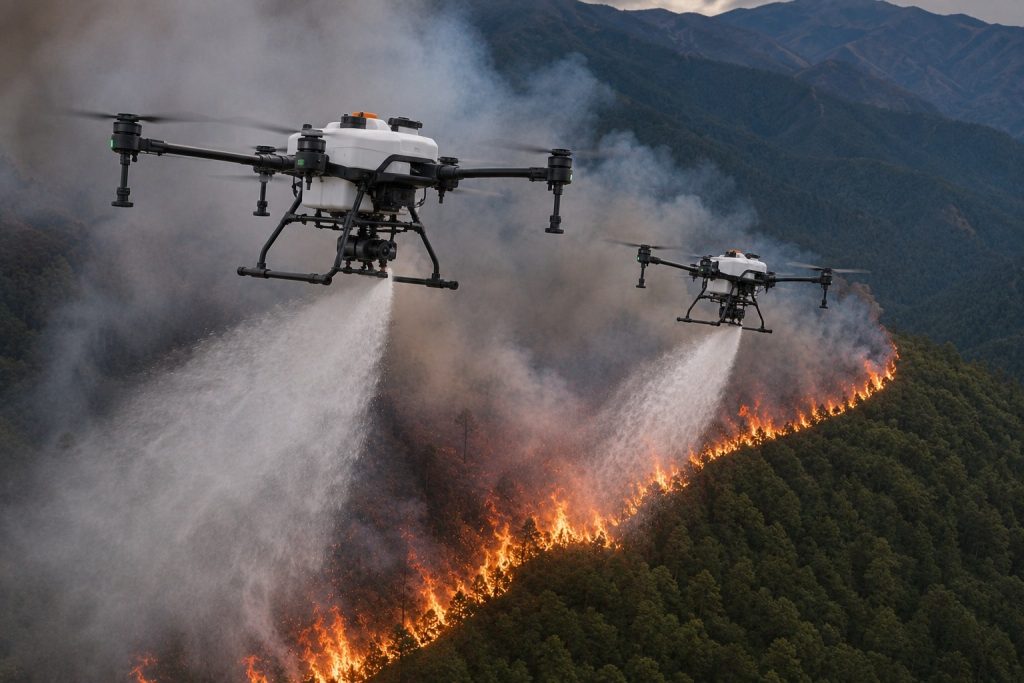
When forest or wildfires break out, they can spread rapidly and create long fire lines due to environmental factors, wind speed, and direction. This necessitates drones with continuous coverage; a payload of 30L-50L is recommended. Firefighting drones within this range possess sustained suppression capabilities, a large operational radius, and can effectively prevent fire spread and establish firebreaks. However, all success hinges on intelligent dispatch capabilities; otherwise, even a large payload will be wasted if the optimal intervention time is missed.
Firefighting and Rescue in Mountainous or Complex Terrain
When responding to fires in mountainous or complex terrain, the flight paths of drones are highly variable due to terrain limitations, limited takeoff and landing points, wind disturbances, and unstable communication. Therefore, 10L-20L firefighting drones are recommended. In this scenario, maneuverability takes precedence over payload capacity. Lighter platforms are less affected by flight conditions, making it easier to complete the mission with lower risk and lower cost of failure.
Urban High-Rise Fires and Dense Building Environments
Urban high-rise fires typically occur in super high-rise buildings, commercial centers, and high-density residential areas. Fires spread rapidly along vertical structures, demanding extremely fast response times. In such scenarios, a payload of 10L–25L is recommended for drones. The focus is not on the amount of fire extinguished per burst, but on rapid arrival and high-frequency cyclical operation capabilities.
While excessively large payloads increase the amount of fire sprayed per burst, they reduce maneuverability, increase flight instability in building wind conditions, and prolong takeoff, landing, and resupply times, ultimately impacting the efficiency of response within the golden response window.
Based on fire dispatch research, urban fires rely more on multiple precise interventions, using continuous small-dose operations to block the fire’s spread. Therefore, medium-to-light-load platforms combined with high-frequency dispatch systems typically offer superior overall fire suppression efficiency compared to heavy-load single drones.
Firefighting Drone Systems Are Shifting Toward Multi-Drone Coordination
In firefighting drone applications, the industry is shifting from “single-unit, high-payload” systems to “multi-drone collaborative systems.” This shift is not merely a conceptual trend, but a result of real-world mission efficiency and engineering limitations.
From a practical perspective, while 50L–60L class drones with larger single-batch spraying capabilities offer greater spraying power, they suffer from significant limitations in continuous operation: reduced endurance (approximately 20%–35% under high loads), decreased maneuverability, higher risk of single-point failures, and longer resupply cycles, which can easily lead to response interruptions.
In contrast, multi-drone collaborative systems have demonstrated higher efficiency in actual fire dispatch research. According to research on wildfire dispatch optimization published in the journal <Drones>, through multi-drone collaboration and dynamic scheduling, resources can be prioritized for high-risk fire locations, thereby significantly improving overall loss control capabilities.
In engineering practice, the advantages of multi-robot systems are mainly reflected in three aspects:
- Rotational operation: Enabling continuous firefighting and resupply cycles
- Parallel coverage: Simultaneous response to multiple fire points, reducing the risk of spread
- Dynamic scheduling: Real-time adjustment of resource allocation based on changes in fire intensity
Therefore, the industry is shifting from “competition based on single-robot capabilities” to “competition based on system-level scheduling efficiency,” and multi-robot collaboration is becoming the mainstream development direction for firefighting drones.
References
Wu, R.-Y., Xie, X.-C., & Zheng, Y.-J. (2024). Firefighting Drone Configuration and Scheduling for Wildfire Based on Loss Estimation and Minimization. Drones, 8(1), 17. MDPI.
Related Products