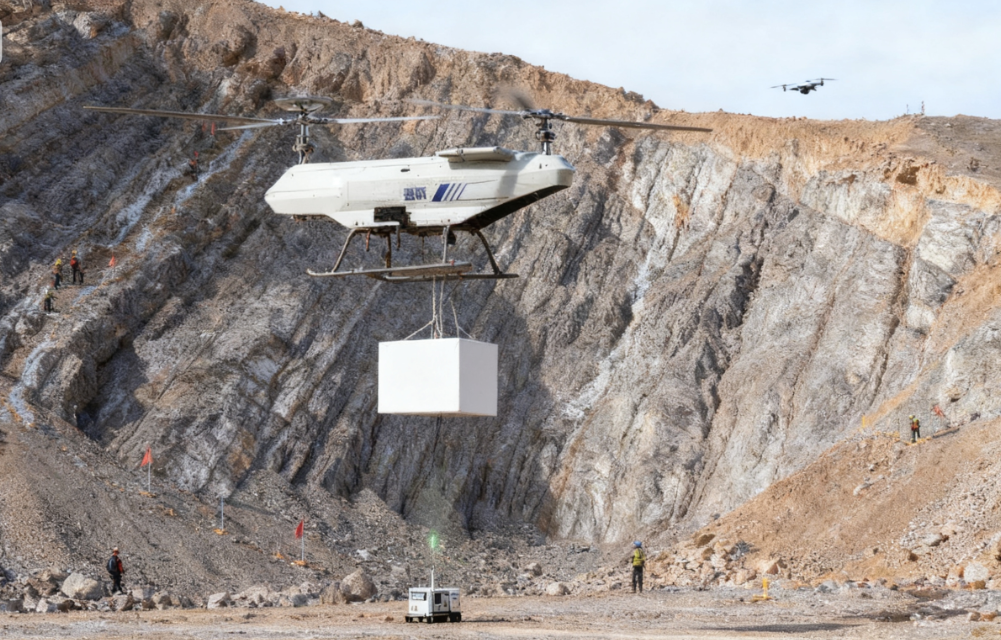
Unmanned Helicopters Improved Sample Transport in a 4,500-Meter Lithium Exploration Area
Project Overview
A lithium exploration project was located at an altitude of approximately 4,500 meters, where transporting geological samples from remote exploration sites presented significant logistical challenges.
Under the traditional transportation method, exploration samples were carried manually or transported using yaks, depending on terrain and accessibility.
Moving a single 20-kilogram sample could take approximately 3 days.
The high-altitude environment also exposed personnel and animals to multiple risks, including altitude sickness, rugged terrain, and potential geological hazards.
To improve the efficiency and safety of sample transportation, the exploration team introduced a heavy unmanned helicopter transportation system in 2024.
The heavy UAV provided an aerial transportation option for moving geological samples between remote exploration areas and designated collection points, reducing dependence on traditional ground transportation methods.
The project demonstrated a more efficient approach to logistics in high-altitude mineral exploration environments.
The Challenge
Extreme High-Altitude Environment
The exploration area was located at approximately 4,500 meters above sea level. The high-altitude environment created additional challenges for both personnel and traditional transportation methods.
Difficult Terrain
Remote lithium exploration areas often involve rugged terrain and limited transportation infrastructure. Moving samples from exploration sites to collection points can therefore require significant time and effort.
Long Transportation Time
Under traditional transportation methods, moving a single 20-kilogram geological sample could take approximately 3 days. This slowed the transfer of samples and affected the efficiency of the overall exploration workflow.
Human Health Risks
Working at an altitude of 4,500 meters can expose personnel to risks associated with high-altitude conditions. Reducing unnecessary manual transport can help limit personnel exposure to demanding field conditions.
Geological Safety Risks
Mountainous exploration areas may contain unstable slopes, steep terrain, and other geological hazards. Transporting materials manually through such environments can increase operational risks.
Limited Ground Transportation Options
In remote exploration areas, conventional vehicles may be unable to reach many sampling locations. This leaves manual carrying or animal-based transportation as potential alternatives, both of which have limitations in difficult terrain.
The Heavy UAV Transportation Solution
To address the logistical challenges of high-altitude sample transportation, the exploration team introduced a heavy unmanned helicopter system.
The UAV provides an aerial logistics option for transporting geological samples between remote exploration sites and designated collection points.
The operational workflow is:
Sample Collection
↓
UAV Loading
↓
Heavy UAV Take-Off
↓
Aerial Transportation
↓
Sample Delivery
↓
Geological Analysis
By moving samples through the air, the system reduces the need to transport heavy materials manually across difficult mountain terrain.
How the Sample Transportation Works
1. Collect Geological Samples
Exploration teams collect geological samples at designated lithium exploration locations. Samples can then be prepared for aerial transportation.
2. Prepare the Payload
The geological samples are securely packaged and loaded onto the heavy unmanned helicopter according to the UAV’s payload and operational requirements.
3. Plan the Flight Route
The aerial transportation route is planned according to the locations of the exploration site, sample collection point, terrain conditions, and operational requirements.
4. Conduct Autonomous or Remote-Controlled Flight
The heavy unmanned helicopter transports the samples through the air, avoiding difficult ground routes where possible.
5. Deliver the Samples
The samples are transported to the designated collection or processing location. This allows geological samples to enter the subsequent analysis workflow without relying exclusively on ground transportation.
6. Repeat Transportation Missions
The UAV can perform repeated transportation missions according to exploration requirements, providing a flexible logistics option for remote mining areas.
Key Technologies
Heavy Unmanned Helicopter
The heavy UAV platform is designed for transportation missions requiring greater payload capacity than conventional small drones. This makes it suitable for logistics tasks such as geological sample transportation.
High-Altitude Operation
The UAV system is deployed in a challenging environment at approximately 4,500 meters above sea level, demonstrating the application of unmanned aerial logistics in high-altitude exploration.
Aerial Logistics
Aerial transportation allows samples to bypass difficult mountain routes and reduces dependence on manual or animal-based transportation.
Remote Operation
Remote operation allows transportation missions to be conducted without requiring personnel to accompany the payload throughout the route.
Flexible Route Planning
The aerial platform can be used to establish transportation routes between remote exploration sites and designated collection points.
Project Results
20 kg Sample Transportation
The heavy UAV transportation system supports the movement of geological samples weighing approximately 20 kilograms per mission.
Reduced Dependence on Ground Transportation
The aerial logistics model reduces reliance on manual carrying and animal-based transportation in remote exploration areas.
Improved Transportation Efficiency
Compared with the traditional method, which could require approximately 3 days to transport a single sample, aerial transportation provides a more direct logistics option.
Reduced Personnel Exposure
By transporting samples through the air, the system can reduce the need for personnel to carry heavy materials across high-altitude and rugged terrain.
Improved Operational Flexibility
The heavy UAV provides exploration teams with an additional transportation option when conventional vehicles cannot efficiently reach remote sampling locations.