
Drone in Greenhouse Plant: Uses, Benefits, and Applications
In modern Controlled Environment Agriculture, high-density crop planting within closed greenhouse environments boosts yield while simultaneously introducing unprecedented operational challenges. Traditional manual inspection walks are not only time-consuming and labor-intensive, but they also struggle to capture early-stage pest and disease outbreaks comprehensively.
With advancements in drone technology, greenhouse inspection and crop protection drones, specifically engineered for indoor environments, are reshaping high-tech agricultural production workflows. So, what specific applications do drones have in greenhouse farming? What unique environment requirements does a greenhouse demand of a drone? And how should growers select the right drone in greenhouse plant? This article provides a detailed overview covering practical applications, equipment selection and more.
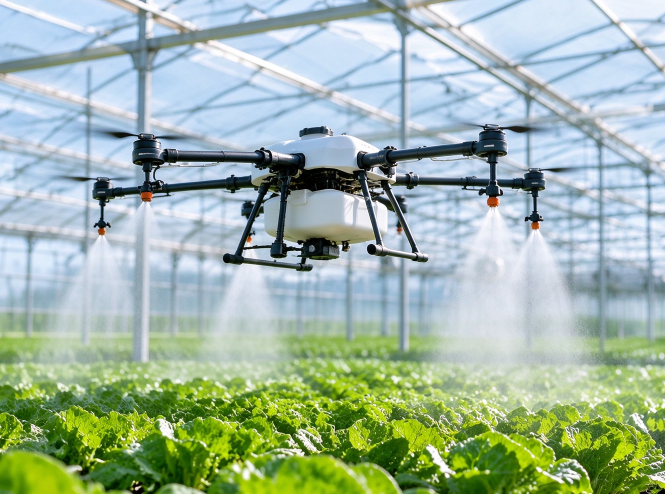
Table of Contents
How Are Drones Used in Greenhouse Agriculture?
The main utility of drones in greenhouse farming is in helping with monitoring, detecting problems, and managing cultivation. Based on the size of the greenhouse and the crops, the drones can be used in the following major areas:
Greenhouse Crop Health Monitoring
Health inspection of crops in the greenhouse is one of the essential tasks for modern greenhouse drones. In conventional systems, employees inspect plants going aisle by aisle and looking at the color of leaves, the shape of plants, and their state.
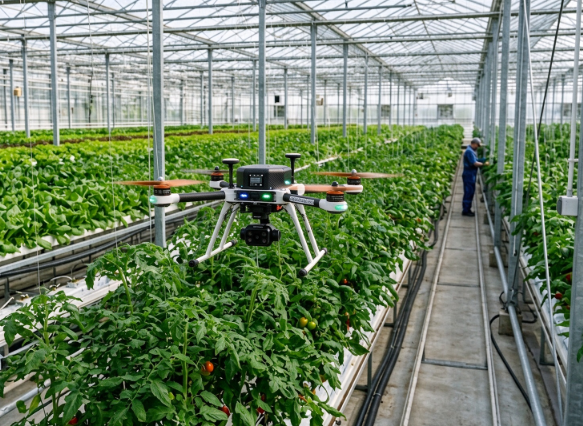
With the help of high-definition RGB camera-equipped drones, managers can analyze leaf color, plant growth, and canopy density. Using the drones with multispectral sensors, we can take reflectance images of crops in various light bands and get such indicators as NDVI.
Note: Greenhouse light levels, background noise and plant varieties will impact upon the calculation of indexes. Multi-spectral indexes need to be validated using real observations. Constantly gathering and comparing data will give growers a better understanding of growth patterns to make precise decisions.
Early Detection of Plant Diseases and Pests
Pests and diseases are some of the most important considerations that influence the production of crops within greenhouses. The high density at which the crops are planted means that the pests may arise from certain sections of the plants.
Drones provide the opportunity for aerial monitoring of various sections of the greenhouse through images that reveal:
- Abnormal leaf yellowing or brown spots.
- Localized wilting or irregular plant growth.
- Pronounced disparities in leaf color or canopy status across planting zones.
- Stunted growth rates in specific sectors compared to surrounding areas.
Integrated with AI image recognition technology, the system categorizes images and marks anomalous zones, enabling farm managers to prioritize high-risk areas for physical inspection.
Plant Growth and Canopy Monitoring
Crops will have different growth phases, canopy structures and light needs. Monitoring the growth can help improve the growing processes in commercial greenhouses.
Regular drone flights are made to monitor crops to determine their height, canopy coverage, leaf positioning and spatial growth variation. In the case of growing greenhouse crops like tomatoes, cucumbers, and sweet peppers, commercial greenhouse operators make use of:
- Growth variations between different planting rows.
- Dynamic changes in canopy coverage density.
- Uniformity of crop growth across the facility.
- Underperforming or slow-growth zones.
- Canopy developments across distinct growth stages.
Since it combines aerial imagery with field measurements and observations, this technique results in a complete digital record of crop development and is ideal for commercial greenhouse settings using batch and long term monitoring.
Greenhouse Inspection and Environmental Monitoring
Other factors affecting crop growth include the structure and microclimate of the greenhouse. This can be quite complicated with large greenhouses having a complex network of irrigation, heating/ventilation, shading, structure and monitoring systems. Some areas may be difficult to visually check due to their height or density.
Under safe operating conditions, drones assist in evaluating physical facility integrity by:
- Inspecting greenhouse roofs and elevated structural frames.
- Monitoring the mechanical operation of ventilation equipment and shading nets.
- Capturing localized ground-level and overhead imagery.
- Reaching hard-to-access structural positions.
Drones can be used in conjunction with static monitoring systems in greenhouses. This provides grower with a complete picture using the visual information provided by drones. Static monitoring provides temperature, RH, CO₂ and solar levels while drones provide visual confirmation of this.
Clarification: Standard optical camera drones cannot directly measure temperature, humidity, or CO₂. Environmental sensing requires specialized payload integration, considering sensor precision and mounting design.
Key Benefits of Using Drones in Greenhouse Farming
Integrating drones into greenhouse farming is more than adding new hardware; it fundamentally upgrades crop inspection and data collection workflows. Key advantages include:
Significantly Expanded Coverage & Operational Efficiency
Manual inspection procedures are time-consuming and can result in missing high altitude or dense plant areas. The automated system based on drones facilitates planned flights and carries out multidimensional surveys of 10,000 sq meters and more greenhouse facilities within several minutes. That decreases manpower by over 60%.
Targeted Application & Reduced Input Costs
Using multi-spectral and high resolution RGB cameras, allows early detection of subtle stress anomalies. These heat maps allow managers to apply targeted treatments using disease heat maps. This results in a 20-35% reduction in chemical pesticides in the greenhouse saving money and reducing chemical residues.
Early Warning System to Prevent Large-Scale Crop Loss
The high density nature of a greenhouse environment can lead to quick disease spread. Drone inspection systems allow for the daily collection of spatial data which identifies the patient zero infection zone early. Agronomists can then quarantine and treat the disease to limit any massive spread. The benefit of using this technique helps to reduce any crop loss. On average this has improved quality and increased yield by between 8%-15%.
Digital Agronomic Records for Standardized Decision-Making
High resolution RGB, multispectral and environmental data can be automatically stored in complete crop records. Farm managers can observe growth patterns across seasons and between sites using objective, ongoing data meaning they can make improvements to their agronomy.
How to Choose the Right Drone for Greenhouse Farming?
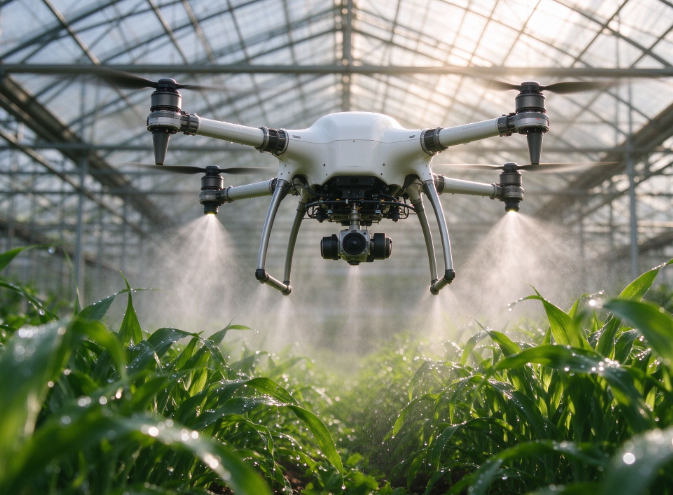
Flying in a commercial glasshouse environment is very different compared to flying over an open field. With complex pipework, roof trusses and areas where GPS may not be available, it is important to know how well your hardware will function indoors and extract valuable data.
GPS-Denied Navigation & Precision Obstacle Avoidance
Greenhouse steel frames and shade nets block satellite signals. Drones must utilize Visual SLAM or LiDAR SLAM to achieve centimeter-level hovering and path planning without GPS. Additionally, 3D radar and depth sensors are required to dodge fine obstacles like hanging wires and heating pipes.
Protective Enclosures & Compact Frame Design
Greenhouse aisles can be very narrow and valuable plants need protecting. Drones will need 360 degree sealed propellers so they do not hit plant life. We will need a small footprint drone that is less wide than the aisles. Sealed against dust and water so it can work in high humidity environments with chemical mist.
Sensor Payloads & Micro-Pest Resolution
Payload quality dictates analytical output. Detecting micro-pests like aphids and spider mites, or identifying early leaf lesions, requires high-pixel RGB optical sensors. Detecting early water or nutrient stress requires specialized multispectral payloads to generate localized NDVI heatmaps.
Onboard AI & Farm Management System (FMIS) Integration
Data must rapidly translate into actionable farm management tasks. If possible choose a platform with AI edge computing hardware to perform real-time image analysis and create immediate risk maps. The platform should have a management system which can communicate with your current climate control computer or farm ERP system.
Autonomous Navigation & Hands-Free Operations
Large-scale commercial applications will love the low hands-on features of the system, which include auto-docking stations and charging pads. Using scheduled tasks, you can ensure that your drone can fully scan the whole facility at off-peak times and autonomously return to its dock.
Are Drones Better Than Manual Greenhouse Inspection?
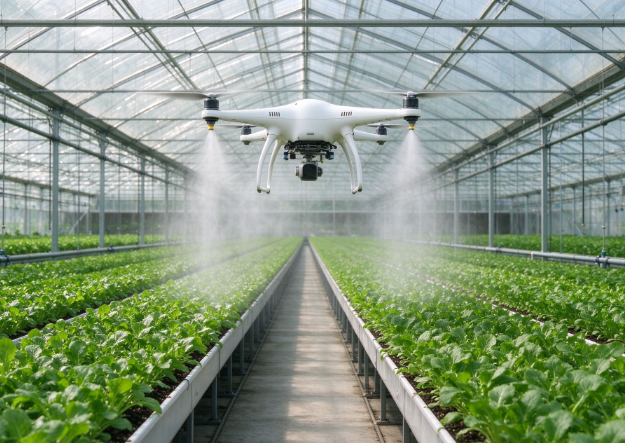
Drones and manual inspections are not mutually exclusive; rather, they serve as complementary methodologies in greenhouse crop management.
Manual inspections allow workers to touch plants directly, examine intricate details on leaves, stems, roots, and fruit, and perform hands-on tasks like pruning, harvesting, and localized pest management. Conversely, drones excel at high-frequency image acquisition, systematic area scanning, and macroscopic crop monitoring.
| Comparison Metric | Manual Inspection | Drone Inspection |
| Inspection Method | Personnel physical entry into growing zones | Aerial image acquisition by drone |
| Coverage Efficiency | Constrained by headcount and walking paths | Automated area coverage via planned flight paths |
| Data Collection | Dependent on visual notes and manual logging | Automated capture via RGB cameras and multispectral sensors |
| Repeatability | Requires continuous manual labor hours | Programmed, reproducible routine flight plans |
| Detailed Examination | Optimal for tactile, close-up physical contact | Subject to camera sensor resolution and flight distance |
| Anomaly Identification | Dependent on individual scout experience | Powered by computer vision and AI image analytics |
| Primary Applications | Disease diagnosis, pruning, harvesting, physical treatment | Crop image logging, spatial mapping, automated surveillance |
The best way to use drones in a commercial greenhouse is to provide surveillance data while also enabling specific scouting. The drone will perform an initial survey providing spatial analysis. If any anomalies are found scouts can be sent specifically to those areas. This helps combine both technologies to provide the best results with no blind spots.
Conclusion
The technology of drones is increasingly becoming an essential infrastructure part of standard greenhouse operation. Being capable of dealing with problems of GPS-denied navigation, close-space collision avoidance, and pest detection at an early stage, greenhouse drones have effectively completed the cycle from collecting automated data to making agricultural decisions.
With the development of edge computing and autonomous base stations, greenhouse drones will be used together with automated spraying and harvesting robots to make Controlled Environment Agriculture truly autonomous and data-driven.