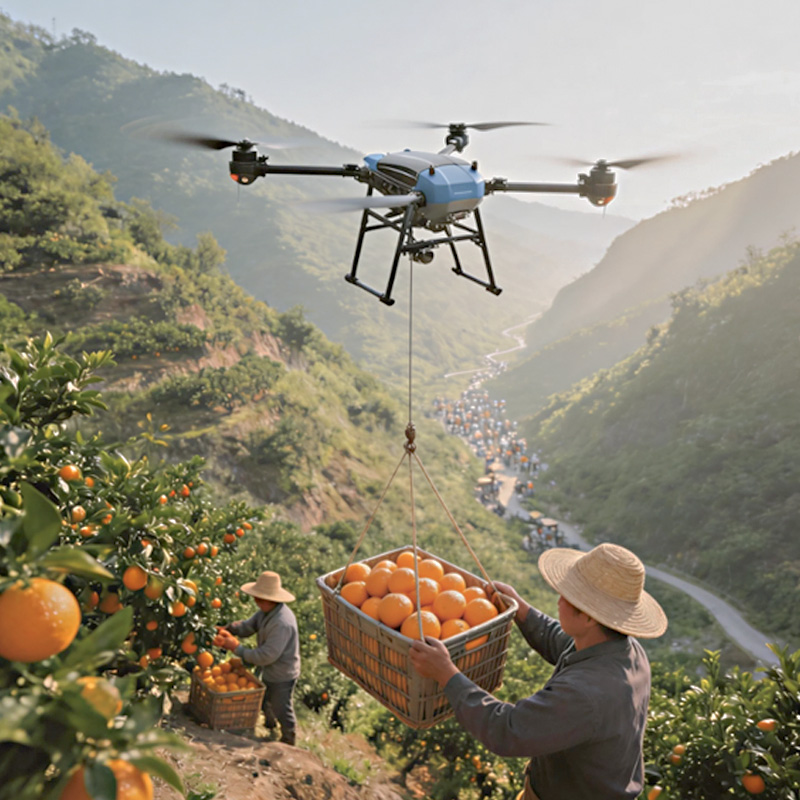
Drone Logistics for Fresh Produce in Mountainous Areas
Project Overview
Fresh produce from mountainous areas often faces significant transportation challenges after harvest. Difficult terrain, winding roads, long travel times, and seasonal landslides can make it difficult to move fruit from remote orchards to cold-chain collection points quickly and safely.
In this project, the client’s orchards are primarily located on mountain slopes at elevations of approximately 800–1,200 meters.
Traditional transportation relies mainly on manual carrying and small agricultural vehicles traveling along narrow and winding mountain roads. A one-way journey from the orchards to the cold-chain collection point at the foot of the mountain can take approximately 2–3 hours.
During transportation, fruit can be damaged by road vibration and exposed to high temperatures. Before the implementation of the drone logistics solution, fruit spoilage caused by transportation conditions could reach approximately 12%. During the rainy season, landslides could also frequently interrupt road transportation.
To address the challenge of “getting fresh produce out of the mountains,” the local agricultural cooperative worked with logistics companies to establish a low-altitude drone logistics network connecting mountain orchards with collection points and downstream logistics facilities.
The Challenge
Difficult Mountain Terrain
The orchards are located on slopes at elevations of 800–1,200 meters, with limited accessibility and challenging terrain.
Narrow and winding mountain roads make conventional transportation slower and less flexible.
Long Transportation Times
A one-way trip from the orchard to the cold-chain collection point can take 2–3 hours, increasing the time between harvesting and cold-chain processing.
For fresh fruit, longer transportation times can increase the risk of quality deterioration.
High Risk of Produce Damage
Fruit transported along uneven mountain roads can be exposed to repeated vibration and impacts.
Combined with high temperatures during transportation, these conditions can contribute to significant post-harvest losses.
Seasonal Road Disruptions
During the rainy season, landslides and other road conditions can interrupt transportation routes, making it difficult to maintain a stable supply chain.
Limited Transportation Capacity
Manual carrying and small agricultural vehicles have limited capacity and depend heavily on road accessibility and available labor.
The Drone Logistics Solution
To overcome these transportation challenges, the local agricultural cooperative partnered with logistics companies to establish a low-altitude drone logistics network.
Instead of relying entirely on winding mountain roads, drones provide an aerial transportation link between remote orchards and designated collection points.
The system is designed to support the movement of freshly harvested agricultural products from difficult-to-access mountain areas to downstream logistics facilities, helping shorten the connection between orchard harvesting and cold-chain transportation.
The drone logistics network provides several key capabilities:
- Aerial transportation across mountainous terrain
- Flexible connections between orchards and collection points
- Reduced dependence on winding mountain roads
- Faster transfer of freshly harvested produce
- Support for logistics operations during challenging road conditions
- Integration with existing cold-chain logistics networks
How the Drone Logistics Network Works
01 — Harvest at Mountain Orchards
Fresh produce is harvested at orchards located on mountain slopes.
Instead of relying entirely on manual transportation over difficult terrain, produce can be prepared for drone-based transportation.
02 — Drone Pickup
The drone collects the prepared agricultural products from designated pickup points within or near the orchard.
This creates an aerial connection between remote production areas and downstream collection facilities.
03 — Low-Altitude Transportation
The drone transports the produce along a planned low-altitude route, reducing reliance on winding mountain roads.
This is particularly valuable where road access is limited or transportation routes are vulnerable to seasonal disruption.
04 — Delivery to the Collection Point
The produce is delivered to a designated collection point at the foot of the mountain or another logistics transfer location.
05 — Connection to Cold-Chain Logistics
After reaching the collection point, the produce can enter the existing cold-chain transportation network for subsequent storage, distribution, and delivery.
This creates a more efficient connection between mountain orchards and the broader agricultural supply chain.
Key Advantages
Faster Connection Between Orchards and Collection Points
Drone transportation provides a direct aerial link between mountain production areas and downstream collection points, helping reduce dependence on long and winding road routes.
Reduced Dependence on Mountain Roads
By moving agricultural products through the air, the logistics network can reduce reliance on conventional road transportation in difficult-to-access areas.
Better Protection for Fresh Produce
Reducing exposure to long and potentially bumpy road transportation can help minimize physical damage and improve the handling conditions of freshly harvested fruit.
Greater Logistics Flexibility
Drone transportation provides an additional logistics option when conventional transportation is constrained by terrain, road conditions, or seasonal disruptions.
Better Connection to Cold-Chain Logistics
By linking mountain orchards with collection points, the drone logistics network helps integrate remote agricultural production areas into existing cold-chain logistics systems.
Addressing the “Last Mile” from the Mountains
The biggest challenge is not necessarily harvesting the fruit—it is moving the freshly harvested produce from remote mountain orchards to accessible logistics infrastructure.
The low-altitude drone logistics network addresses this gap by creating an aerial transportation layer between the orchard and the collection point.
This approach can help transform the traditional transportation model:
Mountain Orchard
↓
Manual Carrying / Small Agricultural Vehicles
↓
Long Mountain Road Transport
↓
Cold-Chain Collection Point
into a more flexible model:
Mountain Orchard
↓
Drone Pickup
↓
Low-Altitude Drone Transportation
↓
Collection Point
↓
Cold-Chain Logistics
A New Logistics Model for Mountain Agriculture
The project demonstrates how low-altitude drone logistics can help address one of the most persistent challenges facing mountain agriculture: moving fresh agricultural products efficiently from production areas to the wider market.
By connecting remote orchards with collection points through an aerial logistics network, drones can complement traditional transportation systems and provide a more flexible solution for mountainous agricultural supply chains.
For agricultural cooperatives, logistics companies, and producers operating in difficult terrain, drone logistics offers a new way to connect harvesting, collection, cold-chain transportation, and downstream distribution.