
Drone Cleaning System Comparison: Tethered Water Supply vs Onboard Water Tank

When choosing a drone cleaning system, buyers often compare payload, flight time, and operating height. But, efficiency of cleaning is also dependent on the water supply system, which determines efficiency, consistency, applicability, and cost of operations.
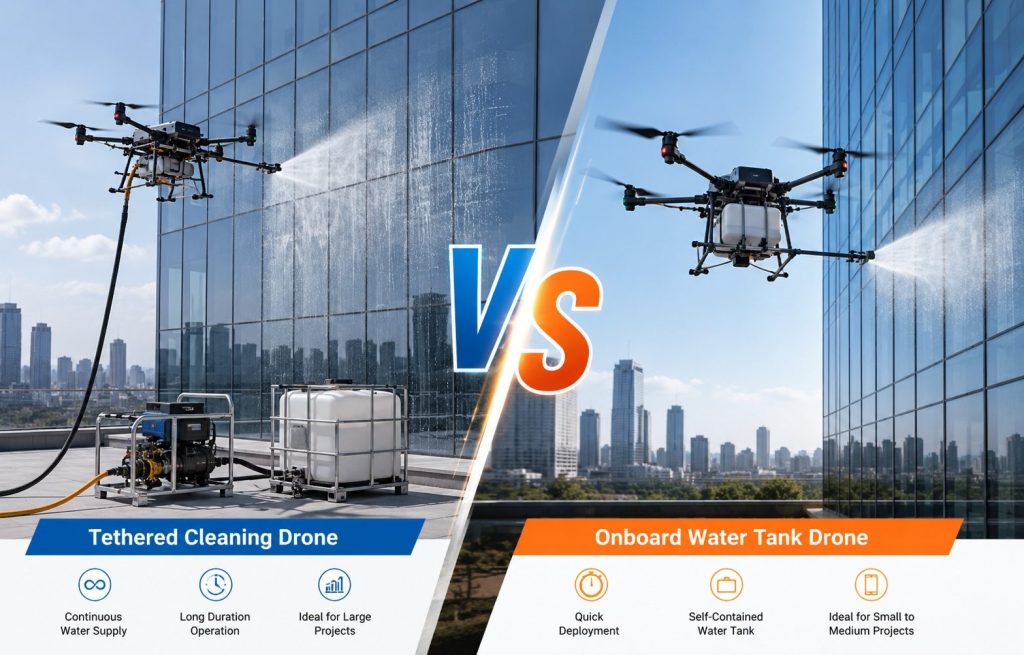
Usually, the industrial cleaning drones make use of either the Tethered Water Supply System or the Onboard Water Tank. Both systems are equally capable of cleaning glass curtain walls, commercial buildings, airports, hotels, stadia, and other high-rise buildings. The purpose of this article is to compare the two systems from both engineering and practical points of view.
Table of Contents
Tethered Water Supply vs Onboard Water Tank: What’s the Difference?
Although both systems perform the same task—supplying water or cleaning solution to the drone—their operating methods are fundamentally different.
| Comparison Factor | Tethered Water Supply | Onboard Water Tank |
| Water Source | Continuous supply from a ground-based pump | Water stored inside the drone |
| Cleaning Duration | Continuous operation | Limited by tank capacity |
| Refilling | Not required during operation | Periodic landing and refilling required |
| Aircraft Weight | Lower onboard water weight | Higher takeoff weight |
| Deployment | Requires hose and pump setup | Faster to deploy |
| Typical Applications | High-rise and large commercial buildings | Low-rise buildings and mobile operations |
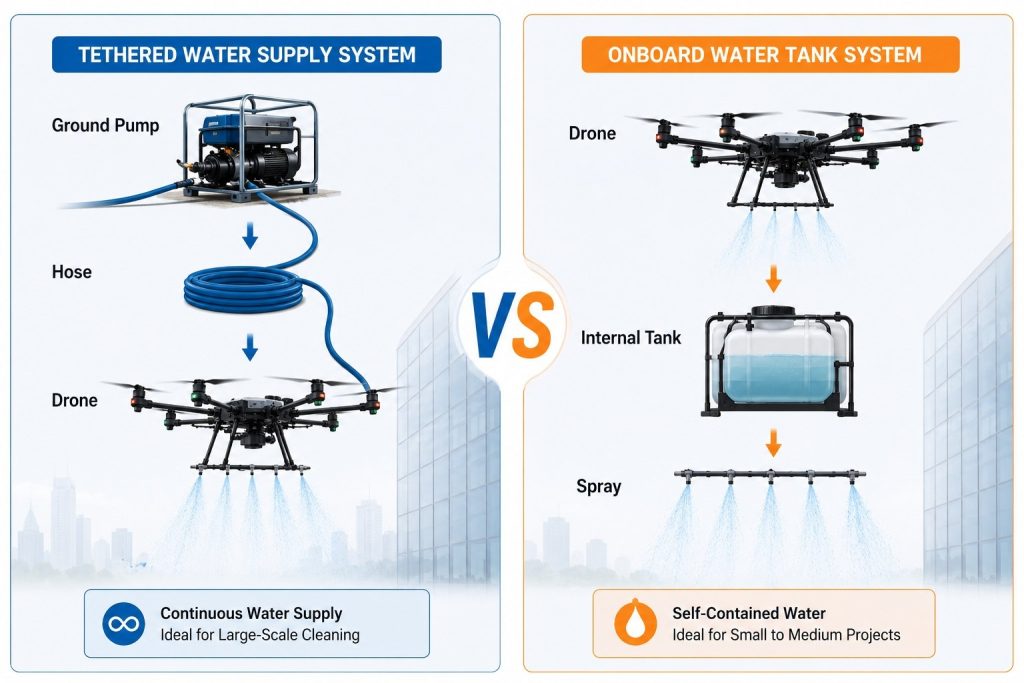
It is not just an issue of water supply source; it involves the frequency with which the drone has to shut down operations, the reliability with which water gets supplied to the cleaning surface, the number of equipment that has to be set up at the work site, and the efficiency with which major projects get done.
To contractors operating in various building sectors, this knowledge proves more useful than flight data alone.
Which System Delivers Better Cleaning Productivity?
Cleaning productivity is not determined by a single specification. Instead, it depends on how much effective cleaning can be completed during a working day.
Continuous Cleaning Time
A key difference is continuous cleaning time.
A tethered water supply provides continuous water from the ground, allowing uninterrupted cleaning of large facades, making it ideal for office towers, hotels, airports, and shopping malls.
An onboard water tank must be refilled when empty. While suitable for smaller projects, refill interruptions become more significant on large buildings requiring extended cleaning cycles.
Downtime Between Cleaning Cycles
Every interruption reduces overall productivity.
With onboard tank systems, downtime includes landing, refilling, equipment checks, and takeoff. Although each stop is brief, repeated refills throughout the day reduce productive cleaning time.
Tethered systems minimize water-related interruptions, enabling a more continuous workflow.
Daily Cleaning Capacity
Daily cleaning capacity depends on project requirements.
For tall structures as well as large glass wall systems, the constant flow of water increases efficiency through minimizing refill time. In cases of shorter projects and smaller buildings, the rapid deployability and portability of the water storage system on board can compensate for the refill time.
Instead of questioning which system operates faster, buyers need to decide on which one reduces unproductive time.
How Does the Water Supply Method Affect Flight Performance?
The water supply system influences more than cleaning efficiency. It also affects how the aircraft performs throughout each operation.
Aircraft Weight Distribution
An onboard water tank adds weight during takeoff, with the aircraft becoming lighter as water is consumed, requiring continuous flight adjustments.
A tethered system keeps most water on the ground for a more consistent payload but must compensate for hose resistance, especially at higher altitudes or in windy conditions.
Each design involves different engineering trade-offs suited to different applications.
Flight Stability
Stable flight is essential for maintaining consistent spray distance and cleaning quality.
With onboard systems, stability changes as the aircraft becomes lighter during operation. For tethered systems, stability depends on effective hose management, pump placement, and flight control algorithms that compensate for hose movement and external forces.
Rather than focusing only on the water supply method, buyers should evaluate the overall system design.
Battery Consumption
Battery performance is affected differently by each system.
Onboard tanks increase energy consumption because the drone carries more weight, especially during takeoff and climbing. Tethered systems reduce onboard weight but are influenced by hose resistance, wind, and the distance from the ground station.
Since operating conditions vary, battery performance should be evaluated alongside overall cleaning productivity, not as a standalone specification.
Which System Provides More Stable Cleaning Performance?
Cleaning quality depends not only on the drone itself but also on how consistently water is delivered to the facade.
Water Pressure Stability
Stable water pressure is essential for consistent cleaning results on large building surfaces.
A tethered water supply uses a ground-based pump to maintain stable pressure during long cleaning operations. An onboard tank relies on its integrated pump, which may experience greater pressure variation during extended cleaning cycles.
For large glass curtain walls, consistent pressure helps ensure a more uniform cleaning finish.
Spray Consistency
Even spray coverage is essential for consistent cleaning performance.
A tethered system provides continuous water delivery, helping maintain uniform spray coverage during long cleaning operations. Onboard tank systems are better suited to projects divided into shorter cleaning sections, where refill interruptions have less impact.
Cleaning Uniformity
Professional cleaning is defined by consistent results, not maximum water volume.
Both systems can yield good results when appropriately set up. In larger-scale commercial works, the tethered system is better in terms of consistency, especially during lengthy procedures, whereas the on-board water tank system is more convenient in smaller cases that require quick setup.
Which System Is Better for Different Building Types?
A one-size-fits-all solution does not exist in all commercial cleaning operations. The efficiency of the water system relies heavily on the height of the building, the size of the facade, the surroundings, and the purpose of the operation.
| Building Type | Recommended System | Why |
| High-rise Office Towers | Tethered Water Supply | Offers extended cleaning cycles with steady water supply. |
| Glass Curtain Wall Buildings | Tethered Water Supply | Well-suited for large continuous facade surfaces needing constant spraying capacity. |
| Airport Terminals | Tethered Water Supply | Large areas would benefit from decreased downtime and non-stop operation. |
| Exhibition & Convention Centers | Tethered Water Supply | Enhances efficiency for large exterior facades. |
| Hotels | Depends on Building Height | Tethered systems work better for high-rise hotels, while smaller hotels use onboard systems effectively. |
| Shopping Malls | Depends on Project Scope | Both types can be efficient depending on the size of the facade and cleaning cycles. |
| Warehouses & Industrial Facilities | Onboard Water Tank | Low-rising buildings with open areas would prefer mobility and quick deployment. |
| Schools & Public Buildings | Onboard Water Tank | Efficient cleaning cycles and low operating heights make the use of onboard systems feasible. |
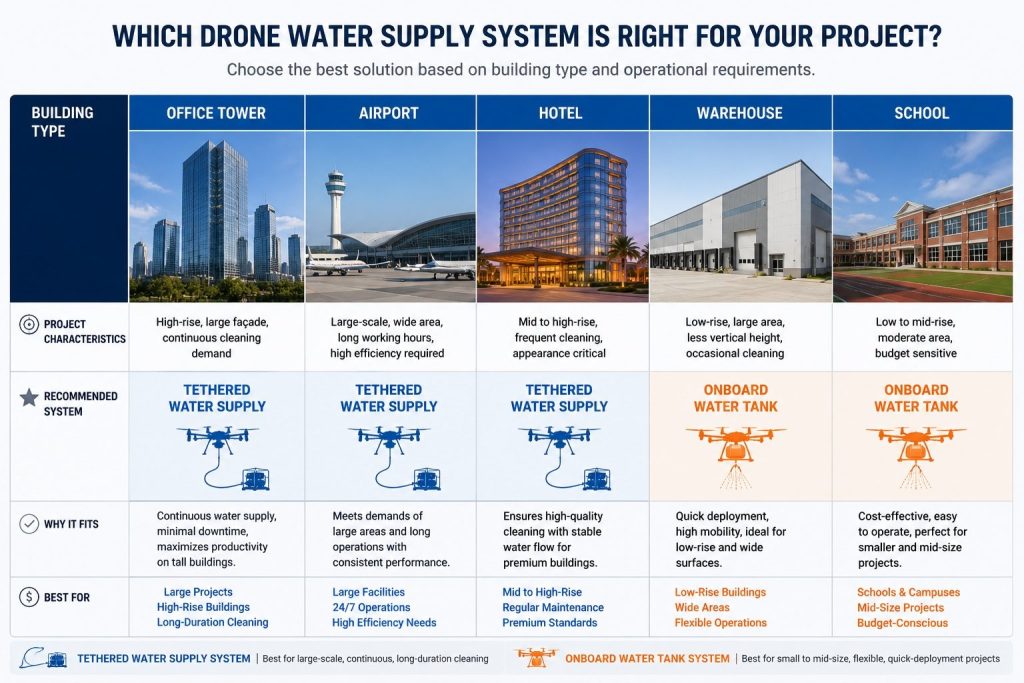
Not only the nature of the structure should be taken into account when choosing the equipment but also how often one will clean such structures, how many times they will have to do daily cleaning, and the size of the area they will have at their disposal.
Which System Is Easier to Deploy?
Deployment efficiency directly affects how quickly cleaning operations can begin.
Initial Setup Time
Onboard water tank systems require little setup, as all the operator has to do is fill the tank and start cleaning.
Tethered systems need extra setup, including pumping setup, hose placement, and pressure check. While this requires more time for setup, it may be worthwhile to save refills during long operations.
Ground Space Requirements
Ground conditions also affect system selection.
Tethered systems need room to store pumps, hoses, and water supply equipment and are therefore more appropriate for open commercial spaces. Onboard water tank systems use fewer ground-based pieces of equipment and thus are easier to deploy in small areas.
Site Mobility
For contractors moving between multiple locations in a single day, mobility becomes a major consideration.
Onboard tank systems are generally easier to transport and deploy across different job sites.
Tethered systems are better suited to projects where cleaning duration is long enough to offset the additional setup effort.
Which System Has Lower Operating Costs?
The purchase price of a drone cleaning system is only one part of the overall investment. Long-term operating efficiency often has a greater impact on return on investment.
Labor Efficiency
More water refilling stops will mean more work for the operator and less productive cleaning time.
Continuous water supply may enhance labor efficiency by helping the operator concentrate on the cleaning process rather than interrupting the process.
Equipment Maintenance
Both the systems need regular maintenance; however, the emphasis of each system is different.
Onboard systems emphasize on tank maintenance along with pumps, valves, and water lines whereas tethered systems need ground pump, hose, connector, and filter maintenance.
Maintenance requirements should be considered when evaluating either system.
Total Cost of Ownership (TCO)
Instead of comparing equipment prices alone, buyers should evaluate:
- Daily cleaning productivity
- Labor requirements
- Battery consumption
- Downtime caused by refilling
- Equipment maintenance
- Expected service life
- Project completion efficiency
For contractors handling large commercial projects, improvements in productivity often have a greater financial impact than small differences in equipment cost.
Which Water Supply System Should You Choose?
Both water supply systems have clear advantages when matched with the right application.
A Tethered Water Supply System May Be the Better Choice If:
- Your projects involve high-rise commercial buildings.
- Continuous cleaning is a priority.
- Large glass curtain walls require consistent water pressure.
- Reducing downtime improves project efficiency.
- Long operating cycles are common.
An Onboard Water Tank System May Be the Better Choice If:
- Most projects involve low-rise or medium-rise buildings.
- Fast deployment and mobility are important.
- Job sites change frequently throughout the day.
- Ground space is limited.
- Cleaning tasks are relatively short.
Instead of making comparisons between individual specifications, consumers should focus on evaluating the capabilities of the entire water system in meeting their operational needs. The right choice would be the one that fits with their project needs and business objectives.