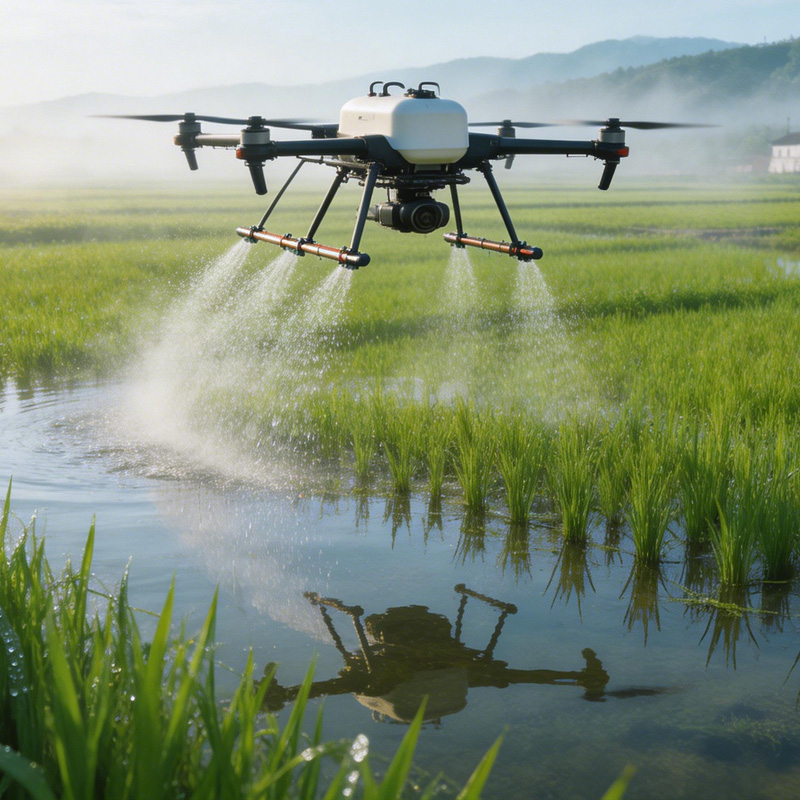
High Efficiency Drone Fertilization in Rice Paddies
Project Overview
During the spring planting season, rice farmers often face a shortage of agricultural labor, making large-scale fertilization difficult to manage efficiently.
To address this challenge, the client adopted agricultural drones for rice paddy fertilization, replacing a significant amount of manual spreading work with efficient aerial operations.
Each drone can spread approximately 70 kg of fertilizer per application, with a daily fertilizer application capacity of around 10 tons. The operation can cover approximately 300–400 mu (20–27 hectares) per day, delivering a workload equivalent to more than 50 agricultural workers.
By combining high-capacity aerial spreading with precision fertilization, the solution significantly improved field management efficiency while reducing dependence on seasonal labor.
Seasonal Labor Shortages
During the spring planting season, farmers often need additional workers to complete fertilization and other field operations within a limited timeframe. However, recruiting sufficient agricultural labor can be difficult during peak farming periods.
Large-Scale Fertilization Requirements
Rice cultivation requires timely and effective fertilizer application across large areas. Relying entirely on manual labor can make large-scale operations time-consuming and difficult to coordinate.
Rising Labor Costs
A shortage of available workers during peak agricultural periods can drive up labor costs, placing additional pressure on farming operations.
Need for More Efficient Field Management
Farmers need a solution that can complete fertilization quickly while maintaining consistent application across large rice-growing areas.
The Drone Fertilization Solution
To improve fertilization efficiency, the client introduced agricultural drones for aerial fertilizer spreading.
The drones can carry and distribute approximately 70 kg of fertilizer per application, enabling large areas of rice paddies to be fertilized efficiently within a short period.
With a daily operating capacity of approximately 10 tons of fertilizer, the system can cover around 300–400 mu (20–27 hectares) per day.
This allows drone-based fertilization to significantly reduce the amount of manual labor required during the critical spring planting season.
How the Solution Works
01 — Load the Fertilizer
The required fertilizer is loaded into the drone’s spreading system before the operation begins.
02 — Plan the Field Operation
The agricultural drone is prepared according to the target rice paddy area and planned operating route.
03 — Perform Aerial Fertilization
The drone flies over the rice paddies and distributes fertilizer across the designated areas, allowing large fields to be covered efficiently without requiring workers to walk through the fields.
04 — Complete Large-Scale Daily Operations
With approximately 70 kg of fertilizer per application and a total daily capacity of around 10 tons, the drone can complete approximately 300–400 mu (20–27 hectares) of fertilization per day.
05 — Improve Field Management Efficiency
The use of drones reduces reliance on seasonal agricultural workers and enables farmers to complete fertilization operations more efficiently during peak planting periods.
Key Performance
70 kg
Fertilizer per Application
Each drone can spread approximately 70 kg of fertilizer per application.
10 Tons
Daily Fertilization Capacity
The operation can distribute approximately 10 tons of fertilizer per day.
300–400 mu
Daily Coverage
The drone can cover approximately 300–400 mu, equivalent to around 20–27 hectares, per day.
50+ Workers
Equivalent Manual Workload
The daily operating capacity is equivalent to the workload of more than 50 workers.
Project Results
Reduced Dependence on Seasonal Labor
Drone-based fertilization helped address the difficulty of recruiting sufficient agricultural workers during the spring planting season.
Improved Fertilization Efficiency
Aerial fertilizer spreading allows large areas of rice paddies to be treated efficiently, helping farmers complete time-sensitive fertilization operations more quickly.
Lower Labor Costs
By replacing a significant amount of manual spreading work with drone operations, the solution reduces the labor required for large-scale fertilization.
More Efficient Rice Field Management
The use of agricultural drones enables farmers to manage large rice-growing areas with fewer workers while improving the efficiency of routine field operations.
Why Choose Agricultural Drones for Fertilization?
For large-scale rice cultivation, agricultural drones offer several practical advantages:
High Operational Efficiency
Large areas can be fertilized within a relatively short operating period.
Reduced Labor Requirements
Drone operations can replace a substantial amount of manual fertilizer spreading.
Flexible Field Access
Aerial operation reduces the need for workers to physically enter and move through rice paddies during fertilization.
Large Daily Capacity
Approximately 10 tons of fertilizer can be distributed per day under the project operating conditions.
Better Seasonal Management
Farmers can complete time-sensitive fertilization work even when seasonal labor is difficult to recruit.
From Labor-Intensive to Efficient Drone-Based Farming
The project shows how agricultural drones can provide a practical solution for large-scale rice cultivation.
By combining high-capacity fertilizer spreading, aerial operation, and efficient field coverage, the client was able to reduce dependence on seasonal workers and improve the efficiency of rice paddy management.
For agricultural operations facing labor shortages or large-scale fertilization requirements, drone-based solutions provide a more efficient way to manage time-sensitive field operations.