
How Drone Cleaning Helps Exterior Window Cleaning Contractors in Cleaning?

As the number of commercial buildings continues to grow globally, the demand for the exterior window cleaning industry is also expanding. In particular, high-rise office buildings, hotels, and shopping malls are placing increasingly higher standards and more frequent requirements on façade cleaning.
However, at the same time, many high-rise cleaning service providers are facing a practical challenge: industry demand is increasing, but profit margins are shrinking.
The main reasons include:
- Stricter safety regulations for high-altitude operations
- Rising labor costs
- A shortage of qualified high-rise workers
- Clients demanding “faster, safer, and more cost-effective” solutions
Against this backdrop, more and more exterior window cleaning companies are exploring new technological approaches, and drone cleaning technology is rapidly emerging as a promising solution.
Table of Contents
Real Challenges Facing the Exterior Window Cleaning Industry
For most exterior window cleaning companies, the issue is not a lack of projects, but that “projects are increasing while profitability and execution difficulty are rising at the same time.”
Labor Shortage in High-Rise Work
Exterior window cleaning is a high-risk industry, but fewer people are willing to enter it. On one hand, younger workers are reluctant to take on high-altitude jobs; on the other hand, professional training takes time, which leads to a continuous shortage of qualified workers.
This directly limits company expansion. Even when demand increases, many projects cannot be accepted due to insufficient manpower.
Rising Insurance and Safety Costs
As risk levels are being re-evaluated, insurance premiums and safety compliance costs continue to increase. Companies are not only paying higher insurance fees but also facing stricter safety regulations and documentation requirements.
For small and mid-sized cleaning contractors, these costs are significantly squeezing profit margins.
Low Project Execution Efficiency
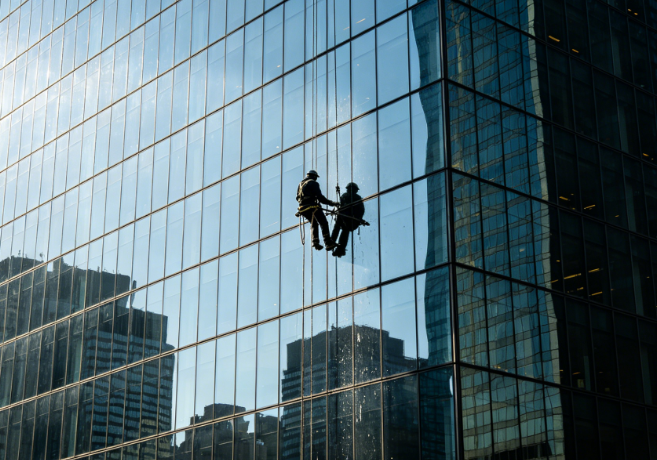
Traditional exterior window cleaning relies on gondola systems, scaffolding, or rope access. These methods often involve long setup time, complex installation and dismantling, and strong weather dependency.
As a result, project timelines are unstable, efficiency is low, and both order capacity and cash flow turnover are affected.
Increasing Market Competition
As competition intensifies, clients demand lower prices, faster completion, and higher safety standards. However, traditional cleaning methods are highly standardized and offer little differentiation.
Eventually, competition tends to become price-driven, continuously compressing industry profit margins.
How Drone Cleaning Is Transforming the Exterior Window Cleaning Industry?
The technology for drones to clean the exterior windows is increasingly moving out of its conceptual phase to become a viable technology in real-life application in the commercial industry.
This system’s primary advantage lies not in replacing cleaning personnel entirely but in transforming the entire working model.
Less Dependency on High-Rise Cleaners
One of the biggest impacts that the drone cleaning technology can bring about is that of reducing the dependency on high-altitude cleaners. The conventional method of exterior window cleaning uses either ropes or gondolas that expose personnel to extreme risk.
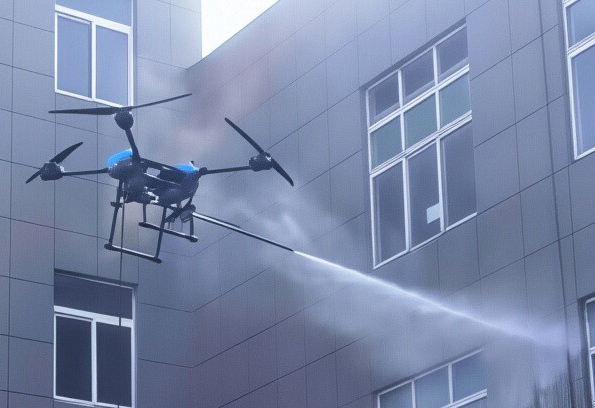
Using drones to carry out these operations allows remote control from the ground level and eliminates the necessity of having cleaners operate at such high levels.
Faster Project Deployment
Unlike in conventional cleaning practices, drones do not need scaffolding or gondola erection before cleaning can begin, which means once the necessary equipment is delivered at the scene, work begins immediately.
This is one of the ways through which drones reduce the time taken to complete cleaning projects and consequently increase the volume of buildings cleaned within the same period of time. As for commercial cleaning companies with frequent contracts, improved efficiency results in increased output capacity.
Expanding High-Rise Building Service Capabilities
The use of conventional cleaning systems presents challenges in reaching the highest point on a façade building and in maintaining proper safety standards. However, the use of drone cleaning systems enables cleaners to access such buildings.
This provides an opportunity to venture into challenging projects that would have been impossible to undertake using conventional cleaning systems.
Improving Overall Operational Efficiency
From an operational perspective, drone cleaning technology not only changes how individual projects are executed but also optimizes resource allocation across the entire business. Companies can better coordinate multiple projects simultaneously, reducing idle time for both equipment and personnel.
At the same time, improved efficiency increases output per unit of labor and time, enhancing the overall scalability and productivity of cleaning operations.
The Real Business Value for Cleaning Companies
For exterior window cleaning companies, the most important question is not about the technology itself, but about profitability and the ability to generate sustainable revenue.
Reducing Long-Term Operational Costs
Drone cleaning systems can significantly reduce several key cost components in the long run. These include labor expenses, equipment rental costs such as scaffolding and gondola systems, and safety insurance premiums.
By minimizing these ongoing operational burdens, companies can substantially improve their overall profit structure and reduce financial pressure on each project.
Increasing Profit Margins Per Project
Because drone-based cleaning improves efficiency in multiple ways, including shorter working time, reduced manpower requirements, and lower risk-related costs, the overall cost per project is reduced.
As a result, the profit margin for each individual job typically increases, allowing companies to achieve better returns without necessarily increasing pricing pressure on clients.
Strengthening Bid Competitiveness
In commercial bidding processes, clients are increasingly prioritizing factors such as safety performance, technological capability, and execution efficiency rather than just pricing.
Companies that adopt drone cleaning solutions are often better positioned to demonstrate these advantages, making them more competitive in tenders and increasing their win rate for contracts.
Enabling Business Scalability
Traditional window cleaning business growth is often limited by workforce availability, as scaling requires hiring and training more high-altitude workers. In contrast, drone-based operations are more technology-driven and standardized.
This allows services to be more easily replicated and expanded, enabling companies to grow from local operations into regional or even larger-scale service networks with greater consistency and efficiency.
Traditional Exterior Window Cleaning vs Drone Cleaning Comparison
As the exterior window cleaning industry evolves, the differences between traditional methods and drone-based solutions are becoming increasingly clear. See the difference below.
| Comparison Dimension | Traditional High-Rise Cleaning | Drone Cleaning |
| Working Method | Manual high-altitude operation | Ground-based remote control |
| Safety | Higher risk level | Lower operational risk |
| Deployment Time | Longer setup and preparation | Faster deployment |
| Cost Structure | Labor-intensive | Technology-driven |
| High-Rise Capability | Limited by equipment and access | Stronger coverage of high-rise buildings |
| Scalability | Depends on workforce size | Easier to scale through technology |
Which Cleaning Companies Are Best Suited for Drone Technology?
It is unlikely that all firms offering cleaning services will instantly embrace drone technology, but there are some firms whose nature of operation makes them the most suited for the innovation.
High-Rise Curtain Wall Cleaning Companies
Businesses operating in the field of cleaning high-rise facades and curtain walls are the most suitable for adopting drone technology since their line of work requires a lot of risk and technicality.
Commercial Building Maintenance Companies
Firms providing commercial building maintenance services are well-suited for using drone technology in their operations since their services involve routine and repetitive cleaning services.
Facade Cleaning Service Providers
There is a great potential for facade cleaning firms who specialize in cleaning building facades to take advantage of drones, particularly in the case of modern building architecture with glass exteriors.
Facility Management Companies
Facility management services providers who have many buildings and long-term contracts may also gain from incorporating the use of drones as part of their service offerings.
Industrial Cleaning Service Providers
Firms offering industrial cleaning services can equally harness the capabilities of drones for cleaning exterior parts of large factories or plants.
How Drone Technology Helps Cleaning Companies Grow Their Business
Drone exterior window cleaning is not just a “tool upgrade,” but a shift in the overall business model. It changes how companies position themselves, bid for projects, and scale operations.
Gaining Access to More Valuable Jobs
Drone technology allows for an expansion of the cleaning services to ultra-tall skyscrapers and other buildings that would otherwise be inaccessible due to height limitations. As a result, companies are able to compete in the more profitable niche of high-value jobs and clientele.
Increasing Chances to Win Bids
In the competitive bidding environment, clients now also take into consideration various factors beyond cost, such as safety, innovation, and efficiency. Using drones is a more sophisticated approach to cleaning and thus allows companies to win more bids during tender processes.
Addressing Operational Bottlenecks
The traditional process of building cleaning faces numerous operational challenges due to limited capacity of gondolas, scaffolding systems, and high-altitude workers. The use of drones allows companies to address some of these issues to a certain extent.
Building a Technology-Driven Brand Image
Employing drones for cleaning operations will enable firms to redefine their corporate image in the industry. They can transform from being mere cleaners of structures to technology-based building maintenance companies.
What to Consider When Choosing a Drone Exterior Window Cleaning Drone?
In making decisions concerning the implementation of drones in the cleaning process, it is essential to consider the capability of the equipment to provide a safe, stable, and repetitive performance within practical settings.
High Wind Resistance and Flight Stability
Because the process involves high-altitude cleaning activities in the outdoor environment, wind resistance becomes an important consideration. The equipment needs to perform stably in different wind speed levels, ensuring the delivery of quality service while guaranteeing safety.
Tethered Power System Design
Generally, a tethered system is recommended for the operation in commercial cleaning tasks. It provides longer operating hours, steady energy supply, and avoids the need to change batteries constantly.
Spraying and Cleaning Efficiency
The efficiency of the cleaning operation will depend on several factors including the spray pressure, type of nozzle used, and uniformity of coverage. The proper setup will guarantee the efficient functioning of the cleaning operation for any type of glass or façade.
Safety Redundancy Systems
Safety will be paramount in the case of high-rise building washing operations. A professional system will incorporate several safety redundancy measures like emergency landing, signal protection, among others.
Training and After-Sales Support
Even advanced systems require proper operator training to achieve optimal performance. Strong technical support, onboarding programs, and responsive after-sales service are essential to ensure smooth long-term operation.
System Reliability and Maintenance Cost
Beyond initial performance, long-term reliability and maintenance costs are key factors. Companies should evaluate how often the system requires servicing, how easy it is to maintain, and whether it can operate consistently under frequent commercial use.
Ultimately, the most important factor is not how many functions the system has, but whether it can deliver stable, efficient, and safe performance in real-world, long-term operations.
Is Exterior Window Cleaning Drone Technology Worth the Investment?
From the industry point of view, the application of drones in cleaning has become more of a trend than a tool.
To cleaning agencies, the most significant benefit will be that it reduces risk due to limited work at higher altitudes, enhances efficiency with fast mobilization and implementation, and improves their competitiveness in the competitive bidding process.
Most importantly, it ensures the long-term profit of the company by minimizing the reliance on manpower and managing costs.
If you are looking reliable cleaning drone, VastArrive provides different cleaning drones to meet your demands.