
Drone Roof Inspection: Why Use Drones for Safer Roof Inspections?

For property managers, commercial real estate owners, and roofing contractors, regular roof maintenance is a critical link in ensuring asset integrity and controlling operational costs. However, traditional roof inspection methods are often accompanied by high costs, lengthy timelines, and non-negligible safety hazards.
With the rapid development of industrial drone technology, drone roof inspection is rapidly replacing traditional methods of climbing ladders and erecting scaffolding. This article will deeply explore the core advantages and workflows of drone roof inspection, and how it is bringing transformation to modern building maintenance.
Table of Contents
What is a Drone Roof Inspection?
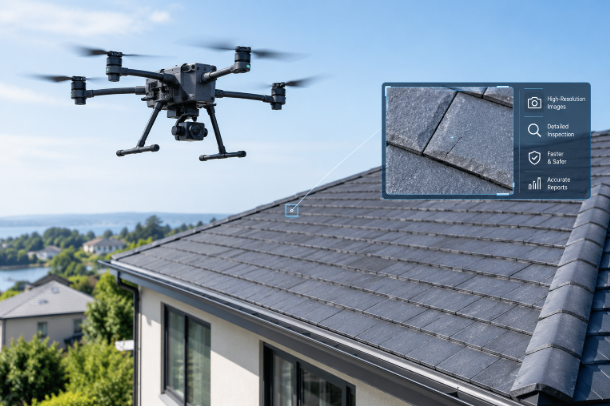
A drone roof inspection is an inspection method that uses drones and onboard imaging equipment to collect rooftop condition information from the air. Operators can inspect roof areas that are not easily observed directly through traditional methods via remote flight, real-time image transmission, and subsequent image analysis.
Compared to relying entirely on personnel climbing up for inspections, drones can acquire imagery without personnel needing to directly enter certain roof areas, thereby reducing some demands for working at heights.
What Issues Can Drone Roof Inspections Detect?
Whether a drone can detect a certain roof defect depends on camera performance, shooting distance, lighting conditions, roofing materials, and the characteristics of the defect itself. The following are several common inspection tasks.
1. Roof Material Damage
With the help of close-up images, inspectors will be able to see any missing or broken tiles, deformed metal roof sheets, and damaged roof membranes.
Drones can take images of different regions on large roofs according to pre-planned routes, which help in locating areas where additional inspection is needed.
2. Roof Seams and Connection Areas Inspection
Roof seams, edges, flashing structures, and connection parts may require regular inspection. These drones may be able to provide images at an appropriate angle in order to detect any signs of cracks, warping, or looseness.
However, the presence of abnormalities in the image does not imply that there has been a leak at this spot. On-site confirmation will need to be carried out when necessary.
3. Drainage Systems and Signs of Pooling
Clogged drainage outlets, gutters, and drainage channels can affect roof drainage efficiency. Drones can assist in observing whether there is visible debris accumulation, drainage obstruction, or signs of water pooling in these areas.
For flat roofs, regular photography helps maintenance teams compare roof conditions across different times and identify areas worthy of further investigation.
4. Thermal Imaging-Assisted Detection
Under specific conditions, drones equipped with thermal imaging cameras can collect roof temperature distribution data. Certain temperature abnormalities may be related to moisture accumulation, insulation layer problems, or equipment heat dissipation.
However, thermal imaging results are easily affected by factors such as solar radiation, wind speed, ambient temperature, roofing materials, and inspection time. Therefore, thermal imaging can help locate areas needing further investigation, but it cannot be used alone as the basis for confirming roof leaks or structural damage.
5. Rooftop Equipment and Peripheral Facilities Inspection
The commercial and industrial roofs generally have ventilation systems, air conditioners, pipes, solar equipment, among others. Drones will help in taking pictures of the equipment, surroundings, and the installation area as well, thus offering a basis for normal maintenance and any other anomalies that may arise.
For projects requiring inspection of equipment operating states or electrical anomalies, corresponding sensors and professional inspection methods should also be selected based on task requirements.
What Are the Advantages of Using Drones for Roof Inspections?
1. Reduction of Certain Fall-from-Height Risks
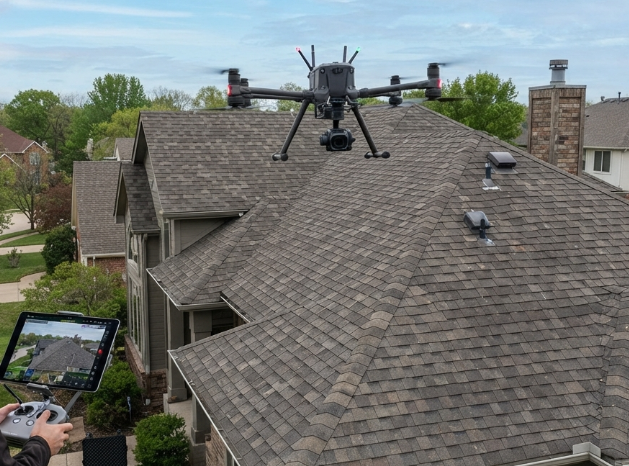
Traditional roof inspections may require personnel to climb ladders, enter high areas, or use lifting platforms. Acquiring parts of the roof imagery via drones can reduce the need for personnel to directly approach hazardous areas.
However, drone operations themselves also carry risks such as collisions, loss of control, and crashes. On-site risk assessments and compliance with applicable flight regulations are still required.
2. Improved Image Collection Efficiency for Large Roofs
The use of drones can help obtain images of different areas for warehouses, factories, commercial centers and others with roofs through aerial photography.
Practical efficiency will depend on the roof’s area, the flight time, route planning, the presence of obstacles on-site and the quality required by shooting. In case of complex objects and defects, additional shots may be needed.
3. Facilitation of Long-Term Maintenance Records
They can take pictures and videos that can be saved using buildings, region, date or defect positions.
When companies require inspections on a consistent basis, it is easy for them to use images at various points in time and check whether any defect has increased, repaired region has been altered, or whether there are new defects.
Such records make it easier for companies to plan their maintenance and repair activities.
4. Lowered Comprehensive Costs for Some Inspection Works
Drones will minimize the necessity of using some lifting devices, people going onto the roof, and repeating photoshoots. Nevertheless, it doesn’t mean that every drone inspection will be less expensive than a traditional one.
Costs may also depend on purchasing equipment, training, permits, insurance, analysis of the gathered data, maintenance, and professional inspections. The companies need to take into consideration expenses along with the frequency and size of projects.
Common Application Scenarios for Drone Roof Inspections
1. Commercial Buildings and Large Warehouses
Commercial properties with huge warehouses always have vast rooftops, with some having ventilation systems, pipes, and other things which could block the line of sight.
Drones could also be used in visual inspection, defect detection, and photography before and after repairs to aid in scheduling the maintenance activities.
2. Industrial Plants and Production Facilities
Industrial plant roofs are also susceptible to adverse effects of weather, machinery installation, and operational environment. With regular roof imaging, maintenance workers will be able to examine any roof damages, drainage areas, and the surrounding area of the machinery.
If there are industrial plants which require safety measures, there must be an assessment of the risk factors like electrical equipment, chimneys, pipelines, radio interference, and other site hazards.
3. Residential and Multi-Story Buildings
Drones may be able to help with inspecting house tiles, eaves, gutters, and some high-altitude areas, eliminating the need for some inspections that involve people climbing.
For multi-story buildings, people will have to be concerned about the safety of those around them, as well as roads, building spacing, restrictions, and privacy concerns.
4. Solar Roofs and Photovoltaic Facilities
For roofs installed with solar components, drones can capture imagery of component surfaces, installation structures, and surrounding roof conditions.
If the task involves identifying thermal anomalies in photovoltaic components, appropriate thermal imaging equipment must be used, combined with environmental conditions and professional analysis. Ordinary visible light photos cannot replace electrical performance testing.
5. Post-Storm Roof Inspections
Winds, hail, or even extreme weather can lead to roofing material damage, displacement of tiles, or even damage to the roof. If weather conditions allow, drones can also help in providing aerial images from the ground to help assess the damaged parts.
When there are still risks of unstable structures, hanging materials, or electricity risks, safety needs to be evaluated before anything else; whether a building is safe or not cannot only depend on the information provided by the drones.
How to Choose the Right Drone for Roof Inspections?
For inspection companies, roof maintenance service providers, and industrial facilities’ management teams, the choice of drone cannot only be based on the cost and flight time but must take into account the roofing material type, defects to be detected, and other environmental factors.
1. Camera Resolution and Image Clarity
The inspection of the roofs needs one to observe objects of various sizes. Large inspections and spotting small cracks or seam damage need different imaging environments.
During the purchasing of the equipment, the issues to consider include the camera’s resolution, lens performance, zoom function, distance for shooting, and actual results for imaging. The higher megapixels may not mean that one can detect all small flaws.
2. Flight Time and Coverage Range
In case of big commercial roofs and industries, endurance of the batteries will affect the amount of load that can be handled in one flight.
Businesses need to consider the right models of the drones depending on the size of the roof, flight paths, conditions for taking off and landing, safety margin in terms of flying back and precision needed for shooting.
In case of inspection tasks that involve replacing of batteries, multiple flights, and slow shooting due to complex areas, all of these have to be considered as well.
3. Flight Stability and Positioning Capability
Wind current changes, wall airflow, metal structures, and complex obstacles may exist near roofs. Flight control stability, accurate positioning ability, and appropriate flight procedures that can adapt to the site can enhance the efficiency of image acquisition.
For buildings with high floors and narrow areas, the flight environment and experience of the operator need to be especially assessed.
4. Whether Thermal Imaging Functions Are Needed
In case the primary purpose of using the equipment is the visual inspection of the integrity of the tiles, the damages on the roof panels, etc., the high-resolution visible light cameras might be enough for you.
However, in case there is an issue with the temperature distribution or any anomalies within the insulation layers, you may want to analyze the thermal imaging payload. Nevertheless, you need to check whether this payload will be suitable for your purposes.
5. Obstacle Avoidance and Safety Features
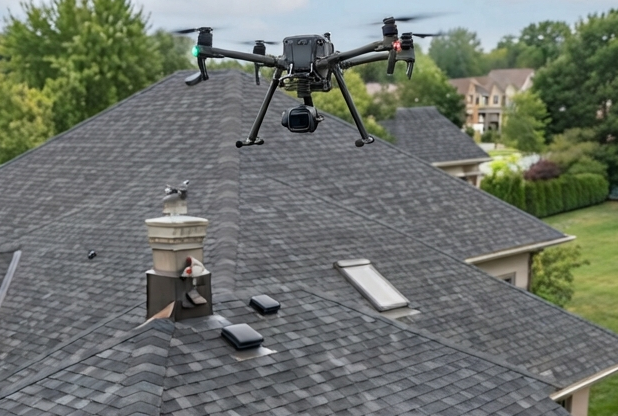
There might be power lines, antennas, trees, railings, chimneys, and other types of obstacles present around the buildings. In the purchase, ensure that the drone has obstacle detection systems appropriate for the task at hand, along with the constraints involved in them due to lighting, material, and flight conditions.
Obstacle detection systems will not replace the functions of observation and flight planning by the operator.
6. Data Recording and Post-Processing Capabilities
Image capture is just one step for companies that offer professional inspection services. Afterward, there may be the need to categorize images, mark defects, create reports, or even make comparisons with data from before.
Thus, image exporting capabilities, data compatibility, data storage solutions, and report generation procedures should be considered by companies to enable them to integrate their systems.
What Is the Difference Between Drone Roof Inspections and Traditional Inspections?
Both methods have their own application scopes, and it cannot be simply assumed that drones can completely replace traditional roof inspections.
| Comparison Project | Drone Roof Inspection | Traditional Roof Inspection |
| Inspection Method | Observe the roof via aerial imagery | Personnel directly enter or approach the inspection area |
| Height Work Requirement | Can reduce some high-altitude access demands | May require ladders, lifting platforms, or roof access |
| Large-Area Image Collection | Suitable for planning flight paths for area coverage | May require more on-site movement and sectional checks |
| Visible Defect Observation | Depends on camera, distance, and image quality | Allows close observation and necessary touching or measuring |
| Hidden Issue Confirmation | Usually only provides indirect clues | Can combine professional instruments and on-site checks for further confirmation |
| Recording Method | Convenient for saving photos, videos, and spatial data | Can combine manual records, measurements, and inspection reports |
| Application Limitations | Affected by weather, airspace, endurance, and sensors | Affected by site accessibility, personnel safety, and operating conditions |
In actual projects, the two methods can be combined: first use drones to collect overall imagery and preliminary anomaly information, and then let professionals carry out targeted inspections on areas requiring further confirmation.
Safe Operations and Best Practices for Drone Roof Inspections
To obtain reliable inspection results, in addition to choosing the right equipment, standardized operating procedures must be established.
First, conduct pre-flight assessments.
Check weather, wind speed, rainfall conditions, airspace restrictions, building surrounding environments, and potential obstacles. Confirm required flight permits, operation qualifications, and other compliance requirements according to national or regional regulations where the task is located.
Second, formulate shooting paths.
Take advantage of the roof structure, area, distribution of equipment, and defects of concern when planning routes to ensure that those areas that require inspection have enough image coverage. It is important to plan shooting angles and distances for those areas of interest like edges, joints, and around equipment.
Third, control flight risks.
Maintain an appropriate safety distance, pay attention to people, power lines, and other obstacles around the building, and set return and emergency plans based on site conditions.
Fourth, check image quality.
After completing the flight, confirm whether photos are clear, whether target areas are completely covered, and whether there are problems such as overexposure, shadows, or inappropriate shooting angles. Re-collect imagery if necessary.
Fifth, form traceable inspection records.
Imagery should be classified using build, location, date, and defect type, and one should separate what has been seen as reality from what is an anomaly and needs more verification.
By using standardized operational practices, companies can ensure that images are readily available and save on effort by avoiding incomplete or incorrect judgments.
VastArrive Industrial Drones: Choose the Right Equipment for Professional Operation Needs
In terms of drones for inspection firms, facility maintenance teams, and drone service firms, a good drone must be able to simulate real working conditions instead of simply having impressive parameter readings.
VastArrive specializes in industrial drones. In terms of drone roof inspection projects for firms, equipment that is fit for use can be identified based on roof size, types of defects to look out for, camera setups, endurance, and on-site conditions. If you are looking for drones for building inspection, roof maintenance, or industrial facility patrol projects, you can contact VastArrive.
FAQs about Drone Roof Inspection
Can I use a drone to inspect my roof?
Absolutely! Using a drone not only avoids the dangers of high-altitude ladder climbing, but also clearly views blind spots such as tile damage or clogs that are difficult to spot with the naked eye.
How to start a drone roof inspection business?
First of all, you must get a commercial drone license and get insured, be equipped with high definition as well as thermal industrial drones, learn how to use surveying and modeling software, and carry out business-to-business operations mostly aimed at property managers and roofers.
How long does a drone roof inspection take?
On-site flight scanning generally only takes 15 to 30 minutes. Combined with subsequent data processing and report generation, complete inspection results can usually be delivered within 24 hours.