
Multi Rotor Drones: Types, Uses, and Key Features

With the rapid evolution of drone technology, multi-rotor drones (Multi-Rotor UAVs) are accelerating their penetration into core industries such as agriculture, surveying and mapping, infrastructure inspection, security, logistics, and construction. Compared to traditional manual operations, they not only deliver a quantum leap in efficiency and a significant reduction in operational costs, but also bring disruptive transformations to data acquisition accuracy and workplace safety.
Driven by the recent wave of the “low-altitude economy” and industrial intelligent upgrades, the commercial drone market is experiencing explosive growth. Multi-rotor drones have officially shed their consumer-grade “entertainment” label, evolving into indispensable, high-value productivity tools that empower modern industrial operations.
What exactly is a multi-rotor drone? What are its core technical advantages? And how does it deeply empower major industrial scenarios? This article provides a comprehensive analysis of the core value of Multi-Rotor Drones.
Table of Contents
What is Defining Multi-Rotor Drone?
A Multi-Rotor Drone is an unmanned aircraft system that employs multiple rotors in order to produce lift and control its movement. Generally, it consists of motors, rotors, and a flight control system. By manipulating the speed of rotors, it takes off, hovers, maneuvers, and lands.
In comparison with other types of drones, namely those with fixed wings, multi-rotor drones feature some specific advantages, such as VTOL, hovering capability, maneuverability, and quick deployment. Thus, multi-rotor drones are ideal for performing low-altitude flights and have many applications in aerial photography, agriculture, power line surveillance, surveying, delivery, and maintenance.
3 Main Types of Multi-Rotor Drone
Multi-rotor drones are primarily classified by their rotor configurations (or axis count). A higher number of rotors generates greater upward lift and provides superior system redundancy, though it also increases power consumption and maintenance costs.
Below are the three most mainstream airframe architectures utilized in commercial sectors:
1. Quadcopters (4 Rotors)
The quadcopter is the most classic and widely adopted architecture, featuring four motors arranged in a cross-symmetrical layout.
Technological Features: It has the most simple mechanics design and also the best aerodynamic efficiency. Due to its few number of motors, its total energy consumption is minimal, and therefore, usually lasts for a long time even with the same battery size.
Industrial Application: Frequently employed where portable use and flight time, but not high load-carrying capacity, is necessary. This includes large-scale base surveying, regular security patrol missions, and ordinary thermal infrared detection of solar or wind generation facilities.
Limitations: Lacks propulsion redundancy. If a single motor or mechanical component fails mid-air, the aircraft immediately loses stability and will crash.
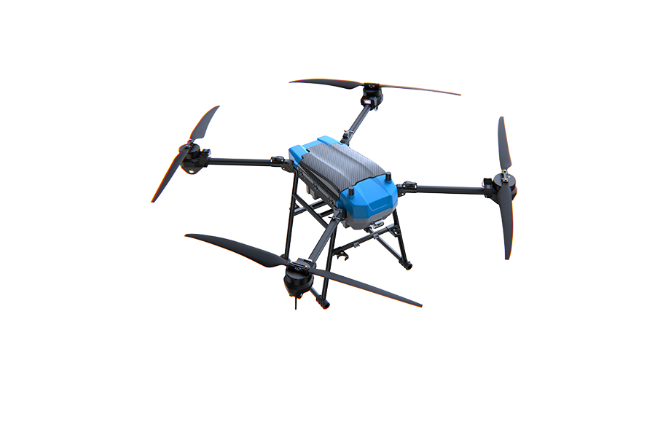
2. Hexacopters (6 Rotors)
With its six motors equidistantly mounted on the frame, the hexacopter is the perfect balance between consumer drones and industrial models.
Technical Specifications: Provides basic redundancy in propulsion systems. Due to the advanced flight control system, even in case of a single motor malfunction while airborne, the rest will automatically vary their speeds for maintaining stable flight. Moreover, its wind resistance and flight stability are far more than that of quadcopters.
Industrial Application: Suitable for transporting mid-range payloads. Applications may include mounting precise LiDAR sensors, multispectral imaging cameras, or high magnification optical zoom lenses for inspecting grids, as well as exterior wall painting and cleaning at higher altitudes.
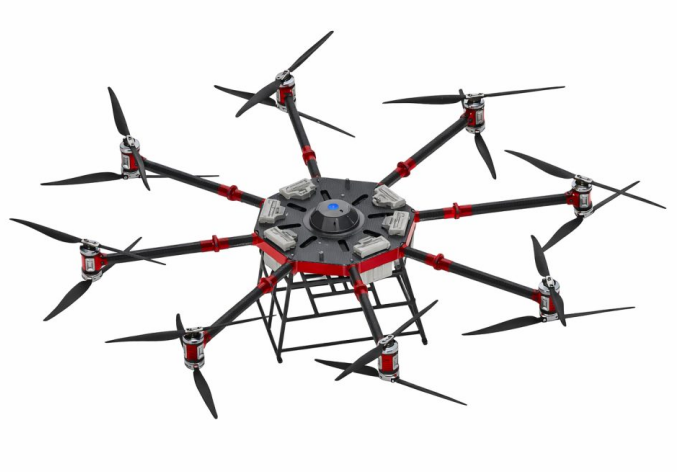
3. Octocopters (8 Rotors)
Equipped with eight motors, the octocopter stands as the “heavy-duty transport truck” of multi-rotor architectures.
Technical Characteristics: Delivers exceptional payload capacity and top-tier propulsion redundancy. The flight control system can maintain absolute trajectory control even if two non-adjacent motors fail simultaneously in mid-air. The collective thrust of eight rotors enables millimeter-level hovering precision even in high-altitude environments characterized by turbulent air currents and strong winds.
Industrial Applications: Explicitly engineered for heavy industrial and extreme specialized missions. Typical applications include large-scale precision agricultural crop protection drones (carrying 30L–50L liquid tanks), tethered firefighting drones equipped with heavy fire-extinguishing projectiles or water hoses, and cinema-grade heavy-lift camera gimbals.
Limitations: Massive physical footprint and weight, typically requiring dedicated transport vehicles. Eight synchronized motors consume power rapidly, dictating extremely stringent requirements for the Battery Management System (BMS).
Which Multi Rotor Drone Type Should You Choose?
To streamline the evaluation process for corporate procurement teams, the decision-making logic can be simplified as follows:
- Seeking Long Flight Time, High Portability, & Low Cost → Prioritize Quadcopters
- Seeking High Safety, Medium Payload, & Cost-Effectiveness → Prioritize Hexacopters
- Seeking Maximum Payload, Extreme Stability, & Heavy-Duty Operations → Prioritize Octocopters
Advantages of Multi-Rotor Drones
In the era of industrial automation, multi-rotor UAVs have become pivotal tools for reshaping productivity. From precision agriculture and high-rise exterior cleaning to solar farm inspections, they help enterprises achieve “cost reduction and efficiency gains” while mitigating the safety risks of manual high-risk operations.
Excellent Hovering Capability
One of the key advantages of multi rotor drones is their ability to hover stably in the air. They can maintain a fixed position for an extended period, making them ideal for tasks such as power line inspection, building inspection, security monitoring, and agricultural spraying where precise observation is required. They perform very reliably in low-altitude operations.
Vertical Take-Off and Landing (VTOL)
Multi rotor drones do not require a runway for take-off or landing. They can be rapidly deployed in mountains, urban areas, construction sites, or narrow spaces. This flexibility makes them highly efficient and convenient for use in complex environments.
High-Precision Flight Control System
Modern multi rotor drones are typically equipped with GPS, RTK, AI vision, and obstacle avoidance systems, enabling high positioning accuracy and stable flight performance. This allows them to be used in professional applications such as surveying, inspection, and 3D modeling.
Suitable for Low-Altitude Precision Operations
Multi rotor drones perform well in low-altitude environments and are suitable for tasks such as agricultural spraying, photovoltaic inspection, wind turbine inspection, and thermal imaging. Compared with manual operations, they offer higher efficiency and improved safety.
Easy Deployment and Maintenance
Multi rotor drones have a simple structure, making them easy to transport and quickly deploy. They also have relatively low maintenance costs. This allows companies to conduct frequent and routine drone operations, improving overall operational efficiency.
Industrial Application Scenarios of Multi Rotor Drones
By integrating various specialized payloads, multi-rotor drones can be tailored perfectly to the bespoke needs of diverse industries. Below are four application scenarios currently experiencing the strongest demand in the global market:
1. Precision Agriculture & Crop Protection
Multi-rotor drones with a payload capability of up to 30L to 50L are widely used in contemporary agriculture.
Methodology: Drones employ multispectral imaging to analyze the health condition of crops and detect areas affected by pests or diseases. After that, the multi-rotor system makes use of its downwash effect to evenly disperse the chemicals on the two sides of the crop leaves.
Economic Benefits: As opposed to the use of manual or ground-based machinery, efficiency is increased while cutting down pesticide use by 30% and water usage by 90%.
2. High-Risk Facility Maintenance & Cleaning
Operating in high altitudes comes with sky-high insurance costs and huge safety concerns.
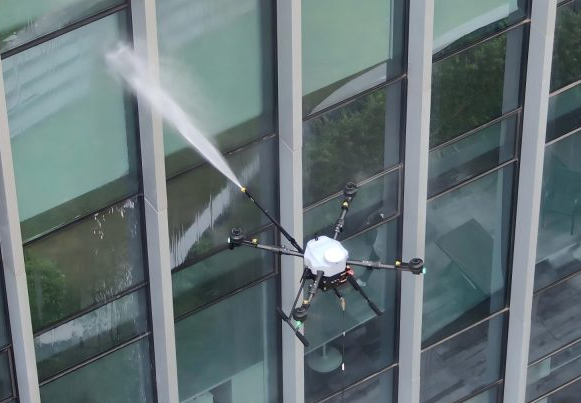
Buildings & Photovoltaics: Multi-rotor UAVs have been utilized to perform cleaning of the exterior walls/windows of high-rise buildings and conduct photovoltaic system inspections. Using UAVs with infrared thermal imaging cameras enables the quick scanning of large-scale solar power systems and identifying problems through identifying hotspots generated from the “hot spot effect.”
Commercial Benefits: No risk of fatalities from high-rise workers, more efficient solar panel inspections by at least 60%, and no risks of power generation losses due to defective panels.
3. Energy, Grid, & Infrastructure Inspection
Operational Logic: Carrying out regular checks of asset integrity through oil and gas pipelines, electric transmission lines, turbine blades, and bridges.
Technical Points: UAVs can be fitted with LiDAR technology for 3D reconstruction of structure or zoom optical cameras capable of capturing minute details like missing cotter pins on electric grid systems or cracks on turbine blades from a distance of several dozen meters away.
4. Emergency Response & Smart Firefighting
Operational Logic: Conventional firefighting equipment sometimes finds it difficult to operate at high elevations in the case of fires in skyscrapers or forests. Multi-rotor drones that are tethered and supplied power from ground through a cable could provide 24-hour continuous aerial endurance as an emergency communication base station and as illuminating lights. Heavy lift drones could carry projectiles capable of breaking the glass windows of skyscrapers.
Multi-Rotor vs. Fixed-Wing: What are the Differences
When making procurement decisions, buyers frequently weigh different airframe configurations. The table below illustrates the competitive advantages of multi-rotor drones in targeted commercial scenarios:
| Feature / Dimension | Multi-Rotor Drone | Fixed-Wing Drone |
| Takeoff / Landing Requirements | Zero space footprint (VTOL); capable of vertical takeoff and landing. | Requires open runways, catapult launchers, or clearing spaces for runway landings. |
| Hovering Capability | Excellent; enables pinpoint precision tasks and long-duration stationary surveillance. | Incapable of hovering; must maintain high-speed forward flight to stay airborne. |
| Control & Automation Complexity | Low; supports highly automated flight path planning and one-key Return-to-Home (RTH). | Higher; demands rigorous operator skills and manual emergency response capabilities. |
| Payload Versatility | Extremely High; easily integrates spraying systems, cleaning arms, gimbals, etc. | More limited; primarily restricted to lightweight downward-facing mapping cameras. |
| Best-Suited Scenarios | High-precision localized operations, high-altitude spot maintenance, confined-space inspections. | Ultra-large-scale geospatial mapping, long-distance cross-country pipeline inspections. |
In summary:
- Multi-rotor drones are optimized for precision-driven, low-altitude, localized tasks.
- Fixed-wing drones are optimized for wide-area, long-endurance, linear mapping missions.
- Enterprises should align their procurement choice with their specific operational environments.
Key Factors to Consider When Buying Multi Rotor Drones
For industrial clients and project managers, procurement of the drone platform is more than just buying hardware; it is an important business choice determining the safety, precision, and ROI of operations. While selecting suppliers and platforms, businesses need to carefully consider these five technical aspects:
Load Capacity:
For various industrial purposes, there is always a set load requirement. Simple functions, like using thermal cameras or lightweight mapmaking sensors, entail a few hundred grams to 2kg in weight. Other complex functions, like using LiDAR, high-pressure cleaning equipment, and agriculture spraying devices, entail heavy loads ranging from 10kg to 50kg. Your drone’s Max Payload should still have a 20% capacity remaining after placing your chosen equipment.
Flight Time (Endurance):
Flight time determines the coverage area and operational throughput per battery cycle. A drone’s endurance is a delicate equilibrium between battery capacity (BMS), propulsion efficiency, and payload weight. Procurement teams must look past idealized “dry weight” specifications and strictly audit the “Max Flight Time with Max Payload” to verify if it satisfies minimum single-sortie requirements.
Wind Resistance:
Commercial UAVs frequently operate under volatile meteorological conditions, such as offshore wind farms, mountainous corridors, or at hundred-meter altitudes. A superior wind resistance rating (industrial platforms should achieve Level 5–6 resistance, or 10.8 m/s – 13.8 m/s) ensures the aircraft remains stable. This is the primary defense against motion-blurred data and catastrophic asset loss.
Precision & Automation:
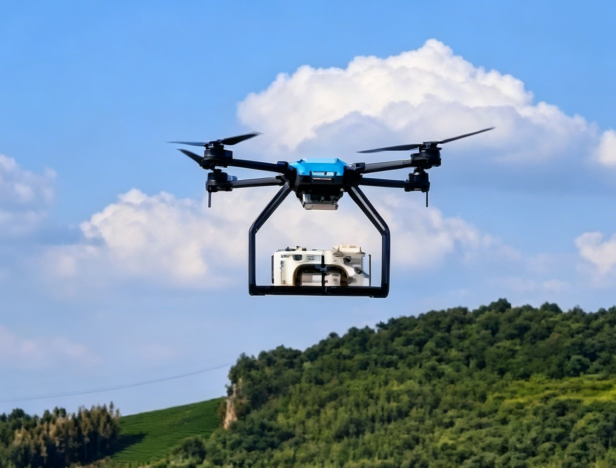
Modern industrial drones rely heavily on autonomous operations. Procurement priority should be granted to platforms supporting RTK (Real-Time Kinematic) technology to achieve centimeter-level positioning and hovering accuracy. Furthermore, verify that the system natively supports automated flight path planning, AI target recognition, omnidirectional obstacle avoidance, and multi-layered fail-safe Return-to-Home (RTH) protocols.
Safety & Reliability:
In complicated industrial environments, the equipment reliability is crucial to the company’s liability protection. For this reason, the commercial multicopter should contain redundant systems for IMU, compass, flight controller, and inherent engine redundancy in a hexacopter or octocopter design. With an additional IP55 or IP66 rating, this would allow the drone to make a safe landing in zones with chemical hazards, bad weather conditions, or high levels of EMF presence.
Regulatory Compliance Note: When conducting audit testing for technical criteria, international buyers need to ensure that the manufacturer is properly certified for their global market access. Buyers should make sure that all the platforms satisfy the requirements of CE, FCC, and ISO9001 Quality Management Systems.
Wrap Up
With the rapid advancement of the low-altitude economy and intelligent automation, Multi-Rotor Drones have become essential tools in the modern era of industrial productivity by virtue of their excellent hovering capabilities, advanced VTOL functionality, and highly precise flight control. Are you looking for an ideal drone partner that will help you transform your particular industrial projects?
Do you require an efficient, world-class drone partner for your particular industrial applications such as high-altitude maintenance, precision agriculture, or facade cleaning?
Contact VastArrive today. VastArrive provides an enterprise-grade fleet of high-performance Multi-Rotor Drones engineered to help businesses enhance efficiency, optimize operational costs, and capture a decisive competitive advantage in the rapidly expanding low-altitude economy.