Which Is Better: DJI Agras T30 or VastArrive VA-B100P Spraying Drone?

Of the current spraying drones used in farming, one that has attracted much attention is the Agras T30 by DJI. However, on the other hand, the VastArrive company has introduced its own version of the agricultural drone, known as the VastArrive VA-B100P.
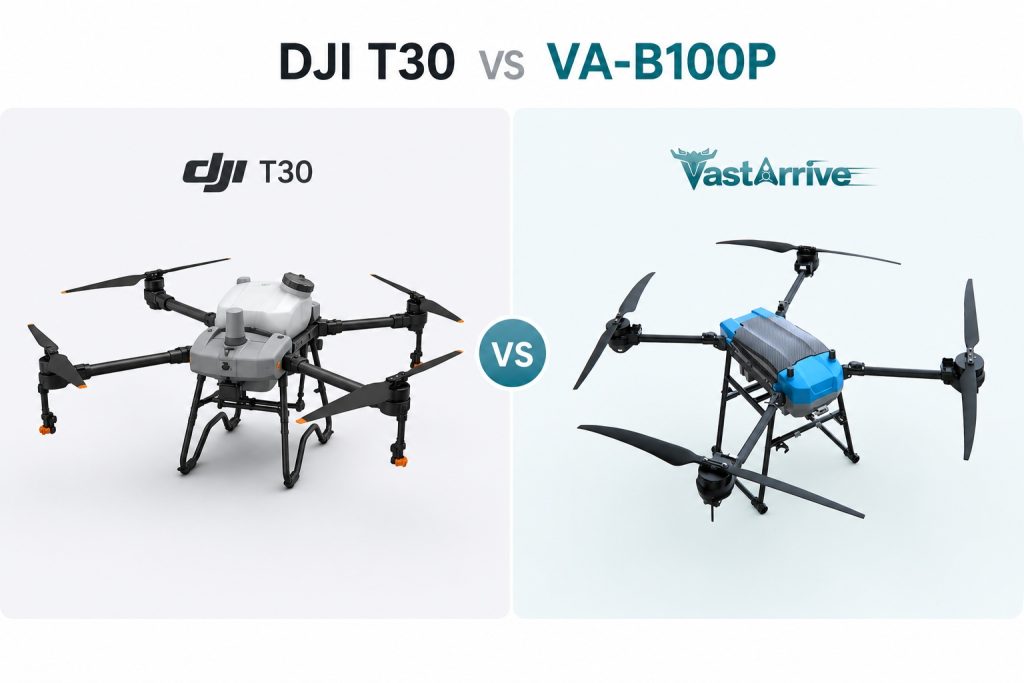
Now, which drone should you go for in order to meet your agricultural needs? It all boils down to your farm’s size and landscape complexity.
Table of Contents
DJI Agras T30 vs VA-B100P: Core Parameters
| Feature | DJI Agras T30 | VA-B100P |
| Primary Focus | Precision crop spraying | Heavy-duty multi-purpose agricultural operations |
| Spray Tank Capacity | 30L | 50L |
| Max Takeoff Weight | 78 kg | 110 kg |
| Terrain Adaptation | AI-assisted terrain following + radar | Heavy-load operation for complex terrain |
| Obstacle Avoidance | Omnidirectional radar system | Omnidirectional radar system |
| Operation Type | Standardized spraying workflow | Spraying + transport + agricultural logistics |
| Target Farms | Medium and large flat farms | Large-scale and complex agricultural environments |
| Payload Flexibility | Primarily spraying-focused | Multi-mission payload capability |
| Smart Features | RTK, AI route planning, cloud platform | Mission flexibility and modular deployment |
The DJI Agras T30 is mainly designed for efficient spray applications. The DJI ecosystem is characterized by automation, path planning, and agricultural workflow standardization. Based on the specs provided by DJI, the T30 can spray an area of 40 acres in one hour.
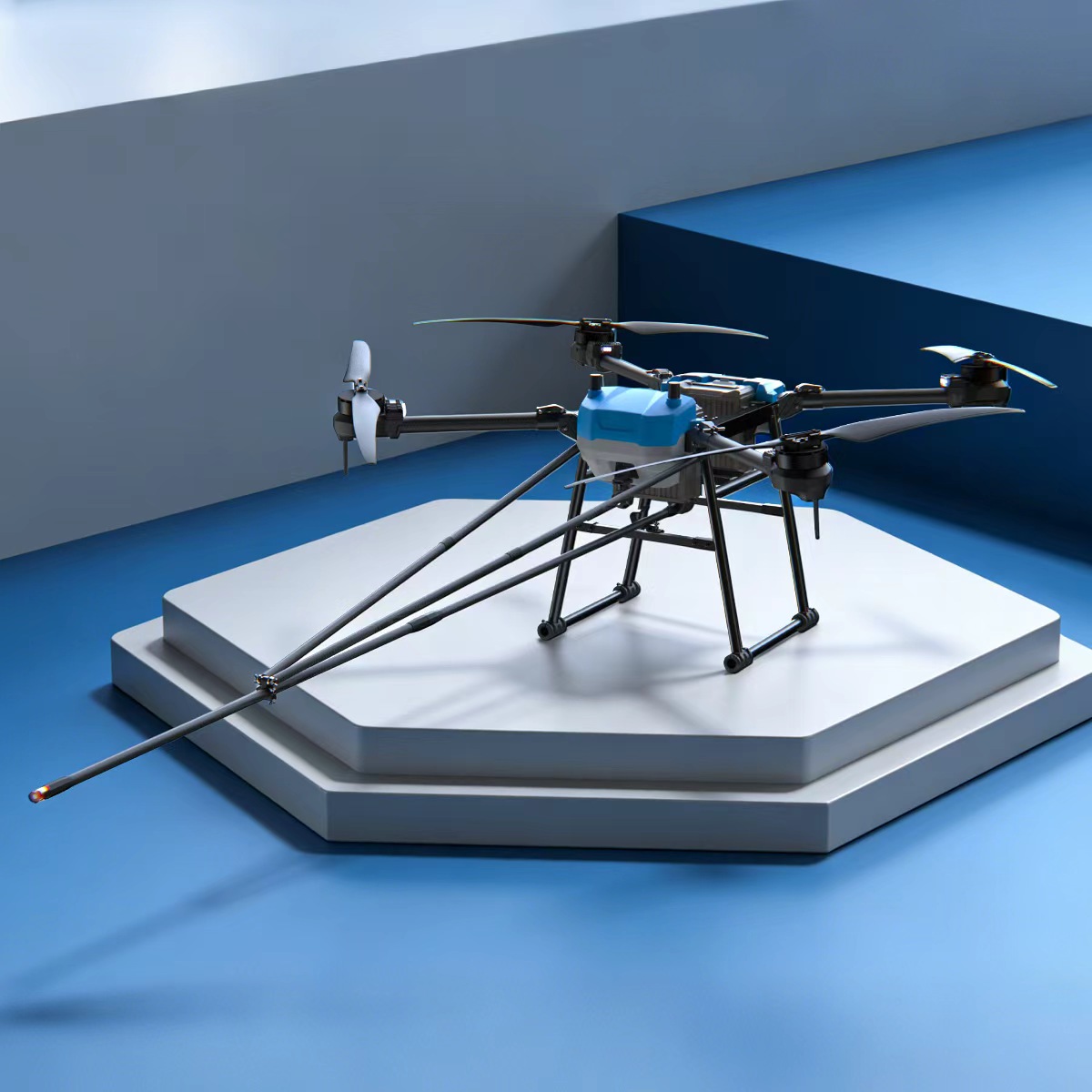
The VA-B100P is designed for heavy-load, multi-scenario operations. The entire machine boasts high protection and strong environmental adaptability. Utilizing a mature flight control system, it achieves automated operation functions such as intelligent route planning and resume flight from where it left off, resulting in a highly efficient and stable workflow. According to official specifications, the VA-B100P can complete spraying operations on 300 acres of farmland per hour. It can also be adapted to various operation modules such as seeding, aerial cleaning, material hoisting, and emergency firefighting, making it a versatile and comprehensive machine with outstanding operational capabilities.
Field Application Comparison
Rice Field Spraying
For flat farmland and large rice fields, the DJI Agras T30 has obvious advantages in operational maturity.
Its RTK-assisted navigation, intelligent route planning, and automated spraying ecosystem make it highly suitable for repetitive large-scale spraying tasks. DJI’s software integration also reduces the learning curve for operators.
However, in large agricultural regions where transportation, material delivery, and multi-role deployment are equally important, the VA-B100P may provide greater flexibility.
Instead of serving only as a spraying drone, the VA-B100P can potentially support broader agricultural workflows such as:
- fertilizer transport
- field logistics
- remote farm delivery
- multi-payload operations
This becomes especially important in remote agricultural zones where infrastructure is limited.
Orchard and Mountain Farms
Orchards and mountainous farms present completely different challenges compared to flat rice fields.
Canopy coverage, variations in height, wind conditions, and narrow paths during operation can make conventional spray drones inefficient.
Terrain following radar and obstacle sensors in the DJI T30 have greatly improved spraying efficiency in varied terrains. DJI states that the T30 supports slope operations up to 35°.
The VA-B100P, on the other hand, appears to emphasize heavy-load adaptability and mission flexibility in difficult agricultural environments.
For example, in mountainous fruit farms, growers may require:
- chemical spraying
- seed transport
- equipment delivery
- emergency supply transportation
A multi-purpose UAV platform can potentially reduce the need for multiple separate machines.
Payload and Multi-Mission Capability
This is where the difference between the two platforms becomes more noticeable.
The DJI Agras T30 is fundamentally a dedicated agricultural spraying system. Its ecosystem, hardware design, and operational software are optimized specifically for crop spraying and spreading applications.
The VA-B100P follows a different design philosophy.
Based on the product positioning and white paper information, the B100P is designed more as a heavy-duty UAV platform rather than a single-purpose spraying drone.
This distinction matters for commercial agricultural operators.
In large farms, drones are increasingly expected to perform multiple operational tasks instead of only spraying pesticides.
Potential applications may include:
- agricultural logistics
- transport missions
- emergency material deployment
- field equipment delivery
- multi-role payload integration
Operational Efficiency and Field Deployment
Operational efficiency in agriculture depends on more than spray width alone.
Real-world efficiency is influenced by:
- battery turnaround speed
- refill logistics
- transport efficiency
- maintenance simplicity
- operator workload
DJI has built one of the most mature agricultural drone ecosystems currently available. The T30 supports intelligent supply-point prediction, automated route coordination, and fast battery charging systems.
However, some operators in drone communities have also discussed challenges related to firmware updates, calibration issues, and heat management during intensive field operations.
For the VA-B100P, the advantage appears to lie more in operational flexibility for large-scale agricultural deployment scenarios.
Instead of optimizing purely for spraying speed, the VA-B100P may provide value through:
- higher mission versatility
- heavy-load capability
- broader field utility
- reduced dependence on multiple separate UAV systems
Smart Features and Automation
DJI currently maintains a strong advantage in agricultural drone intelligence and software ecosystem maturity.
The T30 includes:
- RTK positioning
- omnidirectional radar
- AI-assisted route planning
- cloud-based farm management
- intelligent terrain following
These technologies help improve spraying precision and operational consistency.
The VA-B100P appears to focus more on operational adaptability rather than purely automated spraying intelligence.
For farms operating in remote, mountainous, or infrastructure-limited regions, operational flexibility can sometimes be more valuable than fully standardized automation.
Which Drone Is Better for Your Business Needs?
Whether the choice should be made in favor of either the DJI Agras T30 or the VastArrive B100P does not lie in whether one drone is superior to another in terms of technical advancements; the decision should be made by considering whose system will be more suitable for the agricultural business model of yours.
If your business mainly concerns itself with offering crop spraying services based on efficient, repeatable procedures, then the DJI Agras T30 would definitely serve you well as its workflow caters to those kinds of situations.
If your operation demands something more from agriculture than just spraying crops, that includes transporting materials, handling multi-farm operations, providing remote assistance, or operating within challenging terrain, the VA-B100P is clearly the system of choice for you.
In other words:
- DJI T30 fits businesses centered on precision spraying services at scale
- VA-B100P fits businesses requiring multi-role agricultural UAV operations with higher operational flexibility
The right choice depends on whether your business model is built around specialized spraying efficiency or multi-scenario agricultural operations.