
How Far Can A Drone Fly from the Controller?

Whether you are a beginner looking to buy your very first drone or a seasoned pilot pushing the absolute limits of flight, one burning question is always at the top of your mind: How far can a drone fly from the controller? What is the real control range of the remote?
Simply put, it entirely depends on the type of drone you are using. A basic toy drone might lose connection at just 50 to 100 meters, whereas modern, mainstream consumer camera drones can easily cruise 5 to 10 kilometers away. When it comes to top-tier professional or industrial-grade drones, they can achieve a staggering range of 15 to 25+ kilometers under ideal conditions.
However, there is often a massive gap between the “theoretical maximum range” on the spec sheet and the “real-world flight distance” in your hands. In this ultimate guide, we will break down the actual range performance of mainstream drones, the transmission technologies powering them, and the legal red lines you absolutely must know before takeoff.
Table of Contents
How Far Can Most Drones Fly from the Controller?
The control range varies significantly across different categories of drones:
| Drone Type | Typical Control Range |
| Toy Drones | 30–100 meters |
| Entry-Level Drones | 500 meters – 2 kilometers |
| Consumer Camera Drones | 5–20 kilometers |
| Professional Camera Drones | 10–30 kilometers |
| Industrial Drones | 20+ kilometers |
Note: Manufacturers test their advertised flight ranges under ideal laboratory conditions, which typically feature:
- Open environments with zero obstacles
- No radio interference
- Favorable weather conditions
- A fully charged battery
Real-world control ranges are inevitably shorter. For instance, a drone advertised with a 20-kilometer video transmission range may only be able to fly reliably for 5 to 8 kilometers in a dense urban environment.
What Determines a Drone’s Control Range?
In real-world flights, a drone’s actual control range rarely hits its theoretical maximum. To understand why, we need to explore the 5 key technical and environmental factors that dictate performance.
1. Transmission Technology
Communication technology is the absolute foundation of a drone’s flight distance. It directly determines the quality and stability of data and video transmission between the remote controller and the aircraft over long distances.
Wi-Fi Transmission:
Although Wi-Fi has great cost efficiency, one cannot ignore that its major drawbacks are high latency and low anti-jamming capacity; therefore, typically, the maximum effective operating range is limited to only up to several hundred meters up to around 2 kilometers. At present, in the vast majority of cases, the high-quality drones use other means for controlling the flight at long distances.
Digital Radio Frequency (RF) Communication:
The modern industrial or professional drones are equipped with a special kind of communication via digital radios. It has ultra-low latency and provides high definition video feed back as well as excellent anti-jamming capacities.
Next Generation Advanced Communication and Networking Control (such as OcuSync and LTE/5G):
The industry’s leading proprietary protocols employ advanced algorithms allowing dramatic optimization of bandwidth. Moreover, the integration of LTE/5G cellular network control enables breaking through geographical restrictions of radio waves. As long as there is cellular network coverage, unlimited, ultra-long-distance control is theoretically possible.
2. Remote Controller Antenna Design & Orientation
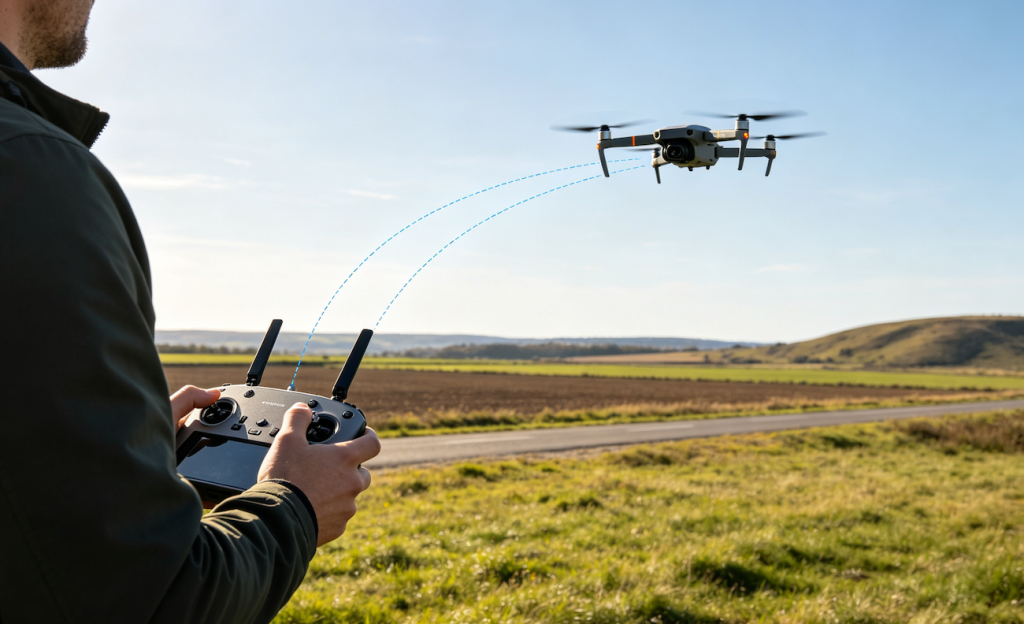
Most pilots only concentrate on the drone itself while completely overlooking the engineering behind the Remote Controller (RC). Quality RCs are equipped with dual antennas, high-gain antennas, and beamforming technology that makes it possible for them to automatically hop between 2.4GHz and 5.8GHz frequencies in search of the clearest signal frequency.
Key Tip: The misalignment of the antenna is one of the leading causes of sudden and unexpected loss of signal. In case the wide flat side of the antenna does not point directly towards the aircraft, there will be significant signal weakening. When this happens, the drone can disconnect unexpectedly despite being quite close.
3. Flight Environment & Physical Obstacles
Radio waves require a clear path to travel efficiently. Therefore, your surroundings have a decisive impact on signal performance:
Open Environments:
Wide open spaces such as grassland, desert, sea/ocean, or farming land offer ideal LOS. Flying in such an environment will make it very easy for a drone to reach its stated maximum control range.
Urban Areas:
Cities have many reinforced concrete buildings, high voltage wires, cellular towers, and a multitude of radio frequency waves from Wi-Fi and Bluetooth devices at homes. The combination of physical obstruction and electromagnetic interference reduces the actual control range by 50% or more.
Mountains and Forests:
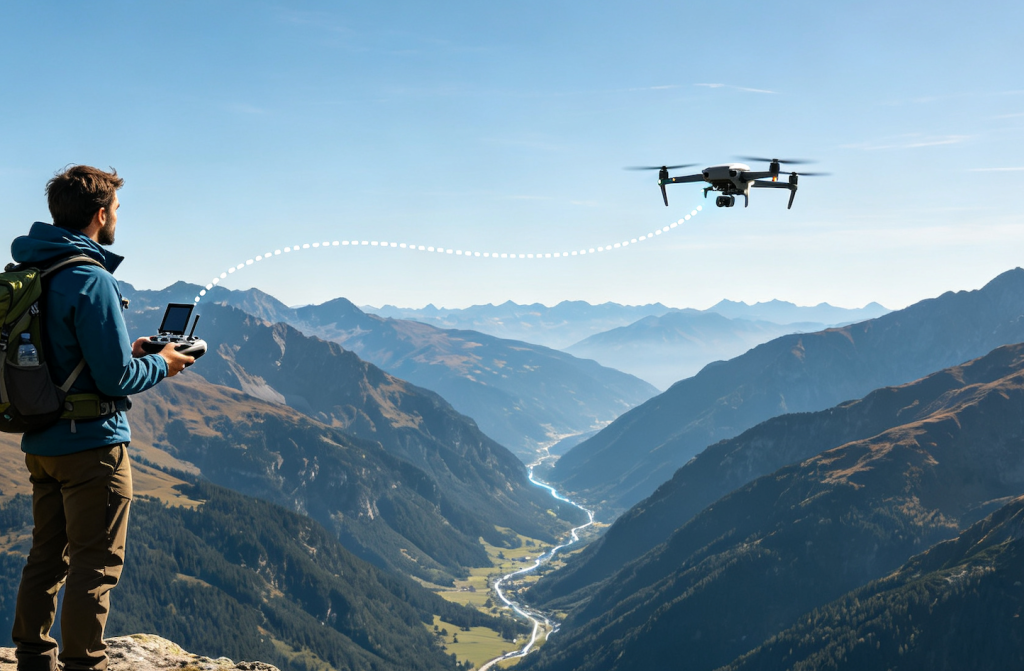
Dense tree canopies and solid rock mountains act as natural shields against radio frequencies. Even if the drone is only a few hundred meters away, flying behind a mountain ridge or dipping into a forest can instantly sever the signal entirely.
4. Weather Conditions & Atmospheric Factors
The effect of weather factors could adversely impact the stability of communication by wireless technology. Bad atmospheric factors like rainfall, fog, snow, and high humidity could add an excessive amount of small water particles into the atmosphere, thus hampering the radio signal.
Though radio waves will not cease working overnight due to weather factors, the atmospheric condition would certainly impact the stability of communication. Also, facing a lot of wind resistance while flying at a higher altitude would mean running the drone’s motor full speed, quickly discharging its battery life.
5. Battery Capacity & Return-to-Home (RTH) Safety Margins
A common misconception is that a drone stops flying further away solely because it loses signal. In reality, battery life is the ultimate physical ceiling for any drone’s flight distance.
Let’s look at a cold, mathematical reality: Suppose a professional drone has a maximum speed of 60 km/h and a battery life of 30 minutes. Theoretical limit is 30 kilometers. But the pilot has to keep in mind that he needs to keep at least 50% of the battery capacity to come back home, which means that the actual range would be much less – around 6 to 7 kilometers. Inbuilt RTH safety feature is the major factor why drone flights never reach theoretical distances.
What Happens When You Fly the Drone Out of Range?
Most nightmares during aerial shooting or industrial mission for a pilot include such messages on a remote control display as “Video signal disconnected” or “RC Signal Lost”. Today’s drones have very smart fail-safe protocols in case they lose their connection with a remote. The drone can perform any of the following procedures:
1. Return to Home (RTH)
This is the most common and reliable protection mechanism. Once the drone detects that the RC signal has been lost for longer than a safe threshold (usually 3 to 5 seconds), the system takes over and strictly executes these steps:
Activation & Calibration: The drone immediately hovers in place and reads the precise GPS Home Point coordinates recorded before takeoff.
Smart Climb: To avoid hitting trees or buildings on the way back, the drone automatically climbs to a safe RTH altitude pre-set by the pilot (if it is already higher than that altitude, it maintains its current height).
Straight-Line Return & Autonomous Landing: Relying on onboard GPS and obstacle avoidance sensors, the drone flies in a straight line back to the takeoff spot. Once it confirms the ground below is clear, it automatically lands smoothly and shuts down its motors.
2. Hover in Place
However, immediate return is not always desirable (in the case when a UAV flies under a dense tree cover, then its rising immediately will lead to collision with the trees). Thus, some drones are configured to hover accurately as an immediate reaction on the signal loss. They hold steady their location using visual positioning systems and barometers until the pilot connects to the UAV by changing his/her location or by pointing the controller in another direction.
3. Automatic Local Landing
When conditions deteriorate further and an RTH cannot be safely executed, the drone will choose to force-land locally to protect core data and minimize the risk of ground injuries:
GPS Signal Loss (ATTI Mode): If a drone loses its GPS connection indoors, in deep valleys, or due to severe interference, it cannot find its way home. It will choose to land vertically right where it lost connection.
Critical Low-Battery Trigger: Even if the drone is already executing an RTH, if the algorithm calculates that the remaining battery is insufficient to make it all the way back, the drone will override the return and force an automatic landing at its current position.
4. Continue Pre-Set Mission
While consumer camera drones must return home upon disconnection, the failsafe protocols for industrial-grade drones (such as those used for powerline inspections, orthophoto mapping, or agricultural spraying) are far more flexible.
Before takeoff, the entire flight path and operational tasks are fully uploaded into the onboard flight control system via a Ground Station. Therefore, even if a temporary radio blackout occurs behind a mountain, in dense woods, or in remote areas, the drone can continue entirely independent of the remote controller signal. It will autonomously complete its pre-set route and gather data until it re-enters signal coverage or safely returns after finishing the mission.
How Far Are You Legally Allowed to Fly?
Even though your drone can actually reach up to 15 kilometers, you cannot just go and fly everywhere since it is not legally allowed for you to do so.
According to the drone laws in China, USA (FAA), European Union (EASA), and practically all other nations and territories around the world, drone flyers have to strictly follow the concept of VLOS (Visual Line of Sight).
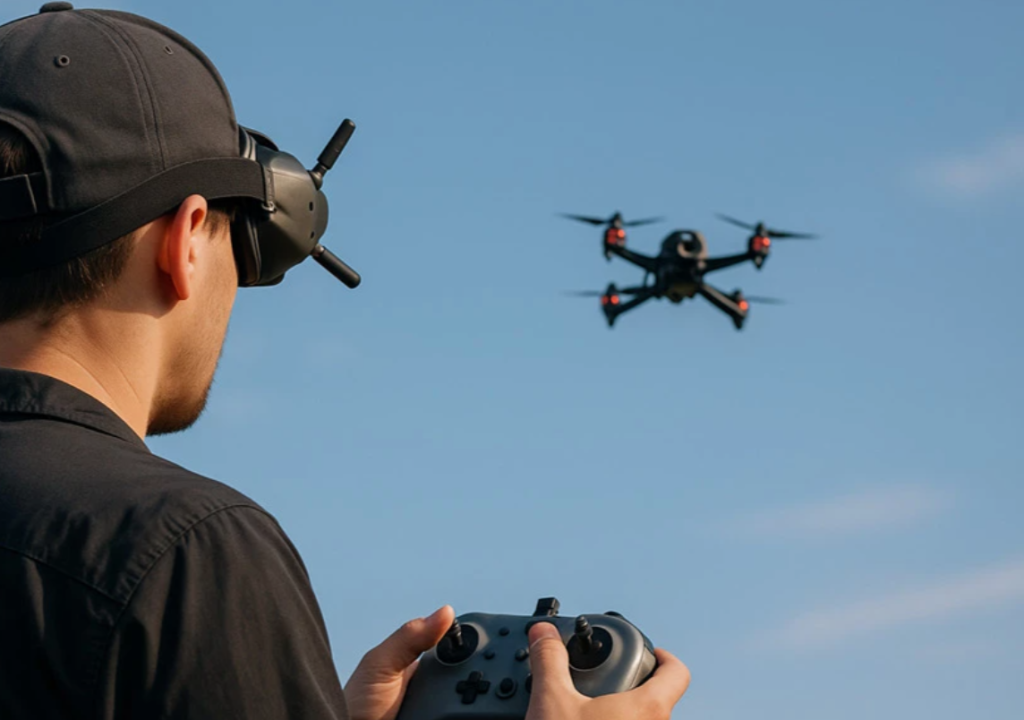
Visual Line of Sight (VLOS) implies that during the entire time of the flight, the flyer should always be able to clearly see the drone using his/her naked eyes (not using any binoculars and only seeing through the remote control monitor).
For the vast majority of people, once a drone flies beyond 500 meters to 1 kilometer, it becomes incredibly difficult to spot with the naked eye. Therefore, from a legal and regulatory standpoint, attempting ultra-long-distance range tests beyond your line of sight constitutes an illegal flight—unless you hold specific industry approvals and a BVLOS (Beyond Visual Line of Sight) waiver.
How to Safely Optimize and Extend Your Drone’s Range
In order to get the maximum stability and clearest transmission of the video signal in legal conditions, use the following guidelines:
Maintain a Line of Sight:
Do not have anything like trees, mountains, and buildings that might obstruct the line of sight between you and the drone. The higher your location, the better the performance will be.
Correct Positioning of the Antennas:
There is a common misconception about the fact that people tend to aim the tip of the antennas towards the drone thinking that the connection will be more efficient this way. On the contrary, the face (wide end) of the antenna should always be facing the drone.
Update Your Firmware:
This step is crucial as many manufacturers tend to update the firmware in order to make the algorithms of the signal transmission more efficient.
Watch High-Altitude Wind Speeds:
It might feel calm on the ground, but winds can be howling at an altitude of 100 meters. Check high-altitude wind forecasts using dedicated apps before taking off to prevent your drone from running out of power on the return trip.
The Bottom Line
How far can a drone fly? Ultimately, it comes down to your budget and your gear. While a toy drone can only buzz around your backyard, a modern consumer camera drone is more than capable of carrying your vision across mountains and rivers. However, instead of blindly chasing “extreme range limits,” focusing on your battery life, keeping an eye on your surroundings, and respecting aviation laws is the true secret to making sure every flight ends with a happy takeoff and a safe landing.