
Drone Inspection for Building Maintenance: A Smarter Way to Inspect Buildings

Building roofs, exterior walls, and high-altitude structures are subject to long-term environmental erosion, making them prone to cracking, aging, and water leakage. Traditional manual inspections are not only time-consuming and costly, but they also pose high-altitude work risks.
Equipped with high-definition, zoom, and thermal imaging sensors, building maintenance inspection drones provide property and facility management teams with a safe, flexible, high-altitude data collection solution. They can accurately pinpoint surface and hidden defects while comprehensively recording the condition of the building.
This article will explore in depth the core advantages, application areas, key technologies of drone inspections, and how to integrate them into daily maintenance plans to help you optimize building asset management.
Table of Contents
What is Drone Inspection for Building Maintenance?
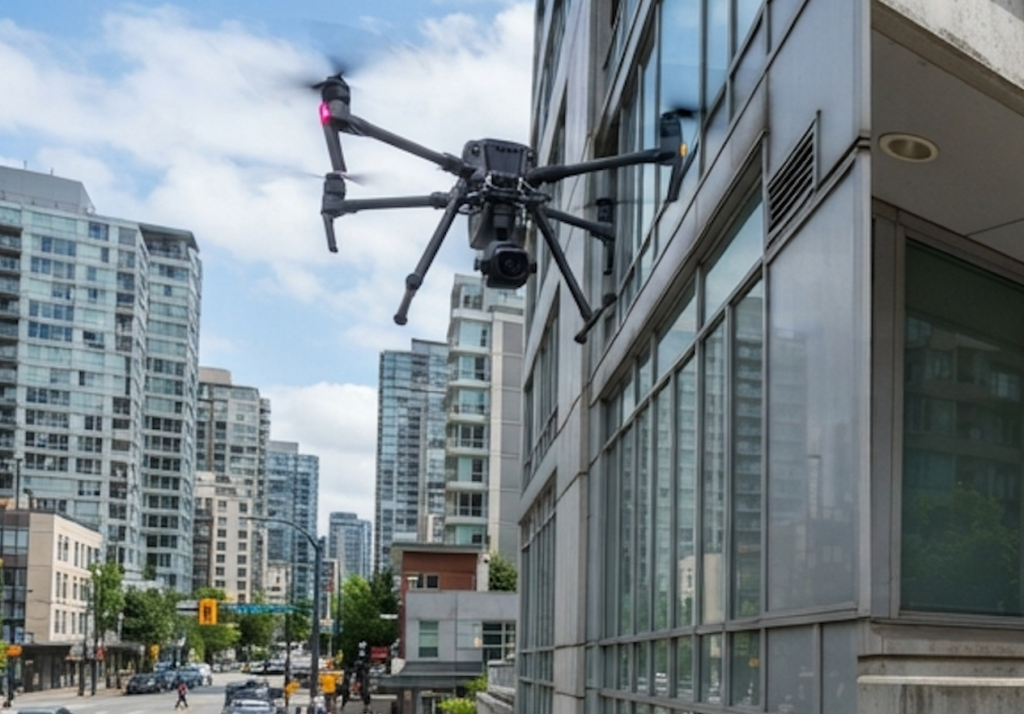
Drone inspection for building maintenance refers to the use of drones equipped with cameras and other sensors to inspect, collect data on, and assess the condition of building exterior structures.
Unlike personnel climbing roofs directly or using scaffolding for inspections, drones can fly along predetermined flight routes around the perimeter of a building to capture high-resolution images and videos.
A typical drone building inspection system may include:
- High-definition visible light cameras
- High-magnification zoom cameras
- Thermal imaging cameras
- GPS/RTK positioning systems
- Photogrammetry systems
- 3D modeling technology
- Data analysis and AI-assisted recognition tools
A complete drone building maintenance inspection process can generally be summarized as:
Drone Data Collection → Image and Data Analysis → Defect Identification → Inspection Report → Maintenance Decision-Making
Therefore, the value of drones goes far beyond simply “taking photos from the air”; they help building maintenance teams obtain building condition information faster and arrange subsequent repair work accordingly.
Which Parts of a Building Can Drones Inspect?
Drones possess extremely high flexibility, easily covering various high-risk and blind spots of a building:
1. Building Roofs
The roof is a core inspection area. Drones can capture high-resolution images of the roof surface, easily discovering material damage, cracks, waterproof aging, clogged gutters, and potential water damage. For large commercial and industrial buildings, this significantly reduces the need for personnel to climb onto roofs, making it a common drone roof inspection application scenario.
2. Windows, Balconies, and Exterior Structures
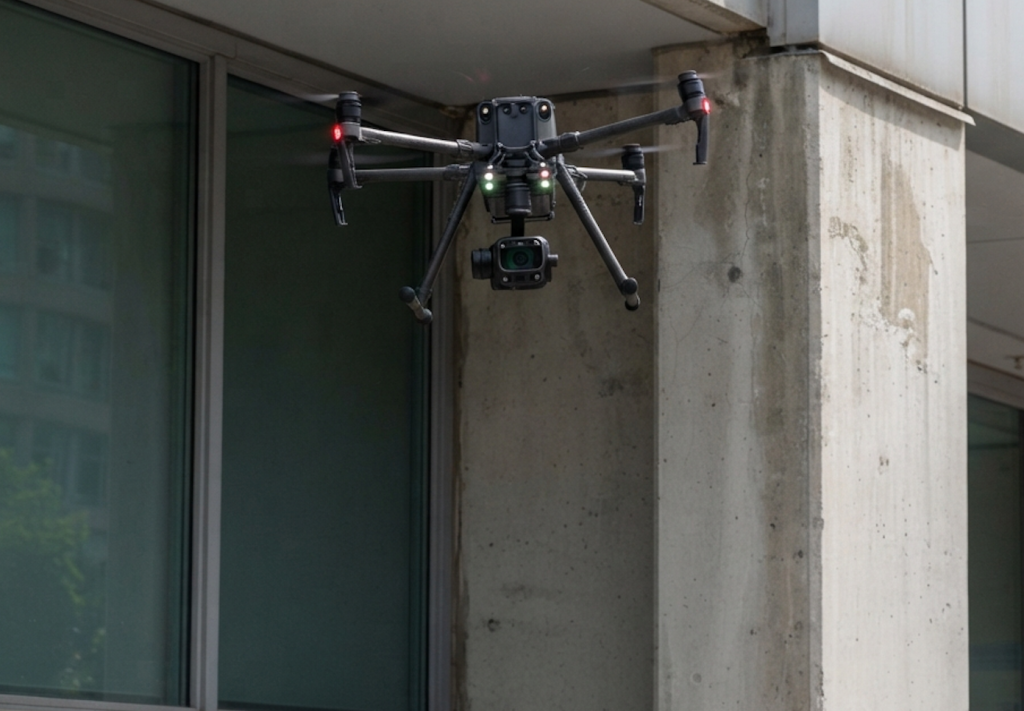
Drones can efficiently inspect high-altitude exterior facilities such as window frames, glass curtain walls, balcony edges, railings, decorative structures, and external air conditioning units. This eliminates the need to deploy complex and expensive high-altitude work equipment, achieving safe and convenient close-range observation.
3. Gutters and Drainage Systems
Clogged drainage systems easily lead to rainwater accumulation. Drones can rapidly patrol gutters, drainage pipes, and downspouts to identify debris accumulation and drainage damage. Especially after heavy rainstorms, they can assist maintenance teams in quickly assessing exterior drainage status.
4. Roof Equipment
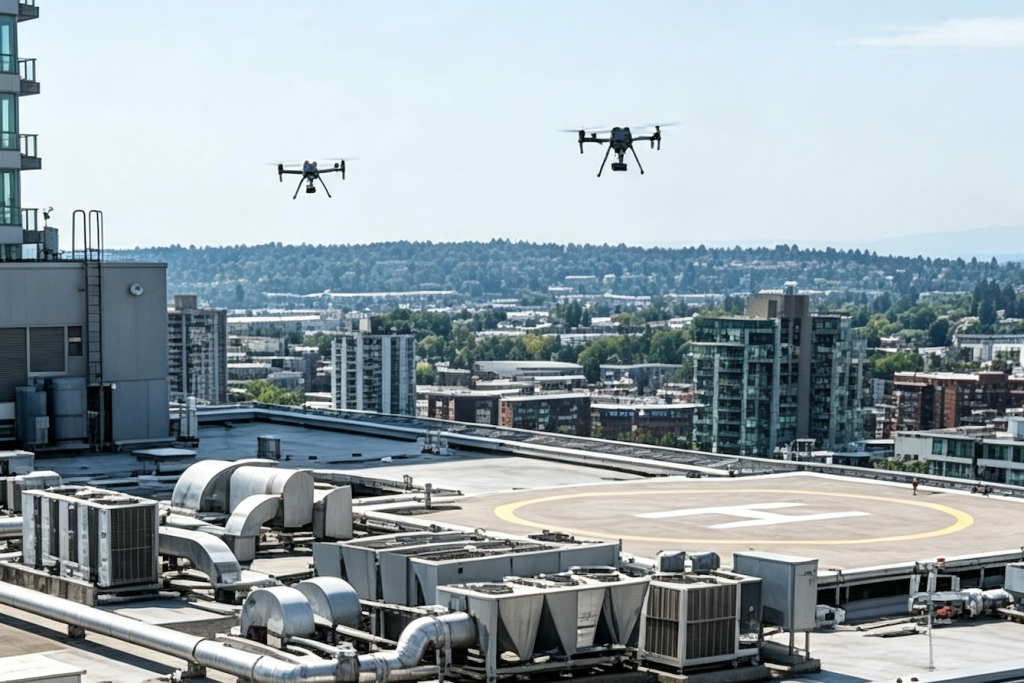
Commercial and industrial roofs are often densely populated with HVAC heating, ventilation, and air conditioning systems, ventilation equipment, chimneys, skylights, and solar panels. Drones can quickly capture exterior images of these equipment items to intuitively determine whether there is exterior damage, corrosion, or other abnormalities.
5. Hard-to-Reach Building Areas
Facing high-rise buildings, narrow sections, or complex structures where scaffolding is inconvenient to erect, drones can flexibly change aerial perspectives to perfectly cover hard-to-reach areas such as high-rise exterior walls and roof edges that conventional methods struggle to touch.
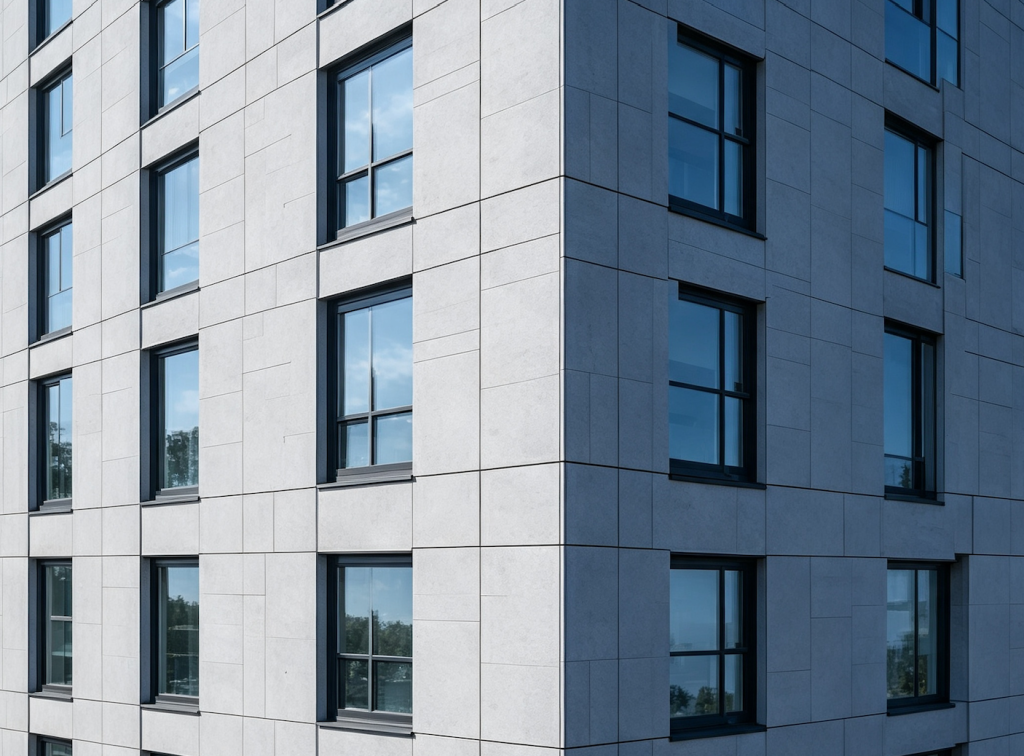
6. Building Exterior Walls and Curtain Walls
Building facades are frequently eroded by the environment. Through drone facade inspection, drones can focus on observing wall cracks, concrete spalling, aging of coatings and sealants, corrosion, and water stains. Compared to traditional scaffolding and rope access, they can quickly capture high-rise facade images from multiple angles.
Why Use Drones for Building Maintenance Inspections?
Drones do not simply replace traditional building inspections; rather, they provide building maintenance teams with a new way to collect data.
Drones do not merely substitute for conventional building inspections; instead, they give building maintenance crews an innovative means of data acquisition.
1. Avoid Dangers Associated with Working at Heights
The use of drones enables operators to take building pictures without physically going up in heights, thus significantly diminishing dependence on ladders, scaffolds, elevators, and rope access systems, which in turn minimizes the chances of falls and injuries among workers.
2. Significantly Improve Inspection Efficiency
Compared to the cumbersome setup and teardown processes of traditional methods, drones can quickly conduct large-scale aerial photography of a building’s exterior after completing flight planning, greatly shortening on-site operation time.
3. Effectively Control Inspection Costs
By eliminating expenses for erecting scaffolding, renting large lifting equipment, and frequently scheduling high-altitude work personnel, drones can save substantial labor and equipment rental costs for medium-to-large or high-rise buildings.
4. Acquire High-Resolution Digital Data
Modern drones can carry high-definition cameras to precisely capture minute defects on building surfaces. These high-quality images can be used not only for real-time recording, but also as valuable data assets for status archiving, repair comparison, and long-term monitoring.
5. Minimize Disruption to Daily Operations
Commercial buildings, hotels, and industrial facilities do not need to shut down
operations on a large scale for routine inspections. Drones can complete efficient collection around the perimeter of the building, minimizing impact on employees, customers, and daily business operations.
6. Empower Preventive Maintenance
Drones can empower teams to regularly record building conditions, achieving a closed-loop of “early detection, condition assessment, prioritized repair,” transforming traditional “reactive repairs” into more forward-looking preventive building maintenance.
How Drones Support Building Preventive Maintenance?
Building maintenance can generally be categorized into different types, and drones can play a role across multiple stages.
1. Routine Maintenance Patrols
Through regular drone inspections, maintenance teams can continuously track the operational status of roofs, exterior walls, drainage systems, and external equipment, accurately capturing subtle changes on building surfaces.
These continuously accumulated data help build detailed, long-term condition archives for each building, realizing early detection and early intervention for hidden hazards.
2. Precise Assessment Prior to Repairs
Before carrying out large-scale roof restorations or exterior wall renovations, drones can conduct rapid and safe preliminary scans of target areas. This not only clarifies specific damage locations and severity levels, but also pinpoints key areas requiring intensive manual re-inspection, assisting teams in formulating more scientific and efficient repair construction plans.
3. Quick Reaction Following Severe Weather
Following severe weather conditions like heavy rainfall, strong winds, or hail, the exterior of buildings is likely to face rapid destruction. The drones can be quickly utilized in conducting the inspections following the disaster, which will involve inspecting the exterior parts of the buildings for any loose roof tiles, wall damages, clogged drainage, and external building equipment failures.
4. Continuous Monitoring of Building Conditions
By using a standard route for flying the drones with standard shooting angles and data format, comparisons between various images taken over different years can be conducted (such as 2026 and 2027).
Common Drone Inspection Technologies in Building Maintenance
1. High-Definition Imaging Technology
High-definition cameras are the most basic and core configuration in drone inspections, primarily used to capture micro-details on building surfaces. They can clearly identify tiny cracks, surface spalling, metal corrosion, coating aging, and material missing that are hard to see with the naked eye.
These high-resolution images can be used for real-time defect localization and archived long-term as valuable visual records for a building’s annual maintenance.
2. Thermal Imaging Technology
Thermal drone inspections can capture infrared radiation data that ordinary visible light cameras cannot obtain, accurately detecting temperature anomalies on building surfaces. In roof and exterior wall testing, thermal imaging is commonly used to find hidden moisture retention, insulation layer failures, and local thermal bridge phenomena.
However, it should be noted that thermal imaging is primarily used to lock onto temperature-abnormal areas, and their specific causes usually require combination with building structures and professional on-site analysis for final confirmation.
3. Photogrammetry and 3D Modeling
By using drones equipped with professional surveying cameras to continuously shoot a large number of overlapping images and combining them with photogrammetry technology, high-precision 3D building models, orthophotos, point cloud data, and facade models can be rapidly generated.
For complex asset management projects such as large commercial complexes and industrial parks, these digital deliverables provide accurate spatial dimensions and geometric data, laying a solid foundational support for subsequent engineering renovations and repair planning.
4. AI-Assisted Defect Identification
With the maturation of artificial intelligence technology, AI algorithms have been widely applied to automated analysis of building images. AI can quickly screen massive amounts of imagery, efficiently flagging visible abnormalities such as cracks, corrosion, and spalling, greatly improving data processing efficiency.
However, a more scientific implementation approach is to build a collaborative model of Drone + AI + Professional Inspection, using AI to improve initial screening efficiency, followed by in-depth reviews by professional construction engineers to ensure the accuracy and reliability of inspection results.
Drone Inspections vs. Traditional Inspections: A Multi-Dimensional Comparison
To more intuitively present the differences between the two, we can evaluate them through the following table:
| Comparison Item | Drone Inspection | Traditional Building Inspection |
| High-Access Method | Aerial photography | Ladders, scaffolding, lifting equipment, etc. |
| Inspection Speed | Generally fast | Large buildings may take a long time |
| High-Altitude Worker Exposure | Reduced | Generally higher |
| Large-Area Facade Inspection | Very suitable | May require more equipment and personnel |
| Image Recording | HD photos/video | Manual photos and notes |
| Thermal Imaging | Can carry thermal imaging equipment | Requires additional equipment |
| 3D Data | Can be combined with photogrammetry | Requires other measurement methods |
| Physical Contact Inspection | Limited | More suitable |
| Material Sampling | Not suitable | More suitable |
| Structural Verification | Usually requires further inspection | Professionals can complete on-site |
Thus, a much more reasonable stance is to state that “drone inspection compliments traditional building inspection” instead of “drone inspection substitutes traditional inspection.” Drones are particularly useful in visual inspections, initial screening, documentation, and long term condition monitoring while professionals may have to perform on site inspection if and where actual touch or tests are required.
Summary
In the pursuit of efficient operations and asset value preservation, embracing intelligent technology has become an inevitable trend in the building maintenance industry. With their advantages of high efficiency, safety, and precision, drone building inspections are gradually becoming a core weapon for protecting building assets and reducing full-lifecycle maintenance costs.
Ready to comprehensively upgrade your building maintenance plan? If you are looking for reliable, suitable industrial-grade drones, contact VastArrive immediately, and we will recommend the most fitting professional flight equipment and solutions for your business needs!