
Why Are Window Cleaning Drones Essential? 4 Reasons and Benefits

In modern cities, glass curtain wall skyscrapers continue to reshape urban skylines. However, they also bring increasingly serious challenges for high-rise building maintenance. For decades, cleaning the glass façades of buildings dozens or even hundreds of floors high has mainly relied on traditional “rope access” workers and Building Maintenance Units (BMUs).
Against this backdrop, window cleaning drones are emerging as a technology worth watching in the building maintenance industry. So, why are window cleaning drones essential? What problems can they solve that traditional cleaning methods struggle to address?
From improving operational safety and cleaning efficiency to reducing certain long-term operating costs and reaching complex areas of buildings, window cleaning drones are providing a more flexible solution for high-rise building cleaning.
Table of Contents
Why Are Window Cleaning Drones Essential?
The limitations of traditional cleaning methods have created a demand for new technologies such as window cleaning drones. They offer significant advantages in safety, efficiency, flexibility, and potential cost savings.
1. Decreased Risk of High-Altitude Personnel Exposure
Window washing using traditional methods entails personnel working at relatively high elevations, some up to several hundred meters above the surface. With drones, there is no need for personnel to work at such heights because the operator works from the ground.
This may decrease risk to the personnel because they will not be working at such high elevations.
2. Improved Efficiency and Potential Cost Savings
Higher productivity:
When applied to appropriate tasks, drones have the potential to clean vast sections of glass façades more efficiently, which may reduce the time taken and lower the amount of labor needed.
Potential cost savings:
The use of drones for cleaning could help to achieve savings in labor, equipment rental fees, and preparations.
3. Precise and Surface-Friendly Cleaning
Modern cleaning drones may use constant-pressure water systems, reverse osmosis (RO) purified water, or environmentally friendly cleaning solutions. These systems can help reduce water spots and achieve consistent cleaning results when properly configured.
Some systems are also equipped with cameras, positioning technologies, and obstacle-detection systems to help maintain an appropriate position relative to the building surface.
4. Adaptability to Complex Building Structures
These devices may offer more flexibility when operating in irregularly shaped architectural designs, such as glass domes, large glass roofs, and difficult-to-access façades. They use their ability to fly to gain access to some areas without needing the ground-based support structure.
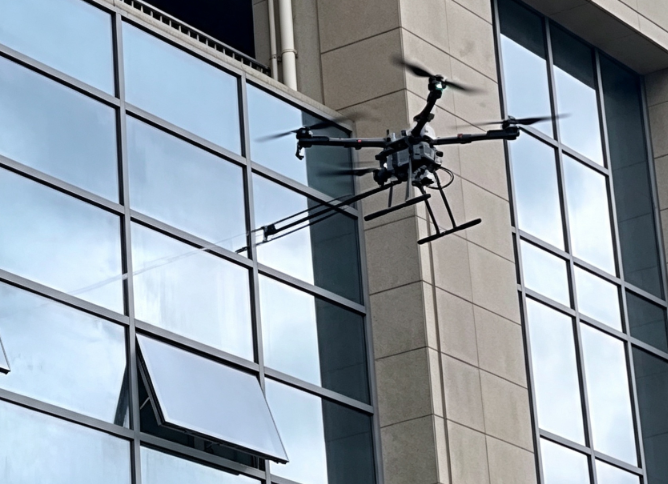
How Do Window Cleaning Drones Work?
Although the design of each system varies, a typical window cleaning drone operation generally involves the following stages.
Step 1: Building and Site Assessment
Before cleaning begins, operators assess the building height, glass type, façade structure, wind conditions, surrounding environment, and other site-specific factors.
This assessment helps determine whether a drone is suitable for the cleaning task.
Step 2: Drone Deployment
The drone and supporting equipment are deployed from a safe operating area. Operators then configure the flight and cleaning parameters according to the requirements of the project.
Step 3: Surface Positioning
The drone flies toward the target area. Cameras, positioning systems, and other sensors can help the operator maintain an appropriate position relative to the building surface.
Step 4: Cleaning
The cleaning system is activated. Depending on the equipment design, cleaning methods may include:
- Water spraying
- Cleaning solution application
- Brush cleaning
- Cleaning pads
- Surface washing
The appropriate cleaning method should be selected according to the surface material and level of contamination.
Step 5: Remote Monitoring
Operators can monitor the drone’s status, position, and cleaning process through the control system.
For large buildings, real-time monitoring can help operators identify and respond to potential problems during the operation.
Step 6: Inspection
After cleaning, cameras or other inspection methods can be used to evaluate the cleaned area and determine whether additional cleaning is required.
Key Benefits of Window Cleaning Drones
In addition to safety and efficiency, window cleaning drones can provide several other benefits for building maintenance.
Reduced Equipment Requirements
Traditional high-rise cleaning may require scaffolding, suspended platforms, lifts, BMUs, or other supporting equipment.
Drone systems can reduce the need for some large-scale equipment, particularly in applications where aerial cleaning is technically suitable.
Flexible Deployment
Drones generally require less ground space than large ground-based equipment. This can provide greater flexibility when operating around commercial buildings in busy urban environments.
Consistent Cleaning Procedures
Drones, together with pre-programmed flight paths, cameras, and remote control technology, could also enable firms to create a standard cleaning process.
Long-Term Cost Savings Potential
While professional window cleaning drones entail costs at the outset, they could lead to optimized long-term operational costs by cutting down on some labor costs, equipment rental fees, and set-up time.
Thus, in determining the cost of the drone cleaning system, firms must look beyond its outright cost of the equipment:
Equipment + Labor + Setup + Maintenance + Cleaning Frequency
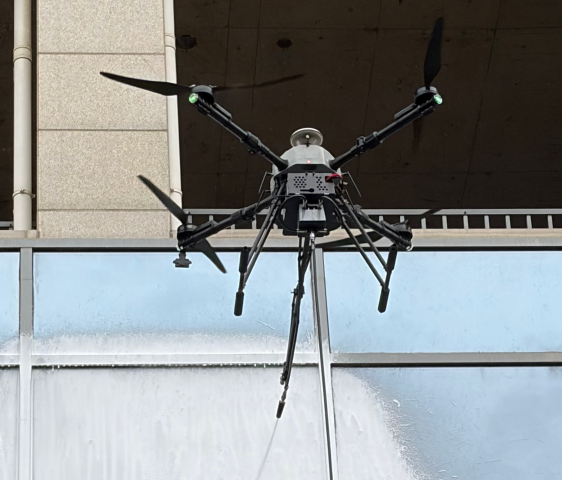
Window Cleaning Drones vs. Traditional Window Cleaning
The comparison between drones and traditional window cleaning should not simply be viewed as a question of which technology will replace the other.
For low-rise buildings and simple window-cleaning tasks, traditional methods may still offer cost and operational advantages.
For high-rise buildings, large glass curtain walls, and complex architectural structures, drones may provide a more flexible alternative.
| Comparison | Traditional Window Cleaning | Window Cleaning Drones |
| Personnel exposure to heights | Relatively high | Can reduce high-altitude personnel exposure |
| Equipment deployment | Can be more complex | Relatively flexible |
| High-rise applications | Requires specialized equipment | Can use an aerial platform |
| Large glass surfaces | Labor-intensive | Suitable for repetitive cleaning tasks |
| Operation | Primarily manual | Remote operation and monitoring |
| Automation potential | Relatively low | Higher |
| Complex areas | Limited by equipment | Greater aerial mobility |
Therefore, a more accurate way to understand this technology is that window cleaning drones are a complementary solution rather than a universal replacement for traditional cleaning methods.
Where Are Window Cleaning Drones Used?
As drone technology continues to develop, its potential applications are expanding.
High-Rise Office Buildings
Large office buildings often have extensive glass façades that require regular cleaning and maintenance.
Hotels
Hotels typically place a strong emphasis on building appearance. For high-rise hotels, cleaning windows and glass curtain walls can be a long-term maintenance requirement.
Shopping Malls
Large shopping centers often feature extensive glass façades and high-level structures. Drones may be used for certain exterior cleaning applications.
Airports
Airports often feature large glass structures, extensive terminal façades, and high-ceiling spaces, making drones for airport glass facades a flexible solution for cleaning and maintaining hard-to-reach exterior surfaces.
Glass Curtain Wall Buildings
Glass curtain wall buildings are one of the most promising application scenarios for drone window cleaning.
Large glass surfaces require substantial repetitive cleaning work, and the mobility of drones can provide a new approach to these tasks.
Are Window Cleaning Drones Safe?
Safety is one of the most important factors to consider when selecting window cleaning drones.
Professional systems should typically consider:
- Flight stability
- Obstacle detection
- Positioning accuracy
- Camera monitoring
- Emergency procedures
- Operator training
- Weather conditions
- Building-specific risk assessment
Factors such as wind speed, weather, building structures, people around and other equipment can impact drone operations when working in proximity to tall buildings.
Thus, window cleaning drones should be operated following proper operational protocol and a safety assessment of the site. There are some situations that do not allow using drones for window cleaning.
What Should You Consider When Selecting a Window Cleaning Drone?
A company interested in buying or utilizing window cleaning drones should not only take into consideration the maximum flight height but also select a drone by the performance needed.
1. Cleaning Capacity
Consider what types of cleaning equipment the drone can carry and whether its cleaning system can meet the requirements of the intended application.
2. Flight Stability
High-rise buildings can create strong and unpredictable airflow. Therefore, flight stability is an important factor when operating near tall buildings.
3. Payload Capacity
If the drone needs to carry cleaning solutions, brushes, pads, hoses, or other equipment, its effective payload capacity should be carefully evaluated.
4. Control and Monitoring
Reliable remote control, cameras, and real-time monitoring systems can help operators maintain better control of the cleaning process.
5. Safety Features
Key safety features may include:
- Obstacle detection
- Positioning systems
- Emergency return
- Flight monitoring
- Fail-safe functions
6. Surface Compatibility
Different building surfaces require different cleaning methods.
Glass, metal curtain walls, and other façade materials may require different cleaning approaches. Therefore, it is important to confirm that the drone and its cleaning system are compatible with the target surface.
VastArrive Window Cleaning Drone
VastArrive provides professional drone solutions for high-altitude operations, building maintenance, and other challenging environments. VastArrive Cleaning Drones are designed to provide a safer, more efficient, and flexible alternative for high-altitude cleaning, including windows, glass curtain walls, building exteriors, photovoltaic panels, and high towers.
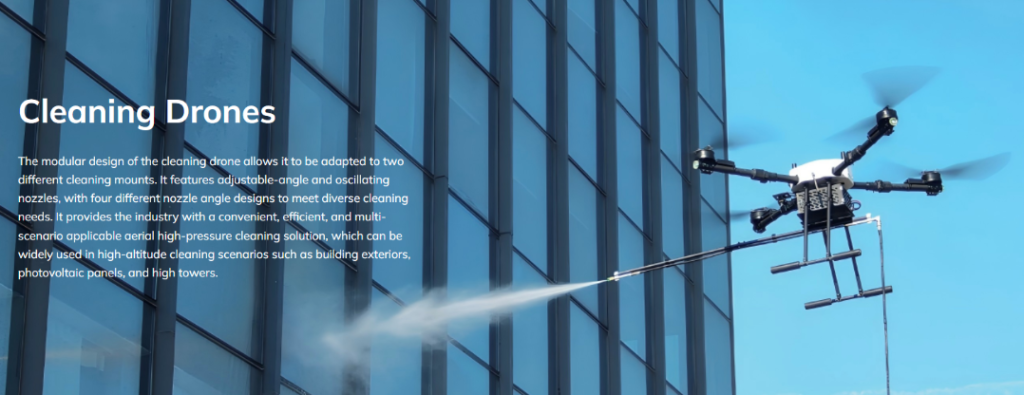
Why Choose VastArrive Cleaning Drones?
- Higher Efficiency: The high-pressure cleaning is capable of supporting higher efficiency, up to 1,000 m²/h in large-scale cleaning.
- Safer Operations: Aerial cleaning in remote areas makes it possible to reduce the repetitive works for high-altitude cleaning by humans.
- Intelligent Navigation: With the intelligent route planning and accurate positioning, the cleaning can be carried out steadily and precisely.
- Flexible Design: Modular cleaning mounts and multiple nozzle angles adapt to different surfaces, structures, and cleaning requirements.
- Multi-Scenario Applications: Suitable for building facades, glass curtain walls, photovoltaic panels, high towers, wind turbines, and other difficult-to-access areas.
If you are looking for a window cleaning drone or a professional cleaning drone for high-altitude applications, VastArrive can provide a suitable solution based on your cleaning requirements and operating environment.
Contact VastArrive today to explore the right drone cleaning solution for your project.