How We Test the VA-D15R Cleaning Drone Before Delivery

At VastArrive, every VA-D15R cleaning drone goes through a standardized delivery test process before it reaches our customers. From indoor inspections to outdoor flight tests and real-world scenario simulations, each step is designed to ensure the drone is stable, safe, and ready for high-altitude cleaning work right out of the box.
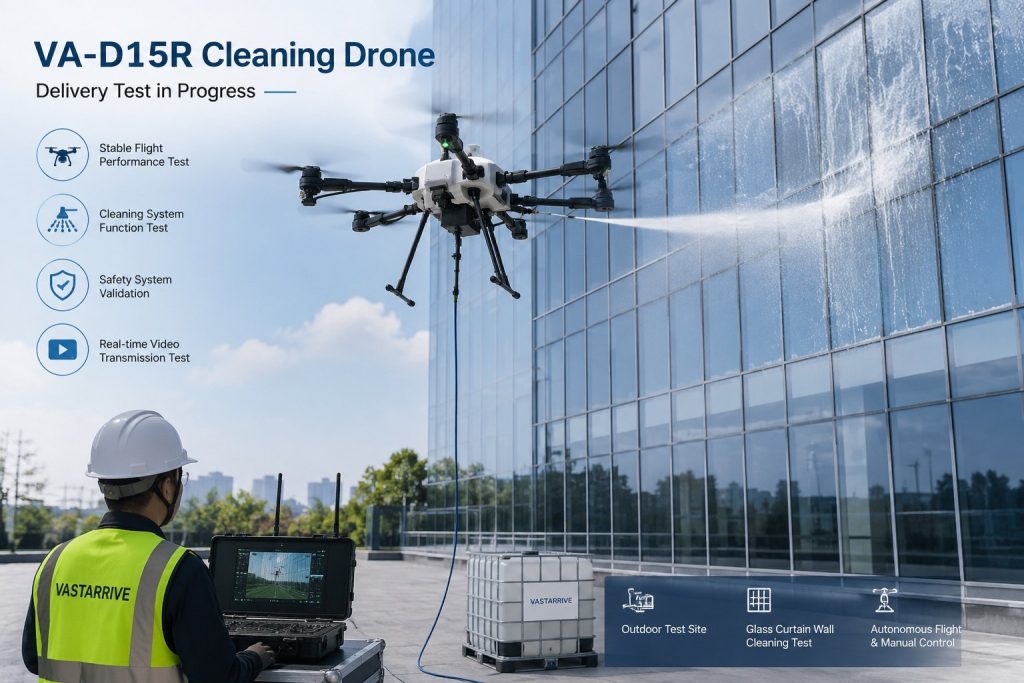
High-altitude cleaning places strict demands on flight stability, safety systems, and cleaning performance. Even a small issue can lead to safety risks or project delays. That’s why we don’t just ship units—we verify each one against real job requirements before delivery.
Table of Contents
Indoor Inspection: Controlling Quality from the Source
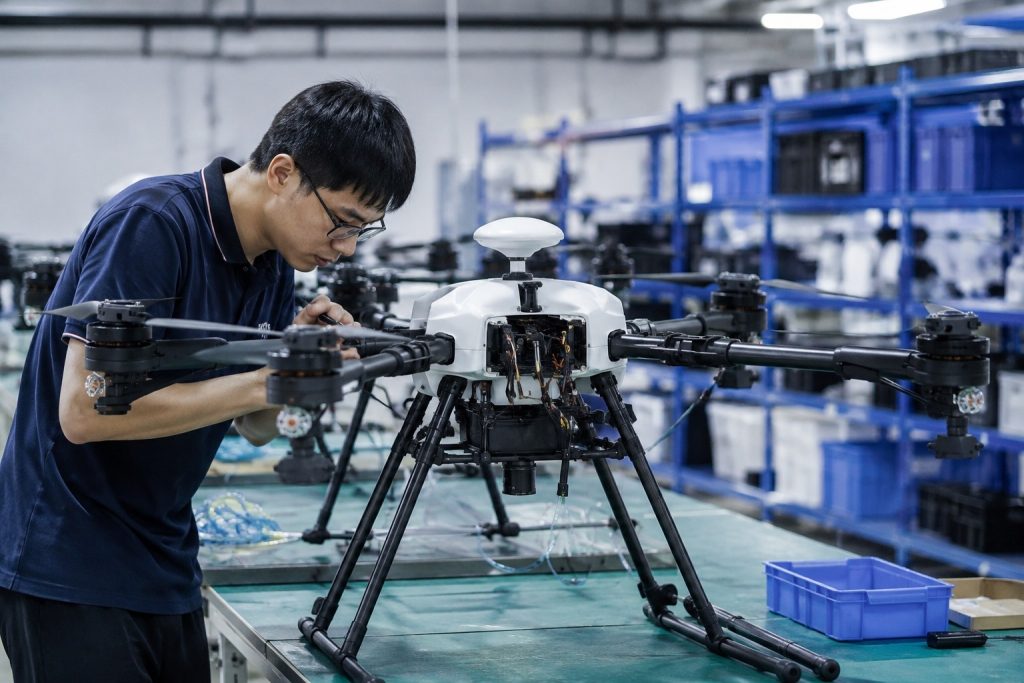
The first stage of our delivery test happens indoors, where we perform a detailed, unit-by-unit inspection to catch any potential issues before the drone ever leaves our facility.
Core Component Verification
We check each VA-D15R against design specifications and production records:
- Serial number and nameplate information
- Core component configuration (flight controller, sensors, motors, etc.)
- Consistency between actual hardware and design requirements
This ensures there are no parameter mismatches or incorrect parts, so every unit customers receive matches the approved design.
Appearance and Assembly Check
Our technicians carefully inspect:
- Fuselage and shell (body panels) for damage, deformation, or contamination
- Connectors, cable routing, and harness fixation
- Nozzle assembly and related accessories
- Overall workmanship against our process standards
Any unit with loose fittings, visible damage, or assembly issues is reworked before it can proceed to outdoor testing.
What this means for customers: Fewer on-site failures caused by assembly or configuration problems, and a higher “ready-to-work” rate from day one.
Outdoor Performance Tests: Stability, Safety, and Cleaning Power
Once a VA-D15R passes indoor inspection, it moves to outdoor testing. Here, we focus on the three things our customers care about most: stable flight, reliable safety systems, and effective cleaning performance.
Flight Performance: Stable and Precise in Real Working Conditions
Flight Stability
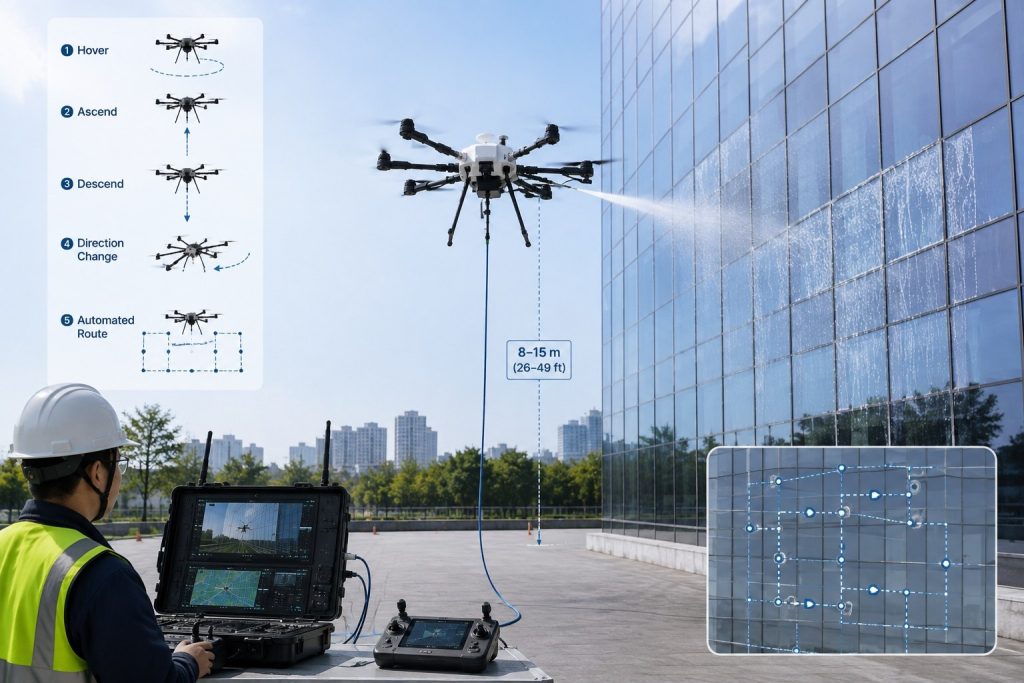
In an open area, we fly the VA-D15R at typical working altitudes and observe:
- Abnormal vibrations or noise
- Stability during hover, ascent, descent, and directional changes
- Behavior under different flight modes used in real cleaning operations
This helps ensure the drone remains steady while cleaning, so water and detergent are applied evenly and the drone does not drift into the structure.
Automated Flight Capability
Using the ground control station, we:
- Pre-plan a typical cleaning mission route
- Let the VA-D15R autonomously complete takeoff, cruise, and cleaning maneuvers
- Verify that it follows the planned path without manual intervention
This confirms that the dual RTK positioning and millimeter-wave radar systems work together as intended, reducing the need for constant manual control in the field.
Remote Controller Response
We test command response for:
- Forward/backward, left/right, and yaw adjustments
- Mode switching, nozzle control, and gimbal adjustments
- Emergency stop function
The drone’s flight path must match operator inputs with no noticeable lag or deviation, so pilots can confidently handle complex cleaning scenarios.
Customer benefit: More predictable flight behavior, smoother cleaning results, and easier operation in demanding high-altitude environments.
Safety Systems: Multiple Layers of Protection
Wall-Proximity (Anti-Collision) Function
We simulate common high-altitude cleaning situations where the drone flies close to building facades:
- Activate the sensor system
- Move the drone toward a vertical surface
- Verify that the wall-proximity function detects the surface and adjusts flight to avoid contact
This is critical for glass curtain walls, towers, and other structures where even minor contact can cause damage.
Return-to-Home (RTH) Scenarios
We test three key RTH modes:
- Auto RTH when the remote controller connection is lost
- One-key RTH during normal operation
- Auto RTH triggered by low battery
In each case, the VA-D15R must return accurately to the takeoff point without drifting or losing control.
Remote Controller Safety Checks
Each controller is tested for:
- Correct mode switching behavior
- Reliable nozzle on/off and flow control
- Smooth gimbal adjustment
- Immediate response to emergency stop commands
Customer benefit: Reduced risk of collisions, loss of control, or extended downtime due to safety system failures—especially important when working at heights with people and expensive structures below.
Core Cleaning Functions: Clean Effectively, Work Longer
Video Transmission and Visualization
At typical working distances and altitudes, we monitor:
- Live video feed clarity and stability (no freezing, no obvious lag)
- Gimbal range and precision for inspecting dirty areas and cleaning results
Clear, stable video helps operators see exactly where they are cleaning and verify coverage in real time.
Battery and Endurance Verification
We:
- Confirm battery parameters match the specification sheet
- Inspect batteries for swelling or other safety concerns
- Set the battery charge level to an appropriate range for storage and transport
- Test charging port compatibility and charging stability
This helps ensure reliable flight times and reduces the risk of battery-related issues in the field.
Nozzle and Cleaning Performance
Using flow rates aligned with real cleaning scenarios, we:
- Run the nozzle system to check for leaks or blockages
- Verify that the drone’s flight is not affected by nozzle operation
- Test the nozzle oscillation mechanism for smooth, jam-free movement
Uniform spray patterns and reliable oscillation mean more consistent cleaning and fewer missed spots.
Customer benefit: Drones that not only fly well, but actually clean well—without leaks, blockages, or unstable spray that would reduce efficiency.
Testing in Conditions That Match Your Jobs
Lab data is useful, but real job sites are where the drone truly proves itself. To make sure the VA-D15R is ready for actual work, we run tests in environments that closely resemble customer use cases.
Glass Curtain Wall Cleaning Test
In a real glass curtain wall setting, we:
- Adjust flight attitude to match the facade
- Select nozzle angles appropriate for the level and type of dirt
- Complete a full high-altitude cleaning pass
This validates:
- Stability in vertical, high-altitude scenarios
- Compatibility of the cleaning system with curtain wall surfaces
- Effectiveness of the wall-proximity safety function in a realistic environment
Complex Environment Navigation Test
We simulate common challenging conditions:
- Obstacles near the work area (pipes, structural elements, etc.)
- Narrow working spaces where maneuverability is limited
The VA-D15R performs unloaded flights through these areas to verify:
- Wall-proximity sensing in tight spaces
- Flexibility and precision of movement
Customer benefit: When the drone arrives on your site, it has already “practiced” in similar conditions, reducing the learning curve and the risk of trial-and-error on expensive or sensitive structures.
What This Means for Your Operations
Our delivery test process is not just about checking boxes—it’s about making sure every VA-D15R can handle real high-altitude cleaning work with minimal risk and maximum efficiency.
Key takeaways for customers:
- Multi-scenario adaptability: Modular design supports different cleaning attachments and nozzle angles for facades, towers, solar panels, and more.
- Precise, automated operation: Dual RTK positioning and millimeter-wave radar, combined with ground-station control, enable automated path planning and reduced manual intervention.
- Higher efficiency, lower cost: Long endurance and high cleaning efficiency help you complete more area per flight, reducing labor costs and exposure to high-risk manual work.
For detailed specifications, payload options, and application scenarios, you can visit our VA-D15R Cleaning Drone product page.
Our Commitment: Consistent Quality on Every Unit
Behind every VA-D15R is a coordinated effort across R&D, production, testing, and delivery. Our test team:
- Records data for each unit
- Checks every function against our standards
- Reworks or replaces any component that does not meet requirements
We continuously refine our test procedures based on customer feedback and new application scenarios, with the goal of providing reliable, high-performance drone solutions for industrial cleaning.
Want to See the Full Test Checklist or Arrange a Demo?
If you’d like to review the complete VA-D15R drone test checklist, discuss how the VA-D15R fits your specific cleaning projects, or arrange a live demo or technical consultation, please contact our sales team for more details.