
Can You Fly a Drone in Brazil? Things to Know Before Flying

Can you fly a drone in Brazil? Yes, but operating a drone in Brazil is not simply a matter of “buying a drone and taking off.” Drone operations must comply with applicable Brazilian requirements for civil aviation, airspace management, and wireless communication equipment, depending on the type of drone, how it is operated, the level of operational risk, and the specific application.
As of 2026, Brazil’s civil drone regulatory framework has undergone important changes. In June 2026, the Brazilian National Civil Aviation Agency (ANAC) approved the new RBAC 100, which establishes general requirements for civil unmanned aircraft operations. ANAC has also issued specific rules for unmanned aircraft with a flight weight of up to 250 grams and for model aircraft. Under the new regulatory framework, drone operations are classified according to risk into three categories: Open Category, Specific Category, and Certified Category.
Therefore, if you plan to operate a drone in Brazil for aerial photography, agriculture, infrastructure inspection, industrial inspection, cleaning, or transportation, you should first determine what type of drone you are using, how it will be operated, and which ANAC, DECEA, and ANATEL requirements apply.
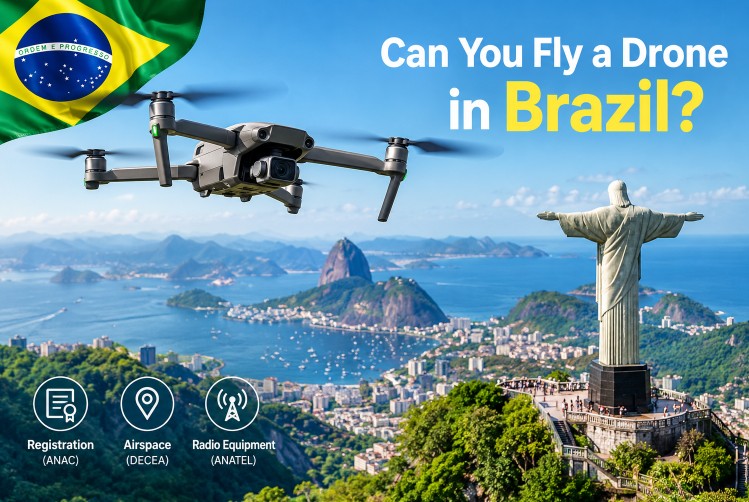
Table of Contents
Are Drones Allowed in Brazil?
Yes, drones are allowed in Brazil.
However, “drones are allowed” does not mean that you can fly a drone anywhere, at any altitude, or in any manner without restrictions.
Brazil currently applies a risk-based regulatory approach to drone operations. Under the RBAC 100 rules issued by ANAC in 2026, lower-risk operations may fall under the Open Category, while operations that do not meet the requirements for the Open Category may fall under the Specific Category. Higher-risk operations may fall under the Certified Category.
According to the Brazilian government’s explanation of the new rules, the Open Category generally covers lower-risk drone operations. These operations typically involve an aircraft with a maximum takeoff weight of no more than 25 kg, operation under VLOS or EVLOS, a maximum altitude of 120 meters, and requirements for maintaining appropriate separation from uninvolved persons.
Therefore, the more accurate answer to the question “Are drones allowed in Brazil?” is:
Yes, drones are allowed in Brazil, but the applicable requirements depend on the aircraft and the operation.
What Are the Drone Laws in Brazil?
When operating a drone in Brazil, three government organizations are particularly important:
- ANAC — Agência Nacional de Aviação Civil, the Brazilian National Civil Aviation Agency
- DECEA — Departamento de Controle do Espaço Aéreo, the Brazilian Department of Airspace Control
- ANATEL — Agência Nacional de Telecomunicações, the Brazilian National Telecommunications Agency
These three organizations have different regulatory responsibilities.
ANAC: Civil Aviation Regulations for Drones
ANAC is primarily responsible for civil aviation regulations related to drone operations.
In June 2026, ANAC approved the new RBAC 100, titled General Requirements for Civil Unmanned Aircraft. RBAC 100 is now included among the regulations listed by ANAC.
The new regulatory framework divides drone operations into three categories:
1. Open Category
Generally intended for lower-risk operations.
2. Specific Category
Applies to operations that do not meet the requirements of the Open Category. Depending on the operation, these may need to comply with an applicable standard scenario or undergo an appropriate operational risk assessment and authorization process.
3. Certified Category
Intended for higher-risk operations, including certain operations involving the transportation of dangerous goods or other operations that ANAC determines cannot have their risks adequately reduced through other means.
This means that commercial drone operators should not determine regulatory requirements based solely on the weight of the drone. They also need to consider how the drone will be operated and the risks associated with the operation.
DECEA: Airspace Requirements for Drone Operations
Even if a drone meets the applicable ANAC requirements, this does not mean it can automatically take off anywhere in Brazil.
DECEA is responsible for managing Brazilian airspace and uses the SARPAS system to process requests related to drone access to controlled airspace. DECEA’s official drone portal provides information on drone regulations, the SARPAS system, and relevant operating guidance.
Therefore, before conducting a drone operation, operators should check the airspace requirements for the specific flight location.
For example, certain areas may involve airports, helicopter operations, military facilities, or other aviation activities. Even if a drone is technically capable of operating below 120 meters, this does not mean that it can automatically operate at that location without additional DECEA requirements.
ANATEL: Wireless Communication Equipment Requirements
Drones commonly contain wireless communication modules, such as communication equipment between the aircraft and its remote controller. As a result, they are also subject to applicable ANATEL requirements.
ANATEL explicitly includes drones, remote controllers, and related equipment within the scope of products subject to applicable conformity assessment and certification requirements. Brazilian official information indicates that relevant telecommunications products cannot be used or sold in Brazil without the required ANATEL approval.
This is particularly important for commercial drone suppliers.
If a drone is intended to be sold or deployed for professional applications in Brazil, operators should consider not only flight performance but also whether the drone’s wireless communication equipment meets the applicable ANATEL requirements.
VastArrive D15R Has Obtained Brazilian ANATEL Certification
For companies planning to conduct high-rise building cleaning, solar panel cleaning, and other industrial drone operations in Brazil, wireless communication compliance is an important consideration alongside flight time, payload capacity, and operational efficiency.
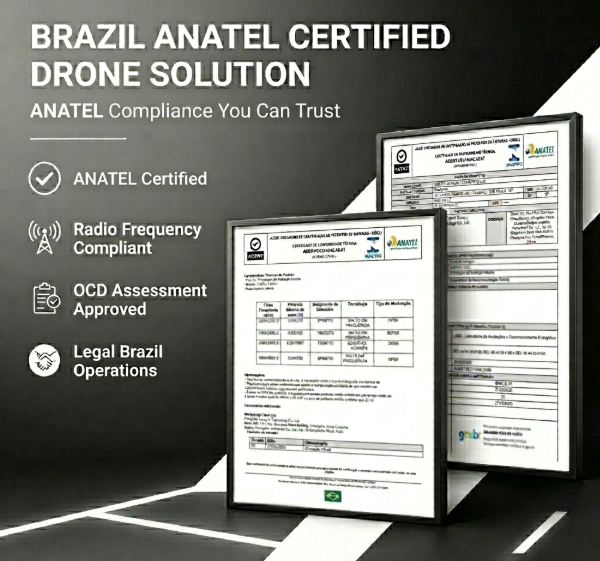
VastArrive D15R cleaning drone has completed the applicable ANATEL conformity assessment process, and its relevant wireless communication equipment complies with applicable Brazilian requirements for radio frequency and communications equipment. This provides important support for the product’s entry into the Brazilian market.
What Does ANATEL Certification Mean?
The ANATEL certification for the VastArrive D15R primarily relates to wireless communications, radio frequency, and spectrum requirements, including assessment by an authorized OCD (Organismo de Certificação Designado).
For companies planning to purchase and deploy industrial drones in Brazil, ANATEL certification can serve as an important reference when evaluating the product’s local market applicability and communications equipment compliance.
Do You Need to Register a Drone in Brazil?
Registration of the drone depends on the class of aircraft and regulations applicable to them.
In the light of the new regulations that came into effect in 2026, it is especially vital to single out the difference between small unmanned aircraft with flight weight not exceeding 250 grams and other aircraft.
ANAC issued Resolution No. 806 in June 2026 that contains special requirements for unmanned aircraft with flight weight not exceeding 250 grams flown VLOS or EVLOS, and for model aircraft.
For model aircraft weighing more than 250 grams, Resolution No. 806 requires ANAC registration. The regulation also allows foreign nationals to register using a passport or another valid travel document.
Therefore, the 250-gram threshold should not be treated as the only factor determining all drone regulatory requirements in Brazil.
In practice, operators should consider:
- The drone’s flight weight
- Whether the operation is conducted under VLOS or EVLOS
- Whether the operation exceeds 120 meters
- Whether the operation falls under the Open Category
- Whether the operation falls under the Specific Category
- Whether additional ANAC procedures are required
- Whether DECEA airspace authorization is required
- Whether ANATEL equipment certification requirements apply
How High Can You Fly a Drone in Brazil?
For Open Category operations, the Brazilian government’s explanation of the new rules indicates that the general maximum altitude is:
120 meters above ground level (AGL)
This means 120 meters above the ground.
Open Category operations generally also require the drone to remain within VLOS or EVLOS and comply with applicable separation-from-persons and other safety requirements.
Therefore, if you search for:
“How high can you fly a drone in Brazil?”
A concise answer is:
For open-category operations, the general maximum altitude is 120 meters above ground level, subject to applicable airspace and operational requirements.
It is important to understand that 120 meters is not a universal authorization to fly without considering other airspace restrictions.
For example, even if your drone is technically capable of flying at 120 meters, the specific operating area may still be subject to DECEA requirements or other airspace restrictions.
How Far Must a Drone Stay From People in Brazil?
The safety of people on the ground is an important part of Brazil’s drone regulatory framework.
RBAC 100 defines the concept of an area away from third parties in relation to maintaining an appropriate horizontal separation between the drone and people on the ground who are not involved in and have not agreed to participate in the operation. Under applicable circumstances, the required separation may be at least:
30 meters horizontally
That means a minimum horizontal distance of 30 meters may apply. In certain circumstances, this separation requirement may not apply where an appropriate and sufficiently robust physical barrier is present.
Therefore, when operating a drone in cities, event venues, industrial parks, or other areas where people may be present, operators should carefully consider:
- The number of people in the operating area
- Whether people are involved in the operation
- The drone’s flight path
- The potential consequences of a drone falling
- Whether physical barriers are available
- Whether the operating area meets the requirements of the applicable category
This is also why industrial drone projects should not be evaluated solely based on maximum flight altitude and flight time.
Can You Fly a Drone for Commercial Use in Brazil?
Yes. There is the potential to use commercially owned drones in Brazil for such purposes as agriculture, energy, construction, mining, infrastructure inspection, industrial cleaning, and transportation of cargo.
Nevertheless, operating a drone commercially does not only mean the purchase of a drone by a company which would then start using it for operations. The specific requirements vary depending on the drone and its operation.
Agricultural Drones for Commercial Use
Applications of agricultural drones include precision farming, farmland surveillance, crop inspection, application of pesticides, fertilizer application, and pest control.
Agricultural drone operations differ from leisure aerial photography as they involve payloads, low-altitude flights, and restricted operating zones. Operators therefore need to determine the applicable regulatory requirements based on the specific operating method and application.
Inspection Drones for Industrial Applications
Industrial inspection is an important application for commercial drones.
Drones can be used to inspect bridges, power lines, oil and gas pipelines, wind turbines, buildings, and other infrastructure.
For these operations, factors such as flight altitude, operating area, and whether the operation requires flight beyond visual line of sight may affect the applicable regulatory requirements.
Cleaning Drones for Buildings and Industrial Facilities
Cleaning operations using drones are becoming more common for building facades, roofs, solar panels, and industrial sites.
As the cleaning drones may have cleaning equipment or liquids on board and can operate close to people, buildings, or infrastructure, then the corresponding safety requirements must be assessed based on real operating conditions.
Cargo and Transport Drones
Large industrial drones can also be used for material transportation, logistics in remote areas, emergency delivery, and industrial cargo transportation.
These operations may involve larger aircraft, additional payloads, and more complex flight environments. Therefore, the rules applicable to ordinary consumer drones should not simply be applied to large cargo or transport operations.
Conclusion
Can you fly a drone in Brazil? Yes. Drones can be used in Brazil, but operators need to comply with applicable aviation, airspace, and wireless communication requirements.
For commercial and industrial drone operations, three organizations are particularly important:
ANAC → Drone operations
DECEA → Airspace
ANATEL → Wireless communication equipment
For high-rise building cleaning and solar panel cleaning projects, the VastArrive D15R has completed the applicable ANATEL conformity assessment process, providing important support for its deployment in the Brazilian market.
If you are looking for an industrial cleaning drone or solar panel cleaning drone for applications in Brazil, contact VastArrive to learn more about the VastArrive D15R.