
How Much Does A Spray Drone Cost?

If you are considering purchasing an agricultural spraying drone, one of the first questions you will probably ask is: how much does a spray drone cost?
In reality, there is no single price that applies to every agricultural spraying drone. Prices vary depending on payload capacity, flight time, battery configuration, spraying system, flight control technology, level of automation, after-sales service, and other factors.
For farms, agricultural service companies, and professional crop protection teams, the drone itself is only one part of the total investment. Batteries, charging equipment, spare parts, maintenance, operator training, transportation, and local drone regulations can all affect the actual cost of ownership.
Therefore, when searching for “how much does a spray drone cost,” it is important to look beyond the initial purchase price. You also need to understand what determines spray drone prices, how to compare different configurations, and how to calculate the long-term operating cost of an agricultural spraying drone.
This guide provides a practical reference for agricultural drone buyers by looking at these factors in detail.
Table of Contents
How Much Does a Spray Drone Cost?
Agricultural spraying drones can be broadly categorized by liquid payload capacity, which provides a useful starting point when estimating a purchasing budget.
| Spray Drone Type | Typical Capacity | Reference Price Range* | Typical Applications |
| Small spraying drone | 10–15 L | US$2,000–4,000 | Small farms, orchards, fragmented fields |
| Entry-level / mid-size spraying drone | 16–20 L | US$3,000–7,000 | Small and medium-sized agricultural operations |
| Commercial spraying drone | 20–30 L | US$4,000–10,000+ | Commercial farms, professional crop protection services |
| Large spraying drone | 40–50 L | US$6,000–15,000+ | Large-scale agricultural operations |
| High-end / heavy-payload professional system | 50 L+ | US$10,000–25,000+ | Large farms, professional agricultural service providers |
These are broad reference price ranges based on publicly available market information and are particularly useful for preliminary budgeting of factory-level or basic configurations. They are not fixed prices from any specific supplier. Actual prices can vary depending on batteries, chargers, navigation systems, radar, spraying systems, spare parts, customization, certifications, shipping, taxes, and other factors.
As per the recent publicly available market information, there is a similar pricing structure for agricultural spraying drones in the 10–15 L, 20–30 L, and 40–50 L categories.
In case you purchase a foreign brand drone or a Ready-to-Fly commercial system, the pricing may go well beyond the quoted factory-level price ranges above. For instance, some publicly available prices for retail products in the 30 L category are around $6,501, while some publicly available prices for the 40–50 L agricultural drone category are around $19,000–30,000.
Therefore, if you simply need a preliminary purchasing budget, you can use approximately:
US$3,000–25,000+
as a broad reference range for general agricultural spraying drones. Large-capacity, branded, or fully equipped professional systems may require a budget of US$30,000 or more.
Why Do Spray Drone Prices Vary So Much?
Many buyers find that agricultural spraying drones can have dramatically different prices. Some models cost only a few thousand dollars, while others can cost US$20,000 or more.
This does not necessarily mean that one product is simply more expensive than another. Different drones may have significant differences in payload capacity, battery systems, spraying systems, navigation, automation, and other configurations.
When comparing spray drone prices, it is therefore more useful to compare the complete specifications and configuration rather than looking only at the basic drone price.
1. Payload Capacity
Payload weight is another key consideration that influences the price of a drone for spraying.
There are drones for agriculture spraying in payloads like 10 L, 16 L, 20 L, 30 L, 40 L, and 50 L. When the liquid payload capacity goes up, the drone needs a bigger airframe, better propelling, and high-capacity batteries. This may cause an increase in price.
As a general reference:
- 10–15 L: Suitable for small fields, orchards, and fragmented farmland
- Around 20 L: Suitable for medium-scale agricultural operations
- 30 L and above: More suitable for commercial farming and professional crop protection services
- 40–50 L: Suitable for applications requiring higher per-flight productivity
However, a larger payload does not automatically mean that a drone is more suitable for your farm. The choice should also consider field size, terrain, crop conditions, and the efficiency of liquid refilling.
2. Batteries and Charging Systems
When comparing spray drone prices, many buyers focus on the aircraft itself and overlook the cost of batteries and charging equipment.
Different quotations may include very different battery configurations. One supplier may provide only a single battery, while another package may include multiple batteries and a fast charger. This can have a significant impact on the final purchasing cost.
When requesting a quotation, make sure to ask:
- How many batteries are included?
- How long can each battery support actual operation?
- Is the charger included?
- Is an additional generator or power supply required?
3. Spraying System
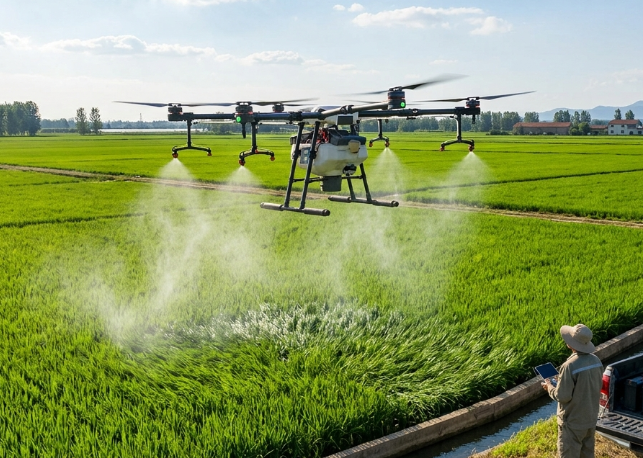
The spraying system is another important factor affecting the overall price.
Tank capacity alone is not the full extent of the system. The spray pump, nozzles, flow control and spraying width may all play roles in affecting performance.
Different crops may need different types of spraying systems too. Hence, when choosing the right agricultural drone for spraying, you have to consider not just tank capacity, but also flow rates, number of nozzles, spraying width and flow control system.
The drone that has a large tank capacity may not give you high productivity if it does not match up with the requirements of your crop.
4. RTK, Radar, and Automation Features
Navigation and automation systems can also create significant differences in spray drone prices.
Basic agricultural drones may primarily rely on GPS navigation, while professional models may include RTK positioning, terrain following, obstacle detection, and automated flight planning.
For example:
- RTK positioning: Improves positioning accuracy during flight
- Terrain following: Helps the drone maintain an appropriate flight height over changing terrain
- Obstacle detection: Helps improve flight safety in complex operating environments
- Automated route planning: Reduces repetitive manual flight operations
These technologies can increase the equipment cost. However, whether they are worth the additional investment depends on the actual operating environment and business requirements.
5. What Else Should You Compare When Evaluating Spray Drone Prices?
When purchasing an agricultural spraying drone, it is not enough to ask only:
“How much does a spray drone cost?”
What would make more sense is to evaluate the drone, the liquid storage tank, the batteries, the charging system, the spraying system, the navigation system, and the automation capabilities in their totality.
The critical consideration here is the alignment of the equipment setup and performance capabilities with your needs rather than which drone costs less.
What Is the Difference Between 10L, 20L, 30L, and 50L Spray Drones?
Payload capacity differences will have an impact on payload capacity, operational efficiency, refill frequency, ease of transport, and buying cost.
When making a decision for agricultural purposes, one cannot just ask how much liquid the drone can hold. There are other factors that must be considered, such as field size, crop type, operational frequency, terrain, and budget.
| Comparison Factor | 10–15 L | 20 L | 30 L | 40–50 L |
| Main applications | Small farms, orchards, complex terrain | Medium-scale agricultural operations | Commercial farms, professional crop protection | Large-scale, high-intensity agricultural operations |
| Typical users | Small farms, individual growers | Small and medium-sized agricultural users | Agricultural service providers, commercial farms | Large farms, professional crop protection companies |
| Per-flight payload | Low | Medium | High | Very high |
| Operating flexibility | Very high | High | Medium | Lower |
| Continuous operating capability | Limited | Moderate | High | Very high |
| Refilling frequency | Higher | Moderate | Lower | Lowest |
| Transportation convenience | High | High | Moderate | More demanding |
| Initial purchasing cost | Relatively low | Moderate | Higher | Higher |
| Reference market price | Generally lower, depending on configuration | Moderate, with significant configuration differences | Approximately US$5,000–10,000+ | Basic systems approximately US$6,000–15,000+; some complete branded systems can exceed US$20,000 |
| Suitable applications | Small fields, orchards, highly mobile operations | Routine agricultural spraying | Large-scale commercial operations | High-intensity, long-duration operations |
| Main advantages | Flexible, easy to transport, lower initial investment | Good balance between payload and flexibility | Good balance between productivity and payload | Large payload and fewer refilling cycles |
| Key consideration | Limited area per flight | Capacity should match actual field size | Battery and charging configuration can affect total cost | Higher equipment, transportation, battery, and maintenance requirements |
What Other Costs Should You Consider Besides the Spray Drone Price?
When purchasing an agricultural spraying drone, the equipment price is only one part of the total investment.
For commercial agricultural operations and international purchases in particular, you should also consider batteries, charging equipment, maintenance, transportation, training, and after-sales service.
Calculating the total cost of ownership (TCO) provides a more accurate basis for comparing different products.
Battery Costs
It is common for the agricultural spraying drones to have more than one battery in order to maintain uninterrupted operation.
In the case of big payload drones especially those having capacities like 30 L, 40 L, and 50 L, batteries account for quite a big share of the total cost of the drone equipment.
The amount of extra batteries to purchase would be based on how many hours per day the drone works.
Charging Equipment
Large agricultural drones generally require high-power charging equipment.
Commercial enterprises would need more generators or portable power sources for their field operations.
In this light, while considering the cost of spray drones, check whether the quoted price covers the charger and if you would need any other power-generating equipment.
Spare Parts and Maintenance
Agricultural spraying drones operate in demanding outdoor environments. Components such as motors, propellers, spray nozzles, pumps, and liquid lines may experience wear during long-term operation.
Typical maintenance and spare-part costs may include:
- Propellers, motors, and other flight components
- Spray nozzles and pumps
- Liquid pipes and related spraying components
- Batteries and electrical components
Keeping commonly used spare parts available can help reduce downtime caused by maintenance.
Transportation, Import Costs, and Taxes
However, when buying agricultural spraying drones internationally, there is also the issue of international shipping and associated costs.
Lithium battery-powered equipment could also have different transport needs compared to other cargoes.
As a result, your budget should include all these international shipping costs, import costs, and taxes that could increase the landed cost significantly beyond the equipment cost quoted by the supplier.
Training and After-Sales Service
Agricultural spraying drones require both flying and professional application operations. As such, operator training, commissioning of the equipment, technical support, and after-sales services could become an important part of the long-term cost.
For overseas purchases, ask the supplier whether they offer operator training, technical support, spare-parts supply, and after-sales services.
While it is not always included in the drone’s price tag, these services can make a huge difference to the long-term efficiency of operations and maintenance.
What Should You Calculate When Purchasing a Spray Drone?
A more realistic purchasing budget can be calculated as:
Drone equipment price + batteries and charging system + spare parts and maintenance + transportation and import costs + training and after-sales service = more realistic total purchasing cost
This approach provides a more meaningful way to compare different spray drone prices than simply comparing the quoted aircraft price.
How Can You Determine Whether a Spray Drone Is Worth Buying?
Determining whether an agricultural spraying drone is worth the investment should not be based solely on its initial purchase price.
For farms and agricultural service providers, it is more useful to evaluate cost per unit area, operating efficiency, and potential payback period.
Evaluate Cost per Hectare
For farmers and professional crop protection service providers, operating cost per unit area can be used to evaluate the long-term economics of a spraying drone.
Cost per hectare = Total operating cost ÷ Actual area treated
Total operating costs may include electricity or fuel, labor, equipment maintenance, battery depreciation, spare parts, and transportation.
If a drone can increase the amount of land treated per day while reducing labor requirements and reliance on traditional equipment, it may provide better long-term economics even if its initial purchase price is higher.
Evaluate the Payback Period
Agricultural service companies can also estimate the potential payback period:
Payback period = Initial investment ÷ Annual net profit
Annual net profit can be estimated based on factors such as:
- Actual annual operating area
- Local crop protection service rates
- Labor and transportation costs
- Equipment maintenance and battery replacement costs
- Actual drone utilization rate
In this way, in determining if the price for an aerial spraying robot is affordable, the important thing is not merely selecting the cheapest product. What matters most is making sure that the configuration of the equipment, its work load, cost of operations, and expected ROI are well-matched.
The correct approach in purchasing is very straightforward:
Select the agricultural spraying robot based on the actual work area and business needs and not only the lowest price or payload capacity.
Thus, in determining the reasonableness of a spray drone cost, the main thing is not just to seek out the lowest-priced drone. Rather, one needs to consider if there is a proper match between the configuration of the equipment, amount of work, operating expenses, and ROI.
The correct principle of procurement is straightforward:
Select an agricultural spraying drone in line with your actual operational area and business needs, rather than seeking only low cost or maximum payload.
VastArrive Agricultural Drone Solutions
VastArrive focuses on professional industrial drone solutions for agriculture, cleaning, transportation, and other specialized applications.
For farms, agricultural service firms, and professional farmers who are considering buying an agricultural spraying drone, the selection criteria must go beyond just the initial cost of the product.
Some of the factors that must be considered during the purchasing of the correct drone include the actual spraying area, the payload capacity, the flight time, the spraying system, the battery setup, among other factors that will affect the cost of operation.
VastArrive provides industrial drones for various applications and assists in evaluating equipment configurations in accordance with the operational requirements and cost.
If you are trying to compare spray drone prices or want to know about the agricultural spraying drone supplier, get in touch with VastArrive for more information.