
Agricultural Drone vs Tractor Spraying: Which is Better for Your Farm?

In today’s rapidly evolving era of precision agriculture, farm owners and plant protection service providers face a crucial decision: should they invest in agricultural drones for crop protection, or continue relying on traditional tractor sprayers?
The differences between the two extend far beyond the equipment itself, they directly impact pesticide usage, soil health, labor costs, and ultimately, crop yield and profitability. This article provides an in-depth analysis of the pros and cons of both spraying methods across multiple dimensions, helping you select the best solution for your business.
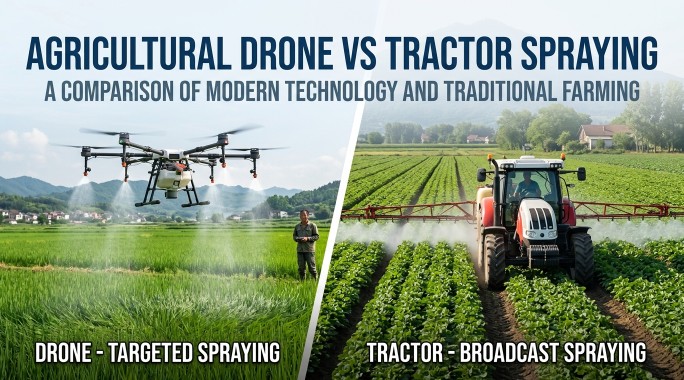
Table of Contents
How Does Tractor Spraying Work?
Tractor spraying systems achieve large-area, uniform coverage through mechanical transmission and hydraulic pressurization. During operation, the tractor’s Power Take-Off (PTO) or engine powers a hydraulic pump, pressurizing liquid chemicals from a high-capacity tank and delivering them through supply pipelines to the unfolded wide spray boom.
As the pressurized liquid flows through mechanically spaced nozzles along the boom, it is atomized into countless fine droplets. Moving at a constant speed along the field, the tractor uses pressure and gravity to continuously and evenly apply the liquid from top to bottom onto the crop canopy and foliage.
How Does Agricultural Drone Spraying Work?
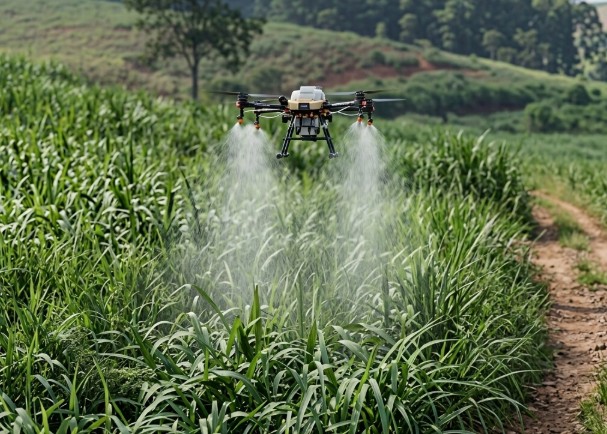
Agricultural drone spraying systems perform aerial application based on precision route navigation and windfield-assisted atomization. Before operation, the system utilizes satellite positioning (such as RTK) to plan flight altitude, speed, and mission routes. During flight, an electric pump onboard the drone feeds the liquid into nozzles (centrifugal or pressure nozzles) for fine atomization.
Unlike ground equipment, multi-rotor drones rely on their high-speed downward rotating propellers to generate a powerful downwash airflow. This downward force not only propels atomized droplets precisely toward crops, but also flips leaves over, allowing liquid to adhere to the undersides and mid-to-lower sections of foliage—achieving a 3D coverage effect that traditional ground spraying struggles to accomplish.
Agricultural Drone vs. Tractor Spraying: 6 Key Differences
When selecting agricultural spraying equipment, there is no absolute “better or worse”; the differences lie in operational scenarios, cost structures, and technical characteristics. Below are 6 key differences comparing agricultural drones and tractor sprayers:
1. Spraying Efficiency
Efficiency is not synonymous with speed; actual efficiency depends on field size and operational continuity.
Tractors, equipped with large-capacity tanks and ultra-wide spray booms, offer high and stable continuous operation capabilities in large, flat, and contiguous fields. Drones, while flexible and quick to set up, have smaller payload capacities that require frequent liquid refills and battery swaps.
Research Fact: A 2024 field study on Costa Rican rice paddies showed that under equal conditions for crop yield and quality, the spraying quality metrics of ground tractors were superior to those of drones under specific flat, large-field conditions. Therefore, across hundreds of hectares of contiguous flat fields, tractors retain a comprehensive efficiency advantage, whereas drones excel in small, fragmented fields due to their strong maneuverability.
2. Crop Damage and Soil Compaction
This is the drone’s most prominent physical advantage over traditional ground equipment.
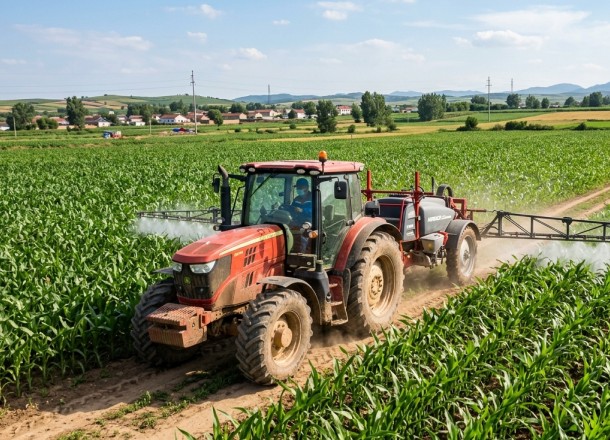
Ground operations with tractors inevitably involve mechanical contact, leading to crop trampling and soil compaction. Particularly during late-stage crop growth (tall/dense canopy) or when the soil is wet after rain, the risk of yield reduction from wheel damage increases significantly.
Drones operate via aerial air-to-ground spraying, completely eliminating ground contact for zero soil compaction and zero crop trampling. However, while offering zero-damage benefits, a drone’s final control effectiveness still depends on factors such as wind speed, flight altitude, downwash airflow, and droplet atomization size.
3. Terrain and Field Accessibility
Terrain conditions dictate the “entry barrier” for equipment.
The functioning of a tractor is largely dependent on roadways in the field, flatness of the land surface, bearing capacity of the soil, and turning radius within the field. In the case of steeper slopes, wet soils, limited space, and fragmented fields, tractors have trouble entering the fields.
Drones eliminate terrain restrictions entirely, operating effortlessly regardless of ground conditions. They handle hilly terrains, post-rain wetlands, and scattered small plots with ease, achieving true “fly-anytime, spray-anytime” accessibility.
4. Operating Cost
Rather than merely comparing purchase prices, it is essential to calculate the Total Cost of Ownership (TCO).
The two options feature distinct cost structures, calculated via the following formula:
Total Operating Cost = Equipment + Labor + Energy + Maintenance + Logistics + Crop Loss
| Cost Component | Tractor Spraying | Agricultural Drone |
| Primary Energy / Consumables | Diesel consumption | Electricity consumption + Battery cycle degradation |
| Depreciation / Maintenance | Depreciation & mechanical maintenance of tractor and spray boom | Drone depreciation, battery capacity decay, high-precision electronics maintenance |
| Implicit Losses | Yield losses due to ground wheel trampling (Crop Damage) | Zero ground contact, zero trampling loss |
Farms should perform comprehensive calculations based on annual operational area (Hectares/year), local labor costs, fuel vs. electricity price differentials, and trampling-induced yield reduction rates.
5. Labor Requirements
Drones do not eliminate labor; rather, they transform the nature of field work.
Traditional tractor operations require operators skilled in heavy machinery driving and field route maneuvering. Drone operations shift human labor toward flight path planning, remote monitoring, and rapid management of battery and chemical refills.
With the adoption of autonomous flight, RTK high-precision navigation, and smart route planning, drone operations are evolving from traditional mechanical driving toward data-driven digital operations.
6. Spraying Capacity & Application Volume
Payload capacity and application volume logic dictate the suitability of each machine for specific scenarios.
Tractors feature high chemical payload capacity (large tanks) and high-volume application capabilities with longer refill intervals, making them ideal for treatments requiring thorough high-volume drenching.
Drones excel in low-volume (LV) and ultra-low-volume (ULV) applications using highly concentrated, finely atomized sprays. When evaluating drone spraying capacity, one must look beyond tank size and factor in spray width, flight speed, battery endurance, and logistical turnaround time for chemical refilling and battery swaps.
Agricultural Drone vs. Tractor Spraying by Application Scene
Operational conditions vary significantly across different crops and geographical environments. Matching equipment to scenarios based on crop canopy, terrain characteristics, and soil conditions is key:
1. Open-Field Crop Spraying
For large, flat, and contiguous field crops like corn, wheat, and soybeans, tractor sprayers remain the most efficient and mature primary solution. Their large-capacity tanks and ultra-wide booms ensure high-volume continuous operation.
Drone Entry Point: When crops enter the canopy closure phase or late-stage tall growth (where ground machinery causes severe trampling damage), or when prolonged rainy weather leaves soil too muddy for tractors to enter, drones serve as an excellent supplementary and emergency spraying alternative.
2. Orchard Spraying
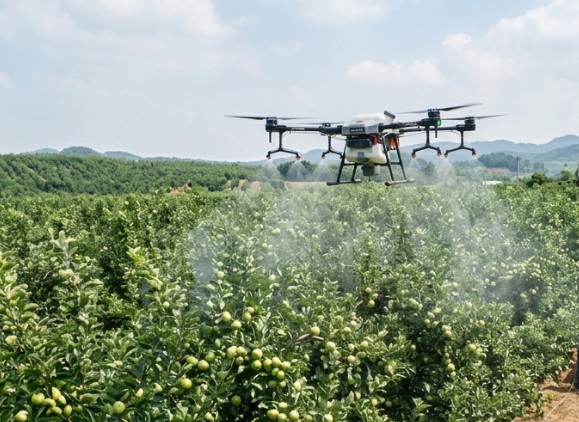
Orchards often present challenges such as tall tree canopies, narrow row spacing, undulating terrain, and difficult ground access. Drones utilize an aerial air-to-ground operation, eliminating ground mobility barriers in complex orchard environments.
Penetration & Deposition Note: Three-dimensional orchard canopies demand exceptional spray deposition. Based on recent research on woody plants such as coffee, it is now believed that drones do not provide coverage equal to that provided by ground equipment at all depths of canopy. In case of applying drones in orchards, the operator will have to make adjustments in nozzle type, drone height, speed, micro-droplets size, and downwash flow.
3. Rice Field Spraying
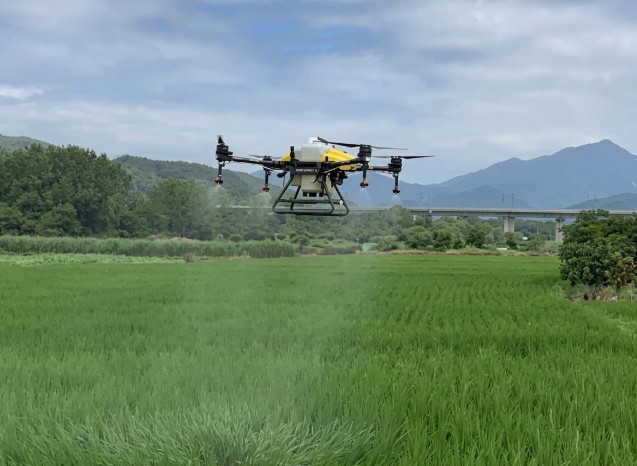
Rice paddies represent one of the most typical and widely adopted applications for agricultural drones. Traditional ground machinery easily gets stuck in muddy soil with low load-bearing capacity and causes trampling damage to dense crops. Drone operations remain entirely unaffected by wet ground conditions.
Scientific Selection Tip: While drones significantly lower entry barriers for paddy field operations, actual pest control effectiveness requires field validation. A 2024 study in Costa Rican rice paddies demonstrated that under specific parameters, tractor booms maintained advantages in atomization deposition quality. Therefore, crop-specific testing and parameter calibration are essential before large-scale drone deployment in paddy fields.
4. Hilly and Mountainous Farmland
On steep slopes, terraced fields, and mountainous plots, sharp inclines, narrow paths, and fragmented fields severely restrict the maneuverability of heavy ground machinery.
Drones serve as a breakthrough solution for hilly and mountainous terrain. In addition, since they do not require any field roads and are completely unrestricted by slopes and contour lines, drones employ RTK high precision terrain following techniques in order to maintain a constant distance from the rugged terrain for accurate application of chemicals.
Core Pros & Cons of Agricultural Drone vs Tractor
Agricultural Drone Spraying System
Pros:
Zero Soil Compaction, Protecting Roots and Soil Structure:
Repeated field passes by heavy equipment cause severe soil compaction, destroying soil porosity and hindering crop root respiration and nutrient uptake. Drones operate entirely in the air, eliminating physical yield losses caused by ground machinery trampling.
High Geographical Adaptability, Overcoming Terrain & Seasonal Limits:
In hilly areas, terraced fields, late-stage tall crop canopies, or extremely muddy fields post-rain where ground equipment stalls, tractors cannot operate. Drones can launch immediately, capitalizing on narrow pest control windows for emergency applications.
Precision Spot-Spraying & Chemical Reduction:
Paired with NDVI vegetation index maps generated by multispectral drones, spraying drones execute Variable Rate Application (VRA). Targeting pest hotspots with precision spot-spraying rather than uniform blanket spraying reduces pesticide usage by 20%–30%, significantly lowering input costs.
Cons:
Payload Capacity and Battery Endurance Bottlenecks:
The chemical carrying capacity is generally in the range of 30 L to 70 L for a single drone due to limited energy densities of batteries available currently. Larger missions involve changing batteries and chemical loading at regular intervals.
Extreme Sensitivity to Wind and Weather:
The efficacy of drone spray is highly dependent on the speed of the wind. If the wind speed exceeds force 4–5 according to the Beaufort Scale, the atomized spray droplets will easily drift, hence decreasing efficiency and posing risks of contaminating the neighboring crops.
Tractor Spraying Machine
Pros:
Massive Payload Capacity & Outstanding Operational Continuity:
High self-powered or towed sprayers have tank sizes with load capacities between 2,000 liters and more than 5,000 liters. In large farms with large land surfaces that are relatively flat, one filling is enough for consistent spraying without breaks for long periods of time.
Mature Technology with Low Operating & Maintenance Barriers:
Traditional machinery operators require no aviation regulation training or complex control software instruction. Furthermore, mechanical structures are intuitive and mature, with spare parts readily available in local markets, ensuring low routine maintenance and troubleshooting costs.
Cons:
Wheel Trampling Causes Physical Yield Loss:
During wheat heading, post-canopy-closure corn, or late-stage dense tall crops, direct tractor tire crushing and wide boom scraping often cause direct physical yield losses of 3%–5%.
High Equipment Acquisition and Diesel Fuel Costs:
Heavy tractors and wide-boom spraying setups carry high upfront purchase costs and heavy depreciation over time. Furthermore, continuous diesel consumption during long, large-scale operations represents a persistent, significant operating expense.
Agricultural Drone vs Tractor Spraying: How Should Your Farm Choose?
Evaluate your choices by balancing terrain conditions, crop types, existing assets, and operating costs:
Prioritize Agricultural Drones if:
You operate in hilly terrains, terraced fields, or fragmented plots where drones cross land barriers effortlessly; you work in muddy post-rain fields or rice paddies prone to vehicle bogging; you grow tall crops like corn and cotton or orchards where aerial spraying eliminates trampling damage; or you leverage multispectral mapping for precision spot-spraying to lower chemical input costs.
Prioritize Tractor Sprayers if:
You manage large, flat, contiguous plains growing low-lying crops like soybeans or early-stage wheat. The tractor’s large payload tank and ultra-wide boom deliver high continuous operational efficiency. If your farm already owns utility tractors, attaching a boom sprayer maximizes existing asset utilization.
Adopt a Collaborative Human-Machine Model:
Large farms do not need to make an exclusive choice. A combined “Tractor Base + Drone Supplementary” strategy offers an optimal hybrid solution: use tractors early in the season for high-volume foundational preventative treatments across the entire field, then switch to drones for precision spot-spraying in late-stage growth or localized disease outbreaks. This combination safeguards overall efficiency while avoiding late-stage trampling losses.
Final Words
The choice between Agricultural Drones and Tractor Sprayers is not a simple matter of replacement.
Tractors remain ideal for large, flat, and easily accessible fields, whereas agricultural drones excel in wetlands, sloped terrains, fragmented plots, and scenarios where minimizing ground trampling is critical.
Your final decision should evaluate Crop, Field Size, Terrain, Application, Labor, and Operating Cost to select the spraying solution best tailored to your operational needs.
If you are looking for suitable drones, VastArrive specializes in industrial-grade drone solutions and can further assess drone configurations matched to your specific application scenarios. Contact VastArrive today to learn more about agricultural spraying solutions tailored to your needs!