
What Sensors Does a Professional Cleaning Drone Need

A professional cleaning drone is influenced by sensors in terms of positioning, distance control, obstacle sensing, and stability. This is particularly true for cleaning facades of tall buildings where the drone flies near buildings carrying cleaning devices as well as controlling the water hose.
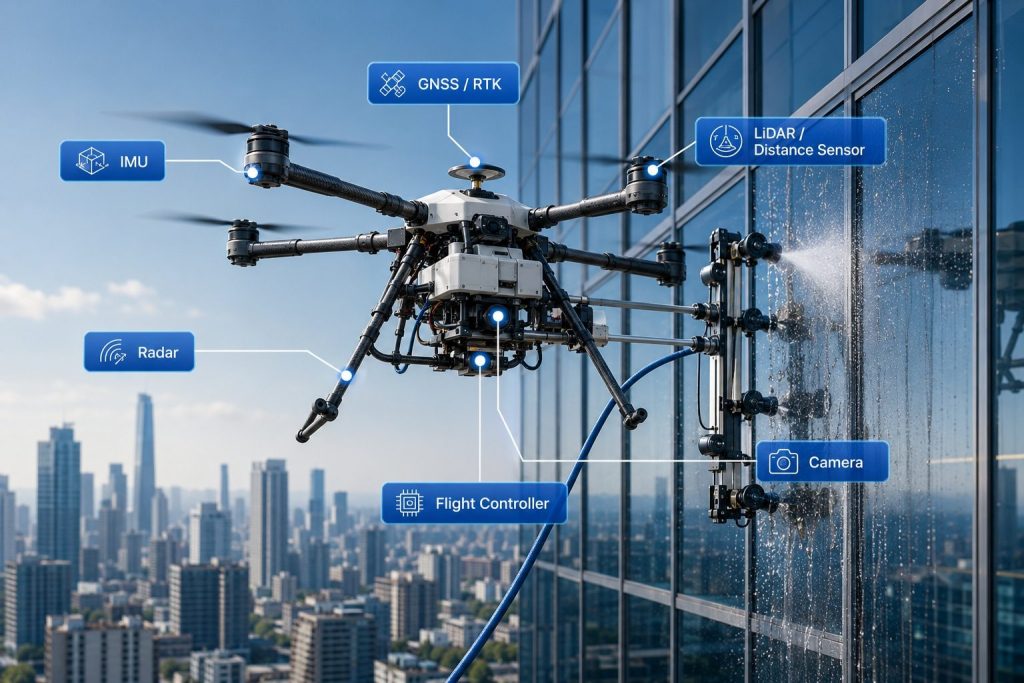
More sensors do not necessarily mean better performance. What matters is whether the sensing system supports the actual cleaning task.
Table of Contents
Why Sensors Matter in Professional Cleaning Operations
A conventional camera drone can often operate several meters away from a building. A cleaning drone works differently.
During facade cleaning, the drone may need to maintain a relatively consistent working distance from the surface while dealing with:
- Building protrusions and balconies
- Cables and external structures
- Different facade materials
- Changing outdoor lighting
- Wind disturbances
- Water spray and hose drag
This means the drone needs to continuously understand where it is, how it is moving, and what is around it.
The purpose of the sensor system is therefore not simply to “measure distance.” It is to provide useful environmental and flight information that can be processed by the flight-control system.
Distance Sensing: Can the Drone Maintain a Consistent Working Distance?
In facade cleaning, the distance from the surface has a direct correlation with its efficiency.
The farther away the drone flies, the lower the effectiveness of cleaning becomes. If it gets too close, the operation may become more difficult and the drone may have less room to react to changes in the facade.
What Buyers Should Evaluate
A professional cleaning drone should be evaluated for its ability to:
- Detect the building surface consistently
- Maintain an appropriate stand-off distance
- Respond to changes in surface geometry
- Operate around different facade structures
LiDAR, radar, laser ranging, ultrasonic sensing, or other technologies may be used depending on the system design. The key issue is not simply which sensor is installed, but whether it can provide reliable distance information under the intended cleaning conditions.
Obstacle Detection: Can It Handle Complex Building Structures?
High-rise facades are rarely completely flat.
Protrusions like balconies, windows, ledges, signboards, piping, cable wires, and more might prove to be obstacles in the drone’s path.
The obstacle detection system helps the drone sense objects in its surroundings and provides data for flight control or human input.
Look Beyond the Sensor Name
For buyers, specifications such as “obstacle avoidance” should not be evaluated in isolation.
Consider:
- Detection range
- Detection direction
- Response time
- Performance around complex structures
- Integration with the flight-control system
A sensor that performs well in an open environment may not provide the same value when the drone is operating close to a complicated facade.
IMU: Supporting Stable Flight Under Cleaning Loads
An Inertial Measurement Unit (IMU) provides information about the drone’s movement and orientation.
This becomes particularly important for cleaning drones because flight stability is influenced by more than the drone itself. The system may also need to manage:
- Cleaning equipment
- Water flow
- Hose weight
- Hose movement
- External wind forces
The IMU works with the flight controller to monitor changes in attitude and movement so that the drone can make continuous flight adjustments.
For this reason, buyers should evaluate the overall flight-control system, rather than treating the IMU as an isolated specification.
GNSS and RTK: Positioning Is Not the Same as Wall-Following
The GNSS technology allows for outdoor positioning, whereas RTK technology increases the accuracy of the position in case there is a suitable correction service.
These can prove useful in large-scale cleaning operations, particularly when there is a need for a repeatable flight path.
A crucial point must be distinguished between:
Accurate positioning does not automatically mean accurate facade following.
GNSS or RTK tells the drone where it is geographically. Distance sensing helps determine its relationship with the building surface.
For professional cleaning, these systems may need to work together with other sensing technologies and flight-control functions.
Vision Systems: Giving Operators More Environmental Information
Cameras and vision systems can provide useful information that numerical sensor data alone may not fully describe.
Depending on the system, visual information can support:
- Surface observation
- Operator monitoring
- Obstacle recognition
- Cleaning area confirmation
- Flight assistance
This is especially useful when the drone is operating at heights where the operator cannot directly observe the cleaning area in detail from the ground.
The value of a camera system therefore depends not only on camera resolution, but also on how effectively visual information is integrated into the overall operation.
Sensors Should Work as a System
One of the most important points when evaluating a professional cleaning drone is that sensors should not be considered independently.
A typical sensing and control process can be understood as:
Sensors → Environmental Data → Flight Control → Drone Response
For example, a distance sensor may detect a change in the distance between the drone and the facade. The flight-control system then processes that information and adjusts the drone’s position.
Similarly, positioning data, IMU information, obstacle detection, and visual information can complement one another.
More Sensors Do Not Automatically Mean Better Performance
Adding sensors does not necessarily make a cleaning drone more capable.
The more important questions are:
- How accurate is the sensing information?
- How quickly can the system respond?
- How well are different sensors integrated?
- Can the system perform consistently outdoors?
- How does the sensing system interact with flight control?
This system-level approach is much more meaningful than simply counting the number of sensors installed.
How to Evaluate a Cleaning Drone’s Sensor System
Before purchasing a cleaning drone, buyers should ask several practical questions.
Can it maintain a suitable distance from the surface?
This is particularly important for facade and glass cleaning where consistent working distance can affect cleaning results.
Can it detect common obstacles?
Ask how the system handles balconies, ledges, cables, window structures, and other building features.
Is the positioning technology suitable for the project?
A small facade project and a large industrial structure may have very different positioning requirements.
Can the sensors operate reliably in the actual environment?
Consider wind, lighting, reflective surfaces, water spray, surface materials, and other operating conditions.
Are the sensors integrated with the flight-control system?
The quality of the complete sensing-and-control system is generally more important than the presence of any individual sensor.
Sensors Are Only One Part of Cleaning Drone Performance
A sensing system cannot compensate for inadequate overall drone performance.
When selecting a professional cleaning drone, buyers should evaluate sensors together with:
- Flight time – how long the drone can remain operational
- Payload capacity – whether it can carry the required cleaning equipment
- Wind resistance – whether it can remain controllable in outdoor conditions
- Operating height – whether it suits the target buildings
- Water pressure and flow – whether the cleaning system meets project requirements
- Hose management – whether the hose can be controlled during operation
- Overall cleaning efficiency – whether the complete system can deliver practical productivity
The right combination depends on the building, cleaning method, operating environment, and project requirements.
Choosing the Right Cleaning Drone for Your Application
There is no single sensor configuration that is suitable for every cleaning project.
A high-rise glass facade, a concrete building, a bridge, and an industrial structure may require different combinations of sensing, positioning, and flight-control capabilities.
In this respect, professional buyers should assess the whole cleaning setup instead of choosing equipment according to just one characteristic of the sensor. When you are assessing the cleaning drone for facade, building, bridge, or industrial cleaning, start from the application and then select the right sensing system and flying and cleaning properties for the task.
A professional cleaning drone should not simply be equipped with sensors. Its sensing system should help the drone operate more precisely, consistently, and efficiently in the conditions where it will actually be used.