
Drone Battery Life Cycle: What is It and How to Extend Its Lifespan?

Whether you are a commercial drone pilot in aerial surveying or agricultural crop protection, or an aerial photography enthusiast chasing the ultimate shot, the drone battery life cycle is a core topic you simply cannot avoid. As the most expensive and fragile consumable on a drone, a battery’s health directly dictates your flight safety, operational runtime, and overall costs.
Many pilots often wonder: “Why did my battery’s runtime cut in half after only a few dozen flights?” or “Do smart batteries really need zero maintenance?”
So, how long can a drone battery actually last? What factors impact its lifespan? And how can you scientifically maintain it to maximize its life cycle? This article will provide you with a comprehensive guide.
Table of Contents
What is a Drone Battery Life Cycle?
A drone battery life cycle refers to the entire service life of a battery from its very first full charge until its capacity degrades to a point where it can no longer support safe flight requirements (typically around 80% of its original capacity).
Crucial Note: A battery’s life cycle is not just determined by “calendar time,” but is primarily measured by Charge Cycles.
What is 1 Charge Cycle?
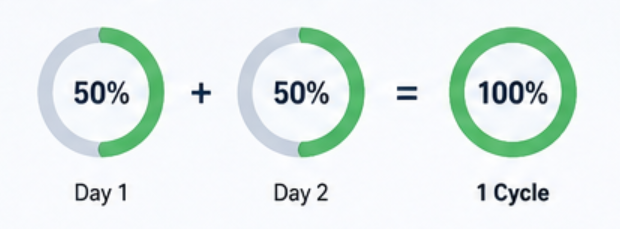
A charge cycle takes place when the total discharge of the battery is up to 100% of its capacity, followed by charging the battery completely again. For instance, if you discharge 50% of the battery’s power on one day and fully charge it, discharge 50% the next day and fully charge it, it will take both of these days to make up one charge cycle.
How Many Charge Cycles Does a Drone Battery Last?
The most popular batteries used in commercially available drones include Lithium Polymer (LiPo), Lithium-ion (Li-ion), and Smart Flight Batteries with power management systems. Their average laboratory cycle lives are outlined below:
| Battery Type | Average Lab Cycles | Common Applications |
| LiPo (Lithium Polymer) | 150 – 300 cycles | FPV drones, DIY builds, high-C rate/high-power demand aircraft |
| Li-ion (Lithium-ion) | 300 – 500 cycles | Lightweight aerial cameras, long-endurance fixed-wing drones |
| Smart Flight Battery | 300 – 600 cycles | DJI full lineup, high-end industrial inspection & agricultural drones |
The advantage of smart batteries is a higher lifespan due to the presence of a built-in BMS (Battery Management System). The system is designed for automatic balancing of cell voltage, current management during charging, and auto discharge management in order to increase the life cycle of the battery.
The Reality Check: Lab Data ≠ Actual Lifespan
It is important to understand that the data provided above was obtained in laboratory conditions. However, when used in high-altitude flights, the actual number of cycles turns out to be smaller due to various factors such as environmental temperature and others.
What Factors Affect Drone Battery Life Cycle?
The internal chemical structure of lithium-based drone batteries is incredibly sensitive. In day-to-day operations, five key factors directly dictate your battery’s true operational lifespan:
1. Extreme Temperatures (The “Number One Killer”)
The ideal operating temperature for lithium-ion batteries is 20 °C to 30 °C. When the battery is charged directly after flying the aircraft or it is placed under the blazing summer sun, it increases side chemical reactions inside the battery and results in quick loss of battery capacity and expansion. In winter, extremely low temperatures cause a significant drop in voltage.
2. Poor Charging Habits
Plugging in a battery to charge immediately after landing inflicts massive physical damage on the cells due to heat accumulation. Additionally, leaving batteries on chargers for prolonged periods or frequently using unverified, third-party high-power fast chargers introduces excessive heat and unnecessary physical stress.
3. Frequent Over-Discharging
Operating your drone beyond its capabilities to get just “one more shot,” and repeatedly having to use RTH or flying it until it dies on you, is a serious error. The deep discharge results in low cell voltage, which in turn leads to irreparable loss of capacity.
4. Prolonged Full-Charge or Zero-Charge Storage
Leaving a battery at 100% full charge for more than 3 days creates peak internal chemical pressure, significantly accelerating chronic degradation. On the flip side, storing a completely drained battery for too long can lead to deep self-discharge, effectively “starving” the battery to permanent death.
5. High-Payload Flights & Aggressive Piloting
Battery fatigue is directly dependent on the discharge rate. In cases when a drone is loaded with payloads such as heavy spray tanks, dual gimbals or even LiDAR equipment, the battery has to provide continuous high currents. Moreover, combating head winds and operating with full throttle results in the rapid heating of the battery cells.
When is it Time to Retire Your Battery?
In order to ensure your flight’s safety and avoid any devastating accidents, keep an eye on these obvious warning signals which clearly show that the battery has reached the end of its lifespan and needs replacement:
Significantly Reduced Flight Time:
If the battery which used to give you 30 minutes of flying time suddenly gives only 20 minutes under the same conditions (a decrease of over 30% in its capacity), this means that the battery’s capacity has been considerably reduced.
Battery Swelling/Bloating:
It is the most critical warning signal. In case your battery is showing any signs of bloating, stop using it right away! Bloating shows that there are explosive gasses created in the cell because of its damaged structure. Using it further or recharging the battery carries serious risks of thermal runaway, fire, and explosion.
Unusually Slow Charging:
As the battery gets older, the Internal Resistance (IR) of the battery increases.
Cell Voltage Mismatch:
Measure the voltage of each cell using the drone app or smart charger. If the voltage difference between any two cells is more than 0.1V at either 100% charge or midflight, one of the cells must be broken and may cause an unexpected and drastic loss of power midair.
Unexpected Voltage Drops During Load:
While the drone app may display 100% charge at the start, there can be instances where the charge percentage drops suddenly from 60% to 20% in a punch-out ascent or while flying against the wind, forcing you to make an emergency landing. The “fake charge capacity” signifies that the battery cannot maintain the voltage during the load anymore.
Excess Heating:
While a slightly warm battery after a flight is perfectly acceptable, an overheating battery that feels extremely hot to the touch (over 55°C) even after just a few minutes of flight or slow charging shows high internal resistance, turning electrical energy into dangerous heat.
Constant Warnings From the BMS:
Today’s drones come equipped with smart batteries that have inbuilt BMS chips. If the drone app gives out constant errors such as “Cell Damaged,” “Voltage Too Low,” “Over-Discharge,” or “Battery Replacement Required,” don’t neglect them.
How to Extend Your Drone’s Battery Life Cycle?
Want to surpass the industry average lifespan and save heavily on replacement costs? Strictly implement this standardized operating procedure (SOP):
Never Charge Immediately After Flight: Allow the battery to cool down for 15–30 minutes until it completely returns to room temperature before plugging it in.
Activate “Storage Voltage” for Long-Term Storage: If you do not plan to fly for more than 3 days, store the batteries at roughly 50% to 60% capacity. The golden storage voltage is 3.80V to 3.85V per cell. Never store them completely full or completely empty.
Respect the 20% Safety Red Line: Set your low-battery warnings to 25% to 30% in the app, ensuring your drone is safely on the ground with at least 20% remaining capacity. Leaving a safety margin for the battery directly protects your wallet.
Calibrate Your Batteries Regularly: Every 20 to 30 cycles, perform a calibration. Fully charge the battery to 100%, discharge it smoothly down to about 15%, and then recharge it back to full. This recalibrates the internal fuel gauge chip, preventing false capacity readings.
How Different Applications Impact Lifespan?
Different industrial missions require vastly different discharge rates (C-ratings), runtimes, and payloads. This leads to completely different degradation mechanisms across sectors:
Agricultural Spraying Drones
Agricultural spraying drones operate under maximum payloads, carrying heavy liquid tanks with frequent takeoff and landing cycles. Because of the extreme weight, the batteries must continuously output high currents, generating intense heat. Combined with hot, dusty summer field conditions, agricultural batteries are highly prone to swelling and rapid capacity drops, typically tracking at the lower end of the industry lifespan baseline.
Power Line & Industrial Inspection Drones
Inspection tasks require long-distance flights or precise, long-duration hovering over power grids and pipelines. This demands exceptional voltage stability. While the discharge style is less aggressive than agricultural drones, high-altitude winds force the battery to work harder. Once internal resistance rises or cell imbalances occur, it directly compromises the drone’s ability to return safely from long-distance missions.
Mapping & Surveying Drones
Surveying drones (especially fixed-wing units doing orthophoto or oblique photography) regularly fly continuous missions lasting dozens of minutes or even hours. These scenarios demand maximum energy density and capacity retention. They are highly susceptible to chronic degradation caused by being left fully charged for too long; once capacity drops by more than 20%, the coverage area per flight drops significantly.
Security Patrol & Emergency Drones
Emergency and rescue drones must remain on standby 24/7 for rapid deployment. Extended periods of sitting idle at high charges combined with spontaneous, frequent patrol flights put immense strain on the battery. If unmanaged, keeping batteries at peak charge for prolonged readiness rapidly shortens their operational life.
Pro Tip: Because the physical strain differs by industry, businesses must tailor their maintenance schedules accordingly (e.g., mandating post-flight cooling periods for agricultural teams, or strictly enforcing storage voltage depletion for mapping teams) to aggressively lower equipment depreciation costs.
How to Properly Dispose of Dair/Old Drone Batteries?
Throwing dead or degraded lithium drone batteries directly into standard trash bins is a major safety hazard. If compressed or punctured by a garbage truck, they can easily short-circuit and ignite intense chemical fires.
Standard Green Disposal Steps:
Step 1. Full Discharge: Mix a bucket made of plastic with a saline water solution (saline in water ratio should be approximately 1:10). Place the used battery inside the bucket filled with the saline water solution for 48 to 72 hours. Saline water is a good conductor of electricity, which will help you discharge the battery to 0V.
Step 2. Insulation: After the complete discharge of the battery, take out the battery and use thick insulation tape to insulate its connectors or terminals.
Step 3. Recycling: Dispose of the battery in an authorized E-Waste Recycling Center. Never toss them into regular trash.
Conclusion
The life cycle of a battery on a drone is never an inflexible figure, it completely depends on how a pilot handles it. By developing scientific practices when charging, developing discipline when storing and regularly conducting health checkups, it is easy to increase the life of a battery by more than 50%. It not only ensures that all takeoffs and landings are safe but also the best way to reduce drone costs.