
Drone for Fertilizer: What to Know Before Buying One?

In the wave of modern precision agriculture development, improving fertilization efficiency and reducing production costs are core challenges faced by farmers and agricultural service providers worldwide. Traditional ground machinery not only easily damages crops but is also helpless when facing complex terrain; meanwhile, manual fertilization suffers from soaring labor costs, and its efficiency falls far short of the demands of large-scale operations.
To address these pain points, agricultural spraying and fertilizer drones are becoming standard equipment in agricultural production. This article provides an in-depth analysis of why drones for fertilizer are a high-return investment, and how to choose the model that best fits your farm’s needs when purchasing.
Table of Contents
Why Invest in an Agricultural Fertilizer Drone?
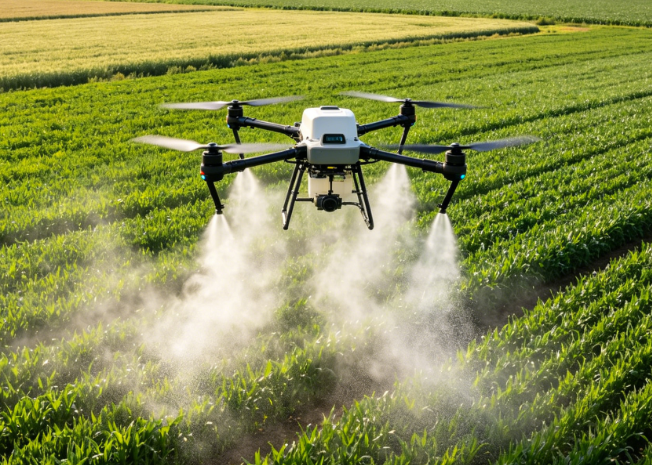
For large-scale farm operators or agricultural integrators, introducing drone technology is by no means just about chasing a tech trend; it is a solid commercial investment. The core value of purchasing a fertilizer spreading drone is reflected in the following three aspects:
1. Slash Labor Costs & Maximize Operational Efficiency
Traditional manual fertilization is slow, physically demanding, and faces severe challenges of seasonal labor shortages and rising labor costs. The operational efficiency of a heavy-payload fertilizer spreading drone can reach dozens of times that of manual labor. Topdressing work that originally took days to complete can now be effortlessly handled in just a few hours, drastically slashing seasonal labor expenses.
2. Maximize Fertilizer Efficiency via Precision Spreading
Traditional fertilization methods often lead to localized fertilizer surplus (causing seedling burn) or deficiencies (affecting yield). Modern agricultural drones are equipped with high-precision radar and intelligent metering systems, enabling “quantitative, uniform, and precise” spreading.
Statistics show that applying precision agricultural drones for fertilization can effectively reduce fertilizer waste by 20% to 30%. With today’s high fertilizer prices, this directly saves you a massive amount of expenditure.
3. Zero Crop Damage Through Aerial Operations
When large and medium-sized ground machinery enters fields for fertilization, it inevitably crushes a portion of the crops, leading to yield reduction.
In contrast, drones operate via aerial hovering and flight, completely eliminating physical damage to crops from ground machinery, which implicitly boosts the farm’s overall total yield.
High-Efficiency Application Scenarios and Target Crops of Drone for Fertilizer
High-quality fertilizer drones feature extreme environmental adaptability. Unrestricted by terrain or crop height, they can easily handle a variety of complex agricultural production scenarios:
High-Value Economic Orchards (Citrus, Apple, Pear, Grape, etc.):
Targeting traditional high-canopy density (dense foliage) orchards and trellised vineyards, drones can perform all-directional foliar fertilizer spraying from high above. The strong penetration of large droplets significantly improves fruit quality.
Broad-Acre Field Crops (Rice, Wheat, Corn, etc.):
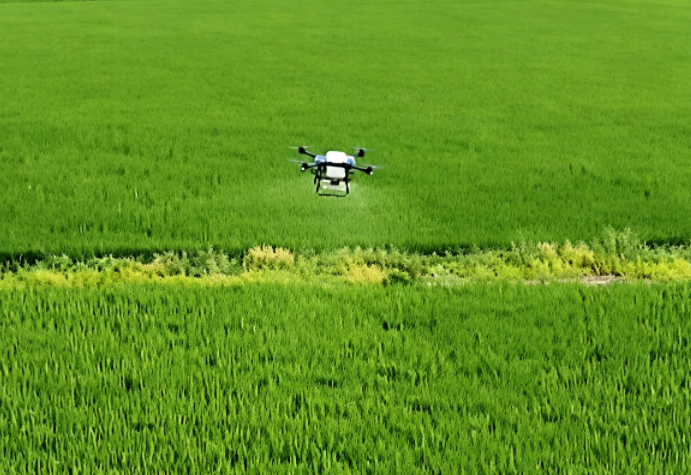
Drones solve the pain points of the mid-to-late crop growth stages (such as after canopy closure or during the heading stage), where ground machinery cannot enter the field and manual spreading efficiency is extremely low. They enable precise “mid-to-late stage topdressing” over large areas during peak yield periods, ensuring every grain is harvested.
Mountainous, Hilly, and Irregularly Shaped Farmland:
Terraces, slopes, and fragmented plots are inaccessible to traditional tractors and heavy machinery. Utilizing high-precision terrain-following technology, drones can adapt to terrain fluctuations, achieving uniform fertilization without any blind spots.
Large-Scale Commercial Farms and Intensive Cultivation Zones:
On large-scale farms of over a thousand acres, the high daily work capacity of drones helps managers complete field-wide fertilization within extremely tight, “golden agricultural windows,” pushing large-scale management efficiency to its limit.
Drone for Fertilizer vs. Traditional Fertilization Methods
To give you a more intuitive understanding of the revolutionary changes brought by fertilizer drones, we have conducted a comprehensive quantitative comparison against traditional manual fertilization and ground machinery fertilization:
| Comparison Item | Manual Labor | Ground Machinery | Fertilizer Drone |
| Efficiency | Extremely Low: A single person can only cover a few acres per day, heavily limited by physical stamina. | Moderate: Tractors are faster but limited by field roads and crop heights. | Extremely High: A single drone can cover dozens to over a hundred acres per hour, boosting efficiency dozens of times over. |
| Precision | Extremely Low: Relies entirely on experience to throw by hand, easily causing uneven distribution and seedling burn. | Moderate: Mechanical row application or broadcasting makes it difficult to adjust quantities precisely based on crop growth. | Extremely High: Combines satellite and radar to achieve centimeter-level, high-precision, uniform, and quantitative spreading. |
| Terrain Adaptability | Average: Can go anywhere a person can walk, but steep slopes and muddy wetlands are exhausting. | Extremely Poor: Difficult to enter mountains, hills, terraces, and paddy fields (prone to getting stuck). | Extremely Strong: Aerial operation with terrain following perfectly adapts to mountains, orchards, and any complex terrain. |
| Labor Cost | Extremely High: Heavy physical labor that faces severe seasonal labor shortages. | Moderate: Requires professional tractor drivers; labor costs are moderate. | Extremely Low: Fully automated flight paths; 1 operator can manage multiple drones. |
| Crop Damage | Slight: Manual trampling causes a small amount of seedling loss. | Severe: Heavy tires directly crush crops, typically causing a 2% – 5% reduction in yield. | Zero Damage: Aerial hovering operation truly achieves “zero crop damage.” |
| Total ROI | High Long-Term Cost: Labor costs rise annually, and fertilizer waste is severe. | High Depreciation & Fuel: High machinery maintenance costs and heavy fuel consumption. | Lower Overall Cost: Saves fertilizer, labor, and time; equipment costs are typically recovered within 1 – 2 seasons. |
Why Drones Win Hands Down
Efficiency vs. Agricultural Timing: A Race Against Time
Agricultural fertilization emphasizes the “golden agricultural window”; a delay of a few days can directly impact final yields. Manual or traditional mechanical fertilization has long cycles and many uncontrollable factors.
Conversely, fertilizer drones possess unparalleled daily work capacity, helping farm owners complete field-wide topdressing in just one or two days to lock in the optimal fertilizer efficacy window.
Precision Showdown: From “Relying on the Weather” to “Precision Agriculture”
Under traditional methods, fertilizer waste rates can run as high as 30% or more. Through high-precision centrifugal spreading discs or pressure spraying systems, fertilizer drones can deliver every single gram of fertilizer precisely and uniformly onto crop roots or foliage. Saving a bag of fertilizer is a bag of fertilizer earned.
Production Safety Showdown: Zero Crop Damage Equals Yield Increase
Tractors entering fields and crushing crops is an unavoidable industry pain point. Taking corn or rice as an example, ruts left by ground machinery lead to obvious yield reductions. Drones completely liberate the ground, reclaiming the roughly 3% of yield that would have been “crushed to death.” For large-scale commercial farms, this represents a massive hidden fortune.
Key Factors to Consider When Choosing the Best Drone for Spreading Fertilizer
Faced with a dazzling array of models on the market, how should buyers evaluate them? When picking a commercial agricultural drone for sale, it is recommended to focus on these 5 hardcore parameters:
| Key Features | Why It Matters | Buying Advice |
| Payload Capacity | Determines the operational area per flight and work continuity. | Small to medium farms can choose 20L – 30L; for large-scale operations or a primary focus on granular fertilizer, it is highly recommended to select a 40L – 50L heavy-payload drone. |
| Spreading System Flexibility | Agricultural fertilization includes liquid foliar fertilizers and solid granular fertilizers (such as urea and compound fertilizers). | Look for a dual-use system that supports rapid switching between “spraying and spreading,” and ensure the spreading disc features an anti-clogging and corrosion-resistant design. |
| Battery Life & Fast Charging | Drones must work continuously in fields; battery life and charging speed dictate daily operational volume. | Pay attention to whether the drone supports “dual-battery cycling” and ultra-fast charging (e.g., fully charging a battery in 10 – 15 minutes) to ensure uninterrupted operations. |
| Terrain Following & Obstacle Avoidance | Ensures the drone flies safely in complex terrains like hills and orchards. | Must be equipped with terrain-following radar and omnidirectional obstacle avoidance systems that can automatically detect trees and utility poles to intelligently bypass them. |
| Navigation Accuracy | Determines whether fertilization will suffer from overlapping or missed spraying areas. | It is strongly recommended to choose a model that supports RTK centimeter-level high-precision positioning to achieve fully automated route planning and precise operations. |
VastArrive: Best Agriculture Drone for Spraying Fertilizer and Pesticides
As a top-tier agricultural drone integrating pesticide spraying and fertilizer spreading, VastArrive agriculture drone provides intelligent lifecycle support from “soil monitoring to crop harvest.” Whether performing large-scale precision fertilization in rice paddies or spraying pesticides in complex orchards, VastArrive utilizes multispectral imaging and intelligent flight control to achieve precise, quantitative operations, truly achieving high-efficiency management with 100% “zero crop damage.”
If you are looking for a powerful, technologically reliable precision agriculture partner, VastArrive is definitely the wise choice you cannot afford to miss!