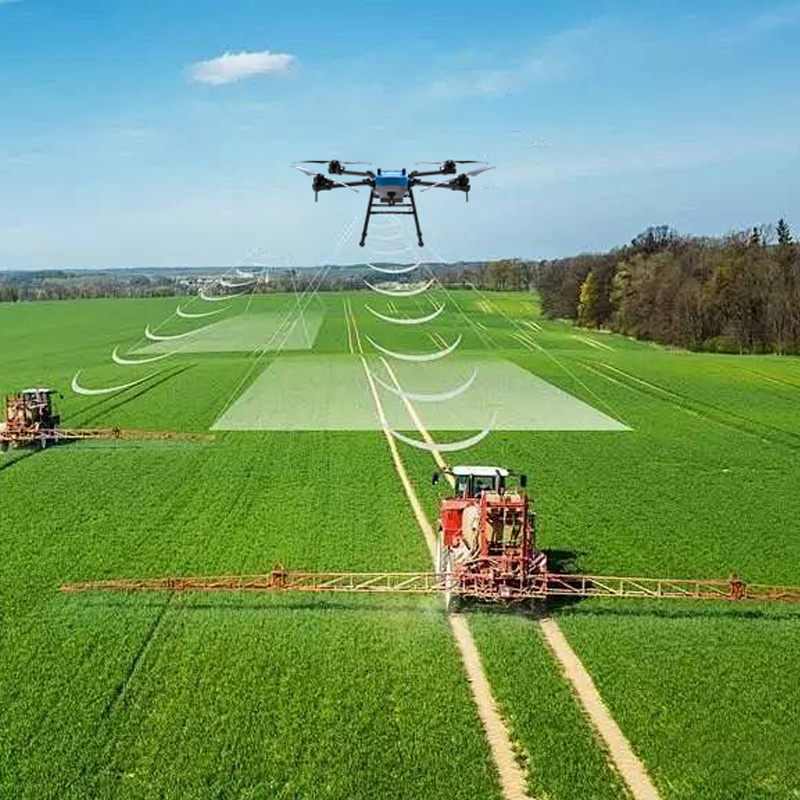
Drone Spectral Sampling Helps Enable Precise Fertilization
Project Overview
Efficient fertilizer management is essential for maintaining crop productivity while controlling input costs. However, conventional fertilization decisions often rely on field experience or limited sampling data, making it difficult to understand variations across large areas of farmland.
To improve fertilization management, the client introduced a drone-based spectral sampling solution at its rice planting base.
The drone collects 200 spectral data points per hectare along a preset flight path. The collected data is analyzed using the NDVI algorithm and processed to generate nutrient-related indicators and a fertilization recommendation map.
The data is transmitted synchronously to a cloud platform, allowing the client to use field data to support more targeted fertilizer management.
The Challenge
Fertilization Decisions Based on Limited Data
Traditional fertilization practices may rely heavily on experience or generalized application strategies, making it difficult to account for differences between individual areas within a large rice-growing base.
Variations Across Farmland
Crop growth and field conditions can vary across different areas. Without sufficient data, applying the same fertilization strategy across an entire field may result in inefficient fertilizer use.
Rising Fertilizer Costs
Nitrogen fertilizer is an important agricultural input. Inefficient application can increase fertilizer consumption and operating costs without necessarily improving crop productivity.
Lack of Long-Term Field Data
Without continuous monitoring, it can be difficult for farmers to track changes in field conditions over time or establish a data-based approach to farmland quality management.
The Drone Spectral Sampling Solution
To address these challenges, the client implemented a drone-based spectral sampling system for rice cultivation.
The drone follows a preset flight path and collects 200 spectral data points per hectare, creating a more detailed dataset for analyzing field conditions.
The collected spectral information is processed through the system’s analysis workflow, including NDVI-based analysis, to generate nutrient-related indicators.
The processed data is then transmitted to a cloud platform, where it is used to generate a fertilization recommendation map.
This transforms field sampling data into actionable information that can support more targeted fertilization decisions.
How the Solution Works
01 — Preset the Flight Path
The drone’s flight path is planned according to the rice planting area to ensure systematic data collection across the target farmland.
02 — Collect Spectral Data
During the flight, the drone collects approximately 200 spectral data points per hectare.
This creates a detailed dataset covering different areas of the rice planting base.
03 — Analyze the Collected Data
The collected spectral data is processed using the system’s analysis workflow, including NDVI-based analysis, to identify differences in crop and field conditions.
04 — Generate a Fertilization Recommendation Map
The analyzed data is converted into visual information and used to generate a fertilization recommendation map, helping identify areas that may require different fertilization strategies.
05 — Support Precision Fertilization
Farmers can use the recommendation map as a data reference when planning fertilizer application, helping improve the efficiency of nitrogen fertilizer use.
06 — Monitor Farmland Over Time
The collected data is stored and managed through the cloud platform, creating a foundation for long-term monitoring of farmland conditions and supporting dynamic agricultural management.
Key Technologies
Drone-Based Spectral Sampling
Aerial data collection enables large areas of farmland to be surveyed systematically without requiring extensive manual sampling.
NDVI-Based Analysis
NDVI analysis helps evaluate vegetation conditions from spectral information and provides useful indicators for agricultural decision-making.
Cloud Data Platform
Collected data is transmitted to a cloud platform for centralized storage, processing, and management.
Fertilization Recommendation Mapping
The system converts analyzed data into a visual recommendation map, making complex field information easier for agricultural operators to interpret and apply.
Long-Term Data Monitoring
Continuous data collection allows changes in farmland conditions to be monitored over time, supporting more dynamic and data-driven field management.
Project Results
The implementation of drone spectral sampling produced measurable improvements in fertilizer management at the client’s rice planting base.
32% Higher Nitrogen Fertilizer Utilization
The data-driven fertilization approach increased nitrogen fertilizer utilization by 32%, helping the client make more effective use of fertilizer inputs.
18% Lower Fertilizer Input Costs
More targeted fertilization management reduced fertilizer input costs by 18%, helping improve the economic efficiency of rice cultivation.
Data-Driven Farmland Management
The cloud platform created a centralized data foundation for monitoring field conditions and supporting longer-term agricultural management.
Dynamic Monitoring of Farmland Quality
Continuous collection and analysis of field data enables the client to track changes over time rather than relying only on individual sampling events.
From Data Collection to Precision Agriculture
This project illustrates how drone technology can connect field data collection with agricultural decision-making.
Instead of treating an entire rice-growing area as a uniform field, spectral sampling provides more detailed information about differences across the farmland.
With continuous data collection and cloud-based monitoring, agricultural operators can gradually build a historical dataset to support more informed fertilization strategies and long-term farmland management.
The combination of drone spectral sampling, NDVI-based analysis, cloud data management, and fertilization recommendation mapping provides a foundation for more efficient and data-driven precision agriculture.