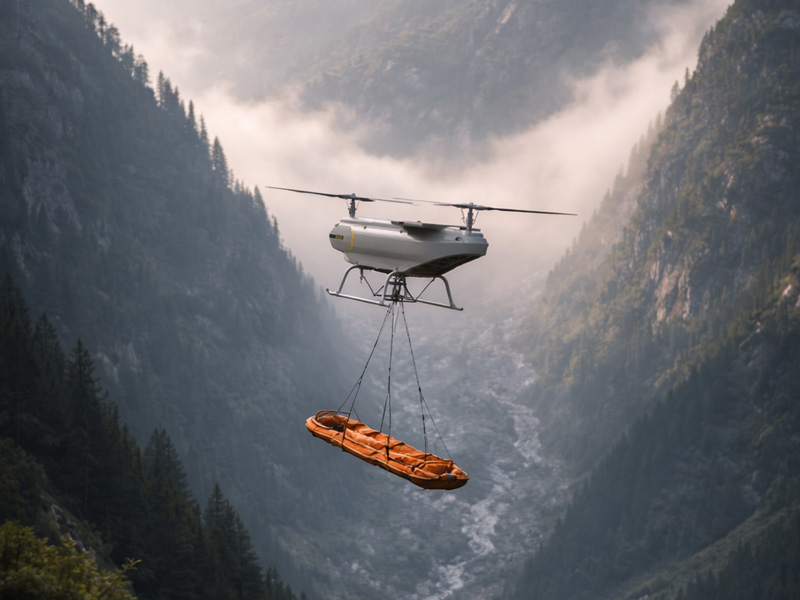
How Heavy-Duty Drones Helped Enable Rapid Emergency Rescue in High-Altitude Mountainous Areas
Project Overview
Mountain rescue operations can become extremely challenging when rugged terrain, high altitude, and limited road access prevent conventional rescue vehicles from reaching an injured person quickly.
In this case, a hiker was injured at an altitude of approximately 3,000 meters in a mountainous border area. The hiker suffered a right-leg injury accompanied by moderate altitude sickness, requiring timely medical assistance and evacuation.
Traditional ground rescue faced significant difficulties. Rugged mountain roads prevented rescue vehicles from reaching the site, while the surrounding canyon created additional safety risks for conventional rescue operations.
To address the situation, a rescue team equipped with a heavy-duty medical transport drone quickly arrived at the scene and initiated an air-ground coordinated rescue operation.
The drone provided an aerial transportation option for the emergency rescue, helping the team overcome difficult terrain and improve the flexibility of high-altitude rescue operations.
The Rescue Challenge
High-Altitude Environment
The incident occurred at an altitude of approximately 3,000 meters, where reduced oxygen levels and difficult environmental conditions can increase the complexity of emergency rescue operations.
The injured hiker was also experiencing moderate altitude sickness, making timely rescue particularly important.
Rugged Mountain Terrain
The mountainous terrain was difficult to navigate, with steep and uneven routes limiting the accessibility of conventional rescue vehicles.
Ground Vehicles Could Not Reach the Site
Due to the condition of the mountain roads, rescue vehicles could not directly reach the injured hiker.
This created a critical gap between the rescue team and the patient.
Canyon Safety Risks
The canyon surrounding the area created additional hazards for rescue personnel attempting to approach or evacuate the injured person through conventional routes.
Time-Sensitive Medical Evacuation
With a leg injury and altitude sickness involved, the rescue operation required a safe and efficient way to move the injured person out of the difficult terrain.
The Medical Drone Solution
To overcome the limitations of ground-based rescue, the rescue team deployed a heavy-duty medical transport drone as part of an air-ground coordinated rescue strategy.
Rather than relying entirely on vehicles or rescuers navigating difficult mountain terrain, the drone introduced an aerial transportation capability into the rescue process.
The solution was designed to help:
- Reach difficult-to-access mountain areas
- Reduce dependence on rugged ground routes
- Support injured-person transportation
- Reduce unnecessary exposure of rescuers to hazardous terrain
- Connect aerial transportation with ground rescue resources
This approach created a coordinated rescue model combining ground rescue personnel and aerial transportation.
How the Rescue Operation Worked
01 — Rescue Team Reaches the Area
The rescue team carrying the heavy-duty medical transport drone quickly arrived near the incident location.
The team assessed the injured hiker’s condition and the surrounding terrain.
02 — Assess Ground Rescue Limitations
Because of the rugged mountain roads and canyon conditions, conventional ground transportation could not provide a safe and efficient evacuation route.
The rescue team therefore introduced an aerial transportation option.
03 — Deploy the Medical Transport Drone
The heavy-duty medical transport drone was prepared for the rescue operation.
Its aerial mobility allowed the team to work around terrain obstacles that limited conventional ground transportation.
04 — Coordinate Air and Ground Rescue
The drone operation was integrated with the work of the ground rescue team, creating an air-ground coordinated rescue process.
Ground personnel remained responsible for on-site rescue and medical support, while the drone provided aerial transportation capabilities.
05 — Support Emergency Evacuation
The medical transport drone helped address the challenge of moving an injured person through difficult mountainous terrain, providing an additional evacuation option when conventional transportation was restricted.
Key Advantages
Aerial Access to Difficult Terrain
Drones can operate above rugged terrain, providing transportation capabilities in areas where conventional vehicles may have difficulty reaching.
Reduced Dependence on Mountain Roads
Aerial transportation can reduce the need to move injured people entirely through narrow, steep, or difficult ground routes.
Support for Rescue Teams
Heavy-duty medical drones can provide additional transportation capabilities, allowing rescue teams to focus on patient care and on-site rescue operations.
Air-Ground Coordination
Combining drones with conventional rescue personnel creates a more flexible rescue model rather than replacing ground rescue entirely.
Suitable for High-Altitude Rescue Scenarios
In high-altitude mountainous areas where terrain and road accessibility create significant challenges, medical transport drones can provide an additional tool for emergency response.
The “Air-Ground” Rescue Model
The key innovation in this operation was not simply the use of a drone, but the combination of aerial and ground rescue capabilities.
Ground Rescue
- On-site assessment
- First aid and medical support
- Rescue coordination
- Patient preparation
Aerial Rescue Support
- Access across difficult terrain
- Medical transportation support
- Reduced dependence on ground routes
- Flexible emergency logistics
Together, these capabilities create a more adaptable rescue system for challenging mountainous environments.
“Aerial Stretchers” for Difficult Rescue Environments
When mountain roads become impassable and conventional vehicles cannot reach an injured person, aerial transportation can provide a new option for emergency rescue.
The deployment of a heavy-duty medical transport drone in this case helped establish an air-ground coordinated rescue approach, demonstrating how drone technology can extend emergency response capabilities into challenging mountainous environments.
For rescue organizations operating in high-altitude, remote, or difficult-to-access areas, medical transport drones can become an important supplement to conventional rescue systems.