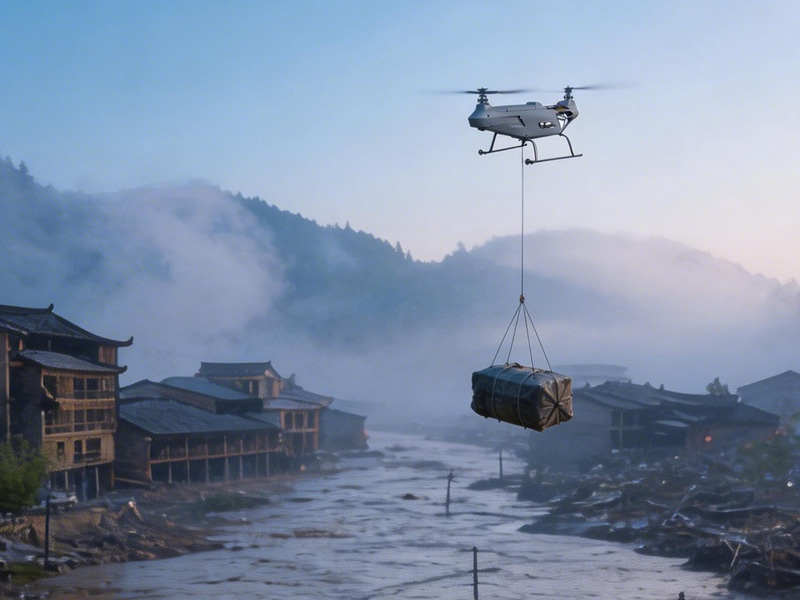
Emergency Supplies to Flood-Stricken Islands
Project Overview
During the 2023 floods, severe flooding surrounded a village and effectively turned it into an isolated “island.”
Rapid water currents made it difficult for traditional rescue boats to safely approach the village, leaving residents stranded on rooftops and creating an urgent need for emergency supplies.
To maintain access to the isolated community, the rescue team deployed three long-endurance drones equipped with turbojet engines.
Using a point-to-point hover drop delivery method, the drones transported essential supplies, including life jackets, emergency lights, and compressed biscuits, directly to people stranded in the flooded area.
The drones were also equipped with millimeter-wave radar, allowing the team to monitor water-flow conditions in real time and support safer flight and delivery operations.
Over 12 hours of continuous operations, the drone fleet provided emergency supplies to approximately 280 people.
The Challenge
Floodwaters Isolated the Village
Rapidly rising floodwaters surrounded the village, cutting it off from surrounding areas and leaving residents stranded on rooftops.
The community effectively became an isolated island with limited access to external supplies.
Strong Currents Blocked Rescue Boats
Traditional rescue boats could not safely approach the village because of strong and rapidly moving floodwaters.
This significantly limited conventional water-based rescue and supply delivery options.
Urgent Need for Basic Supplies
People stranded in the flooded area urgently required essential supplies such as:
- Life jackets
- Emergency lights
- Compressed biscuits
- Other basic emergency materials
Delivering these supplies quickly became a critical priority.
Difficult and Dynamic Water Conditions
Floodwater conditions could change rapidly.
Without real-time information about water-flow conditions, rescue teams would face additional challenges when planning safe delivery operations.
The Drone Emergency Logistics Solution
To overcome the limitations of conventional rescue boats, the rescue team deployed three long-endurance drones equipped with turbojet engines.
The drones were used as an aerial emergency logistics platform, allowing essential supplies to be transported directly to isolated residents without requiring a boat to reach the flooded village.
The solution combined:
- Long-endurance drone operations
- Turbojet-powered flight capability
- Point-to-point hover drop delivery
- Millimeter-wave radar
- Real-time water-flow monitoring
- Continuous emergency supply delivery
This provided an alternative logistics channel when ground and water-based transportation were severely restricted.
How the Emergency Delivery System Worked
1. Assess the Flooded Area
The rescue team assessed the isolated village, surrounding floodwaters, and the condition of conventional access routes. Because rapid currents prevented rescue boats from approaching safely, an aerial delivery method was selected.
2. Deploy Long-Endurance Drones
Three long-endurance drones equipped with turbojet engines were deployed to support continuous emergency supply operations.
Their long-endurance capability allowed the team to maintain repeated delivery missions over an extended period.
3. Monitor Water Conditions
The drones used millimeter-wave radar to monitor water-flow conditions in real time. This provided the rescue team with additional situational information during the emergency operation.
4. Perform Point-to-Point Hover Drops
The drones flew to designated delivery locations and used a point-to-point hover drop method to release supplies to people stranded on rooftops. This reduced the need for the drones to land in the flooded area.
5. Repeat Emergency Deliveries
Each delivery operation took approximately 8 minutes, allowing the drones to perform repeated supply missions. The fleet maintained continuous operations for approximately 12 hours.
Emergency Supplies Delivered
The drone logistics system was used to transport essential emergency materials, including:
Life Jackets
Provided basic flotation support for people stranded in flood-affected areas.
Emergency Lights
Helped provide essential lighting during emergency conditions, particularly when normal infrastructure was unavailable.
Compressed Biscuits
Provided a compact and easily transportable source of emergency food for isolated residents.
The combination of these supplies helped address basic survival needs while conventional rescue access remained restricted.
Key Technologies
Long-Endurance Drone Platform
The long-endurance drone platform supported repeated emergency delivery missions over an extended operating period.
Turbojet Engine
The drones were equipped with turbojet engines to support the required flight performance during the emergency operation.
Point-to-Point Hover Drop
The hover-drop delivery method allowed supplies to be delivered to designated locations without requiring the drone to land. This was particularly useful in flooded environments where safe landing areas were unavailable.
Millimeter-Wave Radar
Millimeter-wave radar provided real-time information related to water-flow conditions, supporting situational awareness during emergency operations.
Continuous Aerial Logistics
The drone fleet provided a repeatable transportation channel that could continue operating while conventional boats were unable to safely reach the isolated village.
Project Results
The emergency drone logistics operation delivered measurable results during the flood response.
8-Minute Delivery Cycle
Each supply delivery took approximately 8 minutes, enabling rapid and repeated emergency supply transportation.
70% Lower Rescue Costs
Compared with helicopter-based rescue operations, the drone solution reduced rescue costs by approximately 70%.
12 Hours of Continuous Operations
The three-drone fleet maintained continuous emergency supply operations for approximately 12 hours.
280 People Supported
During the operation, emergency supplies were delivered to approximately 280 people, helping meet their basic survival needs while the village remained isolated.
Aerial Emergency Logistics When Roads and Waterways Fail
Floods can quickly destroy or block conventional transportation routes, leaving isolated communities without access to food, lighting, safety equipment, and other basic necessities.
This case demonstrates how long-endurance drones can function as emergency logistics platforms, providing an aerial transportation channel when roads and waterways become inaccessible.
By combining long-endurance flight, hover-drop delivery, real-time environmental monitoring, and continuous operations, drone technology can help emergency teams deliver critical supplies quickly and efficiently to isolated communities.
For flood response, disaster relief, and other emergency scenarios where conventional transportation is restricted, drone-based logistics provides an additional layer of rapid-response capability.