
Multi-Rotor Drones vs Fixed Wing: Which One Should You Choose?

In today’s industrial and commercial sectors, Unmanned Aerial Vehicles (UAVs) have evolved from “cool tech toys” into game-changing productivity tools. Whether conducting high-precision terrain mapping, large-scale crop monitoring, or detailed infrastructure inspections, drones significantly mitigate operational risks while exponentially boosting efficiency.
However, when enterprises prepare to invest in drone technology, they inevitably face a pivotal choice: Should we invest in Multi-Rotor Drones vs Fixed-Wing UAVs?
These two platforms differ drastically in design, aerodynamics, and operational use cases. Making the wrong choice can waste substantial budgets and cause severe project delays due to equipment mismatch. This comprehensive guide will break down the differences across multiple dimensions to help you make the most informed decision.
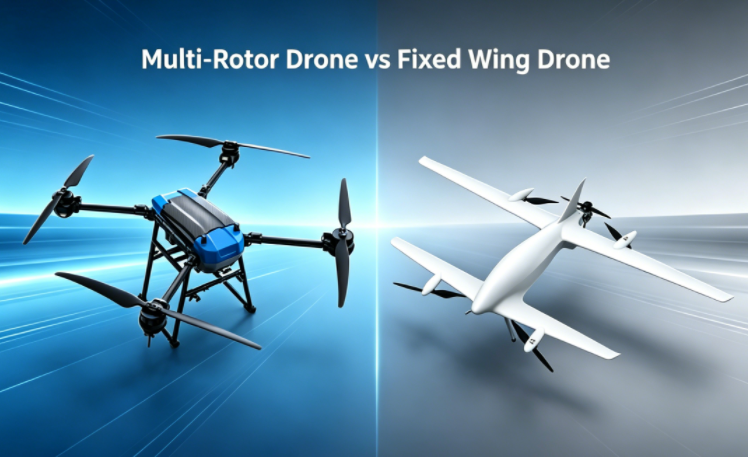
Table of Contents
What is a Multi-Rotor Drone?
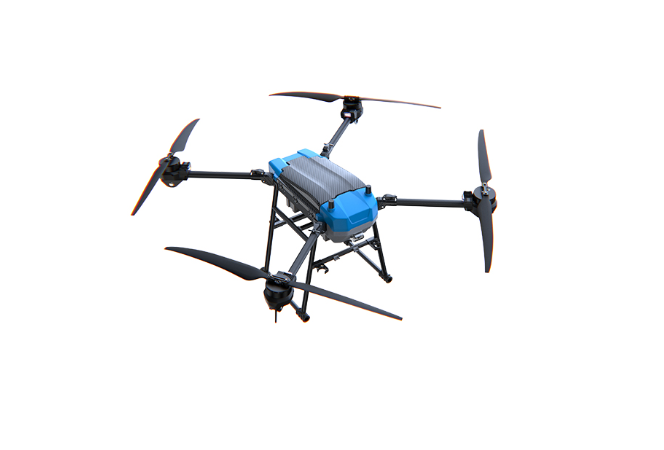
Multi-rotor drones are the most common and recognizable UAVs on the market today. They rely on 4, 6, or 8 vertically arranged rotors to generate lift, operating similarly to miniature helicopters.
Advantages of Multi-Rotor Drone
Extreme Maneuverability & Hovering:
One of the strengths of the multi-rotor is that it can hover perfectly in midair. It will enable it to take photos of its target from various angles for more accurate and detailed data acquisition, whether a crack on the bridge, a wind turbine blade, or a building surface.
Vertical Takeoff and Landing (VTOL):
It does not need an airstrip or launching tools for takeoff and landing. A small patch of land is enough, even for trees, ships, and building roofs.
Shallow Learning Curve:
With today’s advanced multi-rotors, they are fully automated, having GPS and obstacle radar features. Even newbies can use them easily after some initial training sessions.
Disadvantages of Multi-Rotor Drone
Limited Flight Time:
Because multi-rotors must continuously expend massive amounts of battery power to fight gravity, their flight time is heavily restricted by physics. Industrial-grade multi-rotors typically offer single-flight times of 20 to 45 minutes.
Restricted Coverage Area:
Due to battery limitations, multi-rotors are ill-suited for large-scale or long-distance missions. Forcing them into massive mapping projects results in frequent “return-to-home for battery swaps,” crippling operational efficiency.
What is a Fixed-Wing UAV?
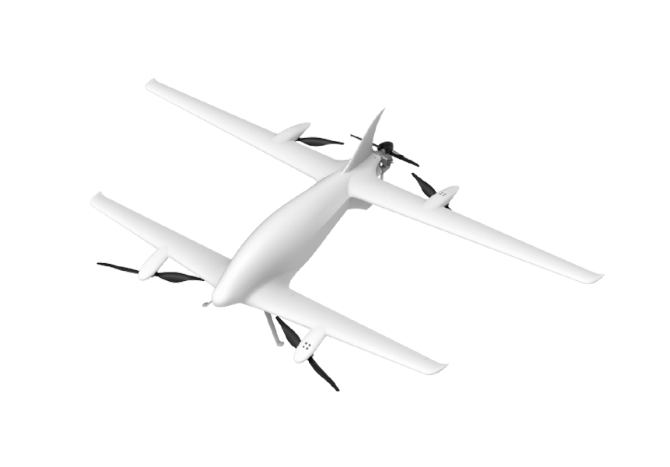
A fixed-wing unmanned aircraft system (UAV) has a similar appearance to a conventional plane. Unlike multi-rotor models that use rotor blades to create lift straight up, a fixed-wing uses forward propulsion and creates lift with its wings.
Advantages of Fixed-Wing UAVs
Excellent Endurance & Range:
Fixed-wing drones are incredibly efficient with energy consumption. They glide through the air once they get up in the sky without consuming a lot of energy or fuel. A single fixed-wing drone can operate continuously for more than 4 hours per flight, flying several tens or even hundreds of kilometers.
Large Area Covering Capability:
To survey vast areas of land, whether it’s thousands of hectares of farmland or pipelines, a fixed-wing drone is your best bet.
High Altitude & Tolerance to Wind:
Because of the aerodynamic design of a fixed-wing UAV, it easily copes with high altitudes and high-speed wind.
Disadvantages of Fixed-Wing UAV
Constrained Space for Launching or Landing:
The existing fixed-wing drones lack the capacity to perform vertical takeoffs or landings. Such drones are typically required to use hand launches, launching from catapult launchers or from runways with a need for landing in lengthy grass fields or parachutes.
Cannot Hover:
For a fixed-wing drone to avoid stall, it needs to retain its velocity. It cannot hover to examine a particular location but circles around the location in order to survey it.
More Operational Barriers & Higher Costs:
It takes more experience and expertise to control a fixed-wing aircraft. In case of any error, the high-speed crash ends up destroying the equipment.
Multi Rotor Drone vs Fixed Wing: Key Performance Comparison
To help you evaluate your options more intuitively, here is a breakdown of their key technical metrics:
| Comparison Metric | Multi-Rotor Drone | Fixed-Wing UAV |
| Flight Time (Single Battery) | Short (20 – 45 minutes) | Long (1 – 4+ hours) |
| Hovering Capability | Supported (Ideal for pinpoint inspections) | Not Supported (Must maintain forward flight) |
| Launch & Landing Space | Minimal (Vertical Takeoff & Landing) | Large (Requires runway, catapult, or open grass) |
| Coverage Area (Single Flight) | Small to Medium (< 1 km²) | Massive (Tens of km² or long-distance lines) |
| Operational Difficulty | Low (Highly automated flight controls) | High (Requires professional, long-term training) |
Industry Applications: Which One Fits Your Business?
1. Choose a Multi-Rotor Drone if your operations involve:
Detailed Infrastructure & Power Grid Inspections:
Close-up inspections of utility pole insulators, wind turbine blade wear, or under-bridge cracks. The multi-rotor’s stationary hovering and high-magnification zoom lenses are irreplaceable for this type of precise “flaw-finding” work.
Precision Agriculture (Spraying & Micro-Seeding):
While fixed-wing drones monitor large areas, multi-rotors rule precision spraying and fertilizer spreading. They fly low, utilizing rotor downwash to push liquids deep into the crop canopy while automatically hugging the terrain.
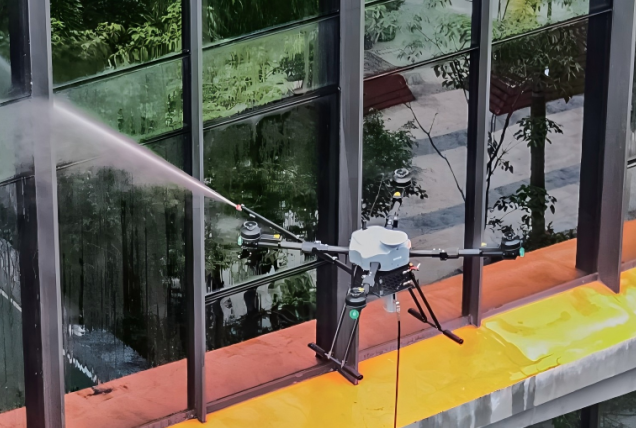
High-Altitude Specialty Tasks (Facade & Solar Cleaning)
Cleaning high-rise glass curtains or commercial rooftop solar panels. Multi-rotors can carry high-pressure water guns or cleaning rollers to work at fixed altitudes, drastically reducing human high-risk exposure.
Frequent Construction Monitoring & Small-Scale 3D Modeling:
High-frequency, high-precision orthomosaic and oblique photography for individual construction sites, earthwork volume calculations, or localized neighborhoods.
Short-to-Medium Range Last-Mile Logistics:
Delivery of food, cargo to islands or mountains, or emergency medical service with supplies (blood plasma, medication). The multi-rotor closes the gap for low altitude logistics through VTOL capability.
Emergency Security, Search & Rescue (SAR), & Cinematography:
Where a quick response is needed as well as a versatile camera angle, functioning as a “flying mobile camera” in fires, search and rescue operations, or movie shoots.
2. Choose a Fixed-Wing UAV if your operations involve:
Agricultural and Forestry Surveillance on a Large Scale:
Employing the use of multispectral or infrared cameras over thousands of hectares of cultivated land or government forests for monitoring Vegetation Index (NDVI). The method will help in measuring crop emergence, plant stresses from diseases and pests, water shortages, and forest fire hazards.
Linear Asset Surveys Over Long Distances:
Regular surveillance over hundreds or thousands of kilometers of oil and gas pipelines, power transmission lines, and railways (for instance, unauthorized constructions and oil stealing).
Environmental Monitoring & Meteorological Observations:
Monitoring ocean red tides, coastline erosion, illegal waste dumping, and wildlife migrations. Advanced fixed-wing UAVs can even carry weather sensors into cloud layers for artificial rain enhancement or edge-data collection before severe storms.
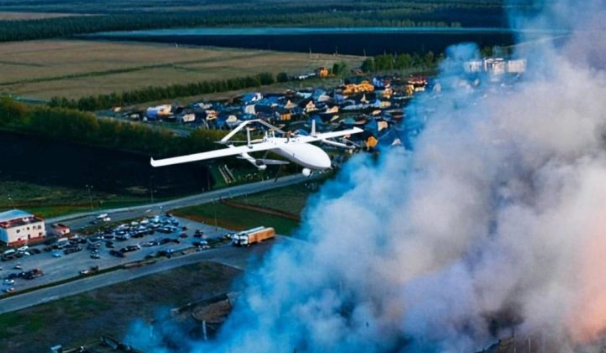
Massive GIS Mapping & Mining Stockpile Surveys:
High-efficiency, large-scale 3D terrain mapping for vast deserts, islands, rugged mountains, or open-pit mines. It excels at periodic volumetric calculations of stockpiles and mineral reserves.
Homeland Security, Border Patrol, and Persistent Surveillance (SAR or ISR Missions):
Constant monitoring during daytime and nighttime along borders against smuggling or sea patrol over large areas through high-resolution thermal imaging and laser night-vision sensors. They can also perform searches for missing persons within large wilderness areas or mountains covered with snow.
Medium/Long-range Cross-Regulatory Transport:
Hybrid-powered drones, heavy-lift drones, and fixed-wing drones can haul loads of up to dozens of kilos at a speed greater than 100 km/hour while transporting vaccines or cargo over long distances.
Conclusion
In the case of deciding between Multi-Rotor Drones and Fixed-Wing UAVs, there is nothing like the “better one”; rather, the question lies on which is “most suited.”
In case your operations require mobility, ability to hover, and precision at close range, then the Multi-Rotor Drone is the better option for you.
However, should you be working on huge coverage, longer flight endurance, and speed efficiency, then a Fixed-Wing UAV is your best bet.
Most businesses adopt a combination of both drones, resulting in greater efficiency.
Looking for a reliable drone solution? Whether you need a Multi-Rotor Drone or a Fixed-Wing UAV, VastArrive provides different types of drones for your specific industry application, helping you deploy and execute missions more efficiently.