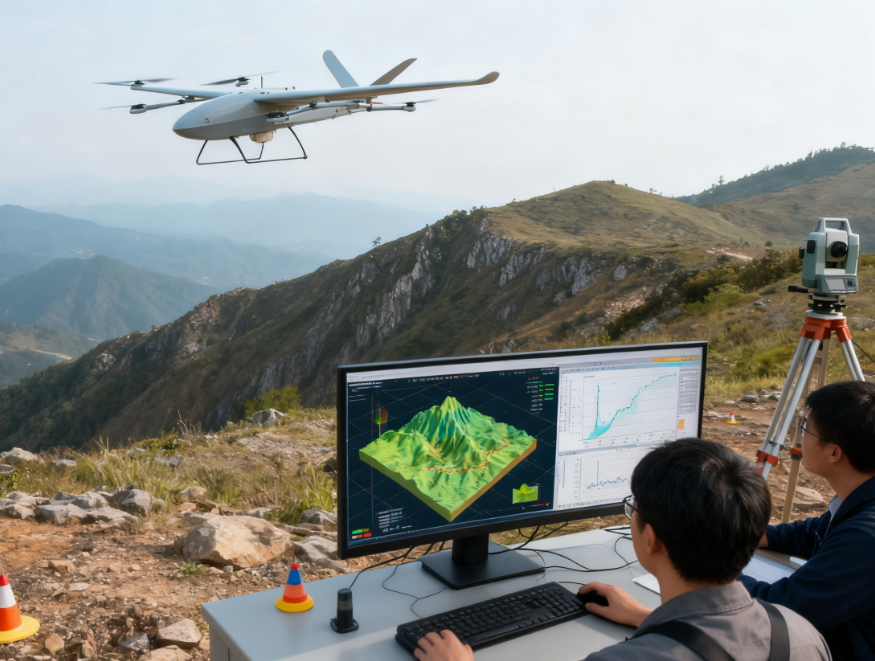
Drone Surveying for Mountain Railway Route Selection
Project Overview
A railway route selection project in a mountainous area faced significant challenges in conducting conventional topographic surveys.
Under the traditional surveying approach, a team of approximately 30 workers required around 4 months to survey only 60 square kilometers.
The complex mountainous terrain also created potential surveying blind spots, making it difficult to obtain comprehensive topographic information for railway route planning.
In 2024, the project introduced vertical take-off and landing (VTOL) fixed-wing drones equipped with LiDAR and oblique photography systems.
The drone-based surveying solution completed a survey of approximately 200 square kilometers in just 3 days.
The high-density topographic data provided the design team with a more comprehensive understanding of the mountainous terrain, supporting more efficient railway route selection and engineering planning.
As a result, the optimized design reduced the required bridge and tunnel works by approximately 20%, saving around RMB 300 million in project investment.
The overall project cycle was also reduced to approximately 1/20 of the traditional surveying time, demonstrating the potential of drone-based surveying for large-scale mountainous engineering projects.
The Challenge
Complex Mountainous Terrain
The railway route selection project was located in a mountainous area with complex terrain. Mountains, valleys, elevation changes, and other geographic conditions made conventional surveying more difficult and time-consuming.
Large Surveying Area
The project required comprehensive topographic information across a large area. However, traditional surveying methods could cover only approximately 60 square kilometers in 4 months.
Large Workforce Requirements
Traditional surveying required approximately 30 workers to conduct field measurements and data collection. This created significant labor and coordination requirements.
Potential Surveying Blind Spots
Complex terrain can make some areas difficult to access through conventional ground surveying. These inaccessible areas can create data gaps or blind spots that affect subsequent route selection and engineering design.
Long Surveying Cycle
The traditional surveying process required approximately 4 months, creating a significant constraint on the overall railway route selection and design schedule.
The Drone Surveying Solution
To improve surveying efficiency and data coverage, the project introduced VTOL fixed-wing drones in 2024.
The drones were equipped with:
- LiDAR
- Oblique photography systems
- High-precision aerial surveying capabilities
The solution allowed the project team to rapidly collect large volumes of topographic data across the mountainous route selection area.
The workflow was:
Aerial Data Acquisition
↓
LiDAR 3D Surveying
↓
Oblique Photography
↓
Topographic Modeling
↓
Railway Route Analysis
↓
Engineering Optimization
Compared with traditional point-by-point ground surveying, the drone-based approach provided broader spatial coverage within a significantly shorter period.
How the Drone Surveying Works
1. Plan the Survey Area
The railway route selection area is divided into designated surveying zones according to the project requirements. Flight routes are planned to provide comprehensive coverage of the target area.
2. Conduct VTOL Drone Flights
The VTOL fixed-wing drones are deployed directly from suitable locations within or near the survey area. The vertical take-off and landing capability provides greater flexibility when operating in mountainous terrain.
3. Collect LiDAR Data
LiDAR sensors collect three-dimensional information about the terrain. This helps generate detailed elevation and topographic data for complex mountainous areas.
4. Capture Oblique Photography
Oblique photography captures images from multiple viewing angles, providing additional visual information about terrain, slopes, infrastructure, and other geographic features.
5. Build Topographic Models
LiDAR and oblique photography data are processed to create detailed digital representations of the surveyed area. These models provide the design team with a more comprehensive basis for railway route analysis.
6. Support Route Selection
The topographic data helps engineers evaluate different railway alignment options and identify potential engineering constraints.
7. Optimize Bridge and Tunnel Design
With a more complete understanding of the terrain, the design team can optimize the railway route and reduce unnecessary bridge and tunnel construction.
Key Technologies
VTOL Fixed-Wing Drones
Vertical take-off and landing fixed-wing drones provide the flexibility required for operations in mountainous areas where conventional runways may not be available.
LiDAR 3D Surveying
LiDAR rapidly captures three-dimensional terrain information and is particularly useful for mapping complex mountainous landscapes.
Oblique Photography
Oblique imagery provides multi-angle visual information that complements LiDAR data and supports more detailed terrain interpretation.
Large-Area Aerial Surveying
The drone system enables large areas to be surveyed within a short period, significantly expanding the coverage achievable through conventional field surveying.
Digital Topographic Modeling
Collected aerial data can be processed into digital terrain and topographic models for engineering analysis and route planning.
Project Results
200 km² Surveyed in 3 Days
The drone-based surveying system completed a survey of approximately 200 square kilometers in just 3 days. This represented a significant expansion in both surveying coverage and speed compared with the traditional approach.
20% Reduction in Bridge and Tunnel Works
The improved topographic information supported railway route optimization and helped reduce required bridge and tunnel works by approximately 20%.
RMB 300 Million in Investment Savings
By optimizing the route and reducing unnecessary engineering works, the project saved approximately RMB 300 million in investment.
Project Cycle Reduced to 1/20
Compared with the traditional surveying timeline, the overall project cycle was shortened to approximately 1/20 of the previous time.
Broader Topographic Coverage
The aerial surveying approach provided comprehensive data across a larger area and helped reduce potential surveying blind spots associated with difficult mountainous terrain.