
10kg vs 30kg vs 50kg Logistics Drone: How to Choose the Right Payload Capacity for Your Transport Needs

Logistics drones are increasingly being used in warehousing and distribution, industrial transportation, medical supply transport, island resupply, and emergency rescue. In practical applications, which type of logistics drone should be chosen: a 10kg, 30kg, or 50kg payload?
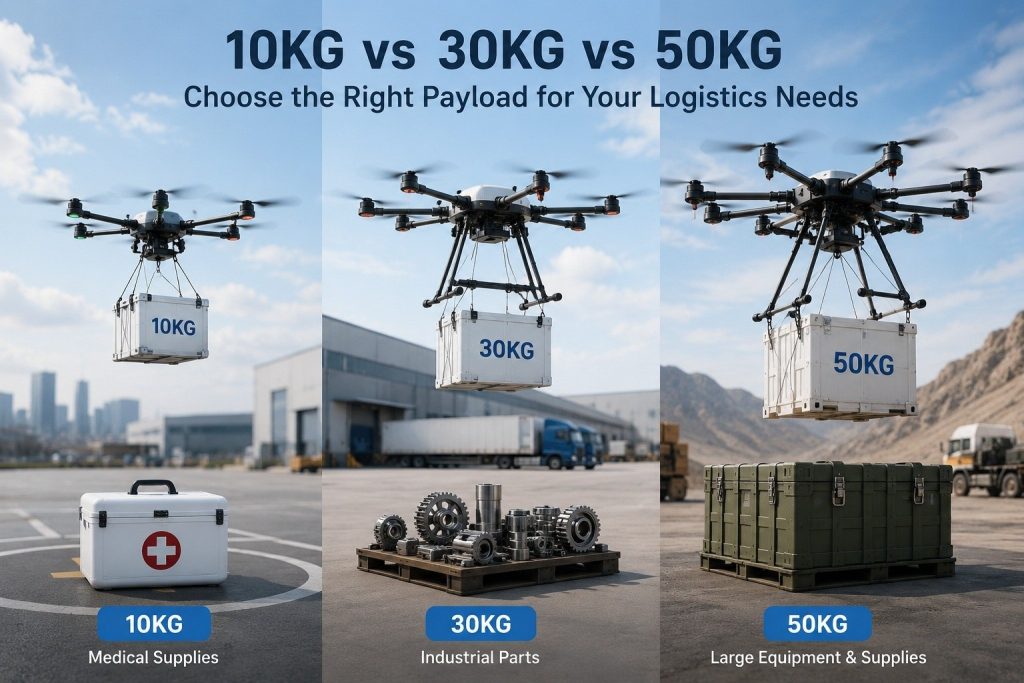
In fact, a larger payload capacity is not always better. It not only affects transportation efficiency but also flight time, range, operating costs, and applicable scenarios.
Table of Contents
Why Is Load-bearing Capacity So Important?
In the field of logistics drones, payload capacity not only represents the maximum weight of cargo a drone can safely transport, but it is also a core indicator for measuring the overall platform’s transport capacity, flight performance, and operational efficiency. According to the International Civil Aviation Organization (ICAO) and multiple drone industry standards, payload is one of the important parameters affecting drone mission planning, energy management, and flight safety, and it is also the first technical indicator evaluated when selecting commercial logistics drones.
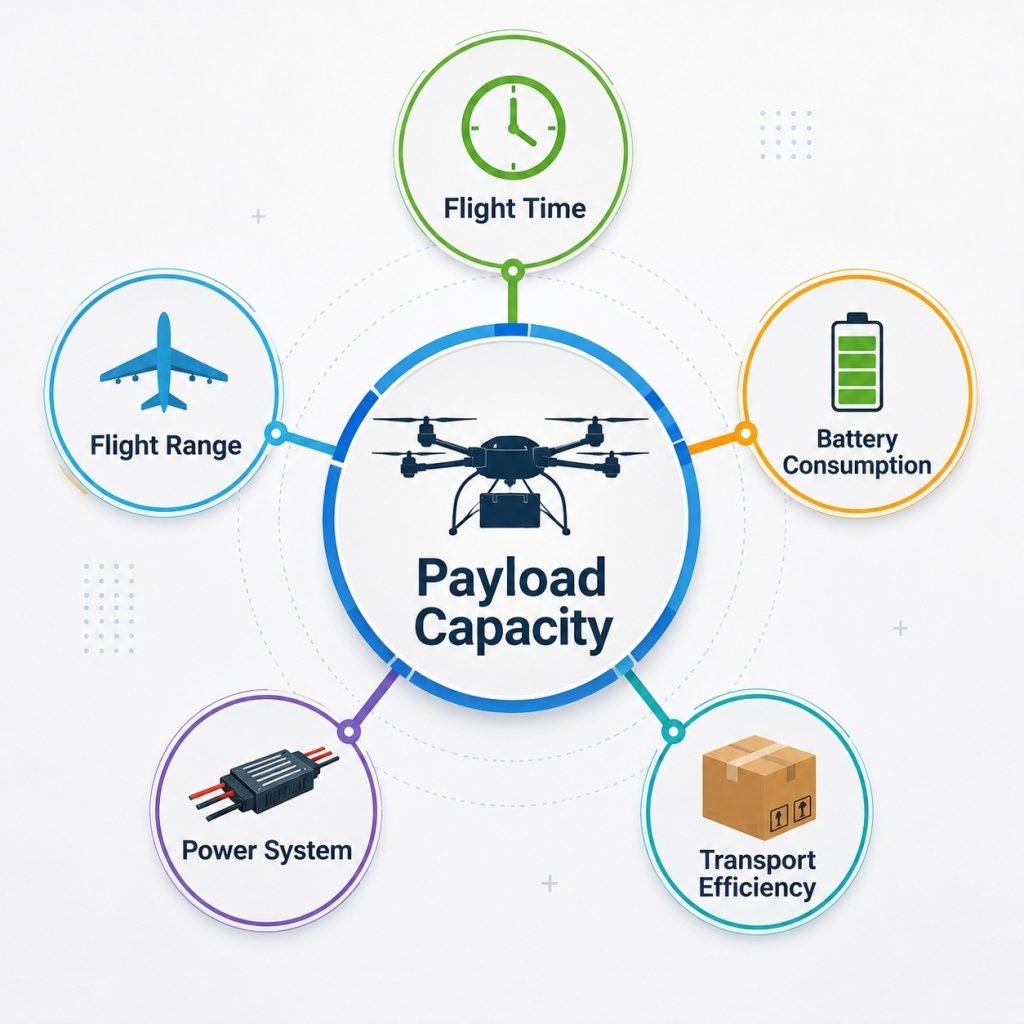
It is important to note that the “maximum payload” listed for logistics drones is usually data obtained under specific test conditions, such as standard atmospheric conditions, low wind speeds, and limited flight distances. In actual commercial transportation, the effective payload also needs to comprehensively consider factors such as flight distance, endurance, ambient temperature, altitude, and remaining battery capacity. Therefore, companies are more concerned with operational payload capacity than just the theoretical maximum payload.
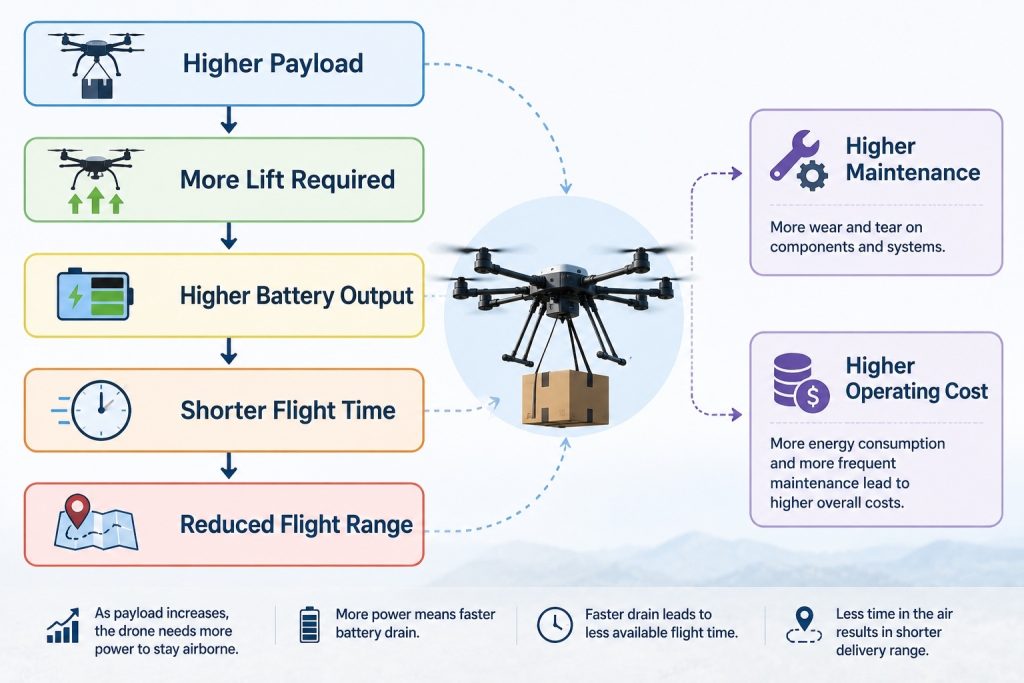
From an engineering perspective, payload capacity directly affects several key performance parameters of a drone. As the load increases, the flight control system needs to output more lift, the power system operates under higher loads, and the battery discharge rate increases accordingly. This ultimately has a cascading effect on overall aircraft performance, including:
- Reduced flight time: Higher power output accelerates battery energy consumption, reducing the endurance for a single mission.
- Decreased effective range: With the same battery capacity, fully loaded flight typically cannot achieve the maximum range under empty or light load conditions.
- Reduced energy efficiency: Increased energy consumption per unit transport weight necessitates a comprehensive assessment of transportation costs and delivery efficiency.
- Increased power system load: Propellers, propellers, and electronic speed controllers (ESCs) operate under high loads for extended periods, affecting system lifespan and maintenance cycles.
- More stringent takeoff and landing conditions: Larger takeoff weights place higher demands on takeoff and landing areas, safety redundancy, and flight stability, particularly in mountainous, island, or complex industrial environments.
For logistics operations, payload capacity is not necessarily better the larger it is; it needs to be matched to the transport mission. Choosing a 50kg-class logistics drone for long-term cargo transport, which weighs only 8–10kg, will not only increase procurement costs and energy consumption but may also reduce overall transport efficiency. Conversely, if transport missions frequently operate close to the platform’s maximum load, it may affect flight safety, shorten equipment lifespan, and increase maintenance costs.
What’s the Difference Between 10kg, 30kg, and 50kg Logistics Drones?
Different payload classes are designed for different transportation missions.
| Comparison | 10kg | 30kg | 50kg |
| Typical Cargo | Small parcels, pharmaceuticals | Industrial parts, equipment | Heavy cargo, large materials |
| Flight Endurance | Longer | Moderate | Relatively shorter |
| Flight Range | Longer | Balanced | More affected by payload |
| Battery Consumption | Lower | Moderate | Higher |
| Operating Cost | Lower | Moderate | Higher |
| Typical Applications | Urban delivery, medical transport | Factory logistics, industrial parks | Mining, island supply, emergency response |
It is important to note that actual performance varies among manufacturers due to differences in airframe design, propulsion systems, battery technology, and flight control algorithms. Therefore, payload capacity alone should not be used to evaluate overall flight performance.
Which Payload Capacity Is Best for Different Applications?
When selecting a logistics drone, you should first analyze the weight of the goods to be transported, the transport distance, and the daily transport frequency.
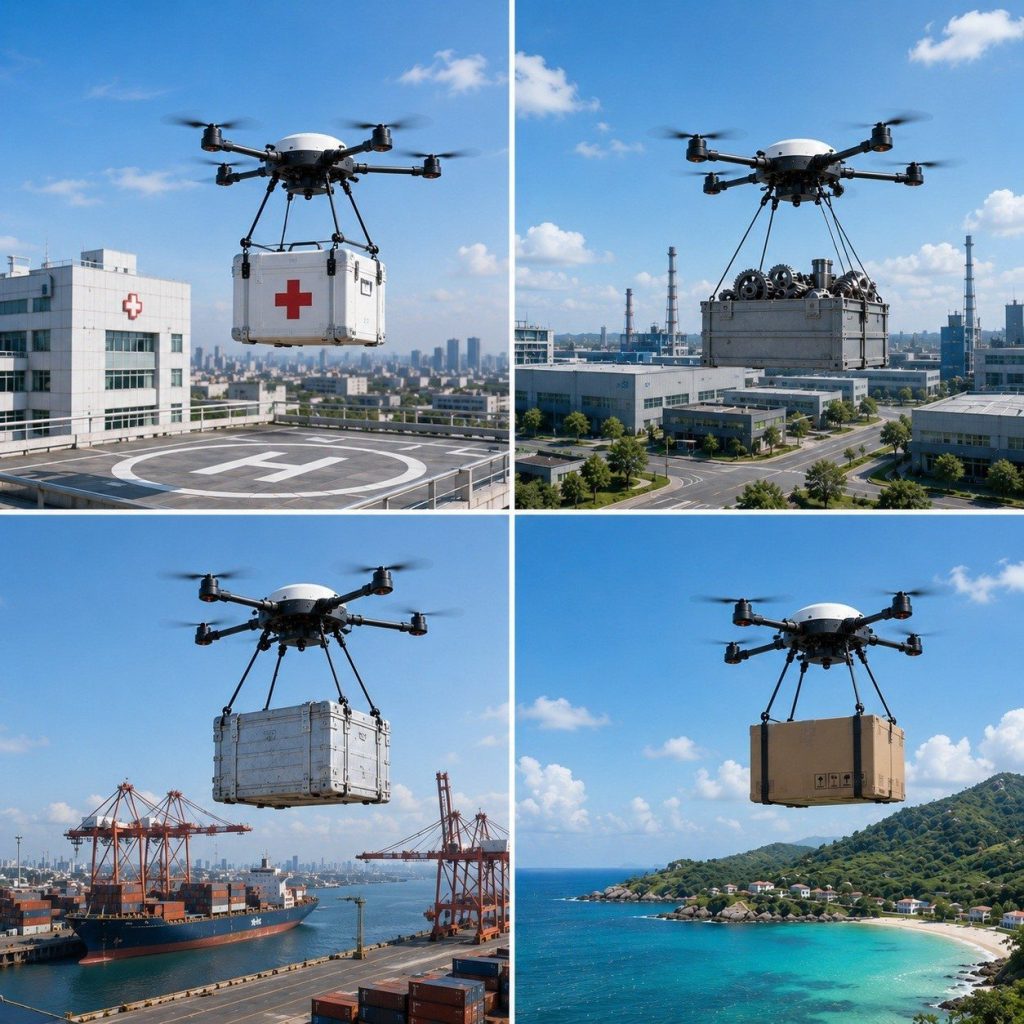
10kg Logistics Drones: Ideal for Lightweight, High-Frequency Deliveries
A 10kg logistics drone is best suited for transporting lightweight cargo such as medical samples, pharmaceuticals, small e-commerce parcels, documents, and emergency supplies. These platforms generally offer longer flight endurance and lower energy consumption, making them well suited for short-distance, high-frequency delivery operations.
Typical applications include hospital campuses, university campuses, industrial parks, and urban distribution networks, where cargo weight rarely approaches the drone’s maximum payload capacity. In these scenarios, a 10kg platform can reduce operating costs while maintaining efficient and reliable transportation. For organizations focused on rapid response and frequent deliveries, this payload class is often the most economical solution.
30kg Logistics Drones: A Balanced Choice for Industrial Logistics
The 30kg payload class is widely regarded as one of the most versatile options for industrial logistics, offering an effective balance between payload capacity, flight range, and operational efficiency. As a result, it has become one of the most commonly deployed payload categories in commercial drone logistics.
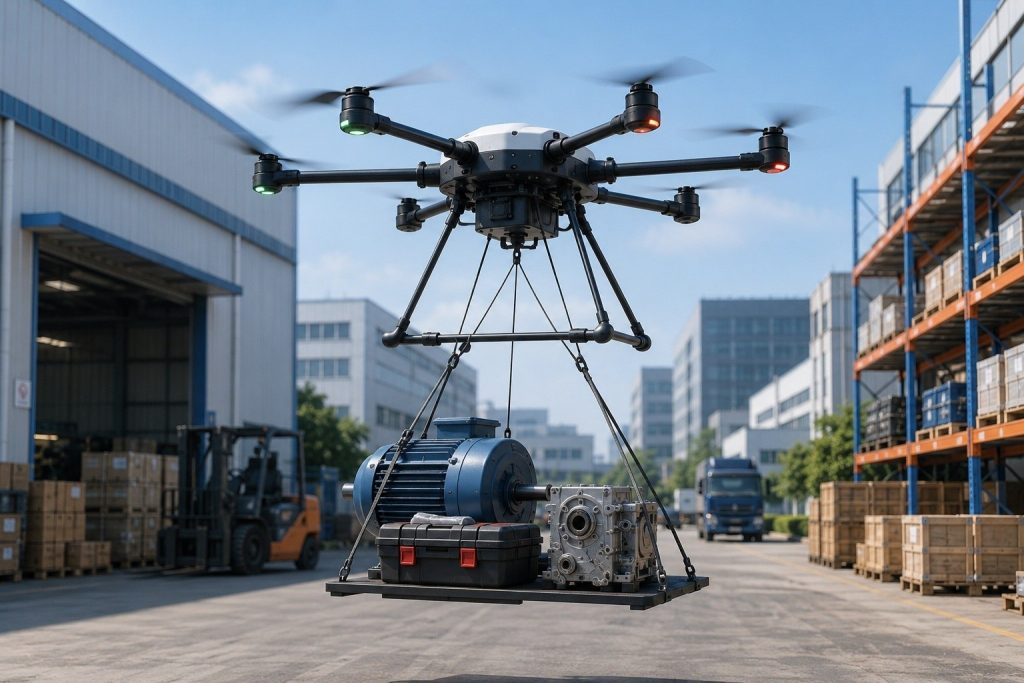
Typical use cases include warehouse-to-warehouse material transfer, factory component delivery, power utility inspection equipment transport, and logistics within industrial parks or port facilities. For businesses that need to transport medium-weight cargo while maintaining efficient operations and reasonable operating costs, a 30kg logistics drone often provides the best overall balance.
50kg Logistics Drones: Designed for Heavy-Duty and Specialized Transport
A 50kg logistics drone is primarily intended for heavy-duty transportation tasks, including mining supply delivery, emergency response equipment transport, large industrial component distribution, island resupply, and logistics operations in challenging terrain. These platforms are capable of carrying larger and heavier cargo, making them particularly valuable in locations where conventional transportation is inefficient or inaccessible.
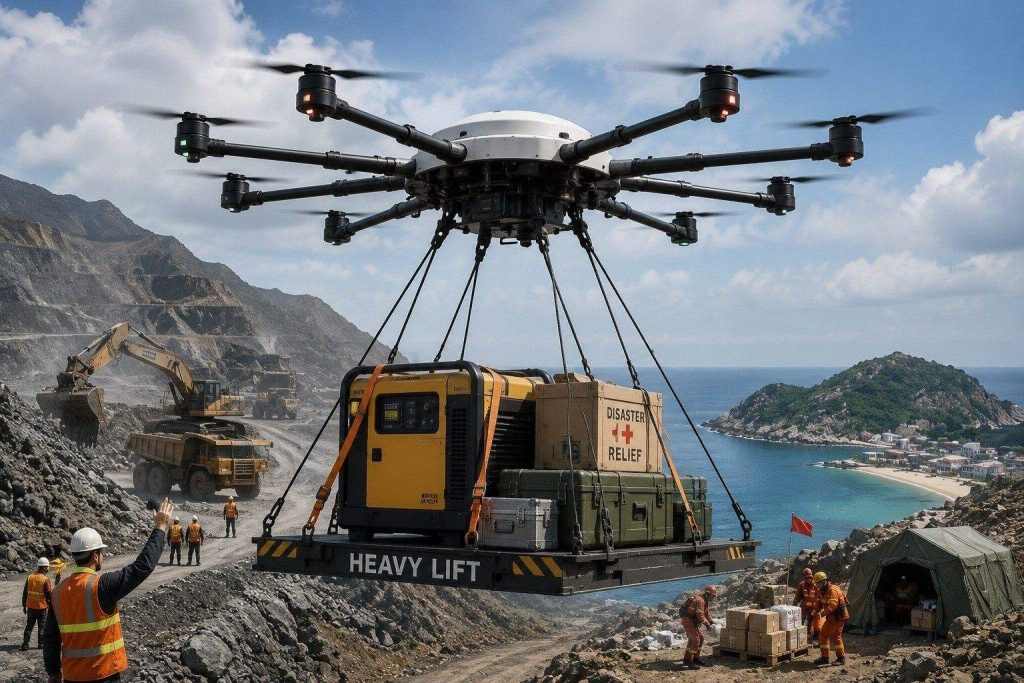
However, higher payload capacity also comes with increased energy consumption, stricter takeoff and landing requirements, and more complex flight planning. For this reason, 50kg logistics drones are generally better suited to specialized transportation missions rather than routine logistics operations.
Industry Insight: Based on practical experience from international drone logistics projects, when purchasing logistics drones, priority should be given to analyzing the average weight of goods transported daily and the main transportation scenarios. Then, a comprehensive comparison should be made of factors such as full-load range, flight time, transportation frequency, and operating costs, rather than focusing solely on the “maximum payload” parameter.
Does a Higher Payload Always Mean a Shorter Flight Range?
This is one of the most frequently asked questions during the purchasing process.
In general, under the same aircraft platform and propulsion system, increasing payload results in shorter flight endurance and reduced flight range because the drone consumes more energy to generate the additional lift required.
However, payload is only one factor affecting flight range. Other important variables include:
- Battery capacity and battery type
- Flight speed
- Flight altitude
- Wind conditions and weather
- Flight route planning
- Propulsion system efficiency
Therefore, when comparing logistics drones with different payload capacities, buyers should evaluate fully loaded flight range and fully loaded flight endurance, rather than focusing solely on maximum payload specifications.
FAQs
1. Which payload capacity is best for logistics applications?
The ideal payload depends on cargo weight, transportation distance, and delivery frequency. In many industrial applications, 30kg offers a good balance of payload, flight range, and operating cost, while heavier missions may require 50kg or higher.
2. Does a higher payload reduce flight range?
Generally, yes. Heavier payloads increase power consumption, which can reduce flight endurance and range. Battery capacity, propulsion efficiency, weather conditions, and flight speed also affect overall performance.
3. How do I choose the right payload capacity?
Evaluate your average cargo weight, delivery distance, and daily transport volume. Selecting a drone based on actual operating requirements is more efficient than choosing the highest payload available.
4. Can logistics drones be customized?
Yes. Commercial logistics drones can be customized with different payload capacities, cargo boxes, battery systems, communication modules, and mission-specific equipment to meet various operational requirements.
5. Do you offer heavy-lift logistics drone solutions?
Yes. In addition to standard payload classes such as 10kg, 30kg, and 50kg, heavy-lift logistics drone solutions can be developed for applications requiring larger payload capacities and specialized transportation missions.
6. What should I compare besides payload?
Besides payload capacity, buyers should also consider flight range, endurance, MTOW, wind resistance, charging efficiency, operating cost, and maintenance requirements to evaluate overall performance.