
Highway Sign Cleaning: What are the Best Practices?

In modern transportation networks, highway signs serve as the first line of communication for directing traffic, conveying speed limits, and warning drivers of potential hazards. However, highway signs that are continuously exposed to outdoor environments inevitably suffer from exhaust fumes, road dust, mud, bird droppings, and UV-related aging.
For Departments of Transportation (DOTs), municipal maintenance agencies, and road maintenance contractors, how to carry out highway sign cleaning efficiently, safely, and cost-effectively directly affects nighttime driving safety, the appearance of transportation infrastructure, and the service life of road assets.
This article explores why highway sign cleaning is important, compares traditional and modern cleaning methods, and explains best practices for implementing professional highway sign cleaning projects.
Table of Contents
Why Is Highway Sign Cleaning Important?
Highway signs need to remain clear, visible, and easy to recognize at all times. This is particularly important at night, during rainy weather, or in high-speed driving environments, when clear signs help drivers obtain important road information in time.
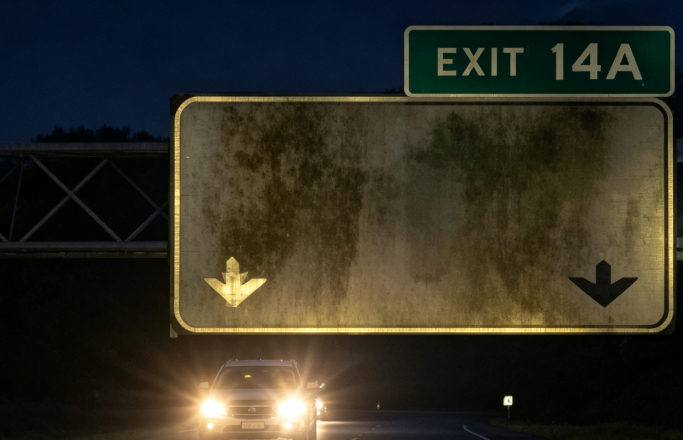
One might think that the outdoor signs are clean since they have been rinsed by the rains. However, this is far from the truth since oil and other particulate matter in the exhaust of cars attach themselves to the signs, which are constantly exposed to the sun, and rain does not rinse them off.
1. Reduce Legal and Compliance Risks
Regulations governing transportation as well as guidelines for maintaining roads might require that highway signage be clear and visible.
If highway signage is excessively contaminated, damaged, or obscured and leads to an accident, then there could be increased liability on the part of the transportation agency and maintenance personnel.
Regular inspection and cleaning can therefore form an important part of a broader road infrastructure maintenance program.
2. Extend the Service Life of Sign Assets
Long-term accumulation of acidic residues, de-icing salts, and industrial dust can accelerate deterioration of aluminum or steel sign panels and their structural components.
Regular professional cleaning can help remove potentially corrosive contaminants and reduce the long-term impact of environmental exposure, helping extend the service life of highway signs and reduce premature replacement.
3. Restore Retro-Reflectivity
Modern highway signs commonly use microprismatic or glass-bead reflective sheeting, which relies on headlights to produce strong nighttime retro-reflection. When the surface becomes covered with oil, dust, and other contaminants, its reflective performance can be reduced, making it more difficult for drivers to clearly see speed limits, exit information, and warnings from a safe distance.
Regular cleaning helps maintain the visibility and readability of highway signs, especially in low-light conditions.
What Causes Highway Signs to Get Dirty?
The environment surrounding highway signs is subject to various contaminants from different sources, but no two signs will come into contact with the same contaminant.
Some of the main sources of contamination are:
Dust and Dirt
Particles of dust, sand, or any other dirt that may be produced by vehicles passing through are likely to settle on signs.
Vehicle Exhaust and Road Contamination
Vehicles running on roads create a lot of pollutants and exhausts that may settle on highway signs.
Mud and Road Spray
During rainy weather or when roads are wet, passing vehicles can create mud and water spray. This can contaminate lower-positioned road signs and nearby roadside infrastructure.
Bird Droppings and Insects
Bird droppings, insects, and other organic contaminants are also common. If these contaminants remain on a sign surface for an extended period, they can become more difficult to remove.
Salt and Coastal Pollution
Highways located near coastal areas may experience increased exposure to airborne salt and marine environments, which can increase maintenance requirements for road infrastructure.
Therefore, an effective road sign cleaning strategy should be adapted to local climate conditions, road environments, and specific types of contamination.
How Are Highway Signs Cleaned?
Highway sign cleaning can generally be performed using manual cleaning, truck-mounted equipment, or cleaning drones. Each method is suitable for different sign heights, sizes, contamination levels, and site conditions.
Way 1. Manual Cleaning
As regards low-level and easily accessible road signs, the personnel could normally employ manual cleaning with brushes, water, and proper cleaning solution.
Such type of cleaning is rather versatile and easy to accomplish, as only basic tools are needed for it. Nevertheless, the situation changes drastically, when the signs have been set up at greater height. In this case, some special access equipment becomes necessary.
Way 2. Truck-Mounted Cleaning Equipment
In the case of large highway maintenance projects, cleaning equipment can be mounted on vehicles. Examples of the systems include water tanks, pressure washers, telescopic booms, cleaning brushes, and lifting equipment.
Such a system can provide adequate water supply and cleaning pressure to clean large highway signs and other road infrastructures.
But practical operation should also take into consideration vehicle access, traffic control, work-zone conditions, space constraints, and overall safety of the site.
Way 3. Cleaning Drones
With the development of cleaning drone technology, cleaning drones have become an additional option for certain high-altitude infrastructure cleaning applications.
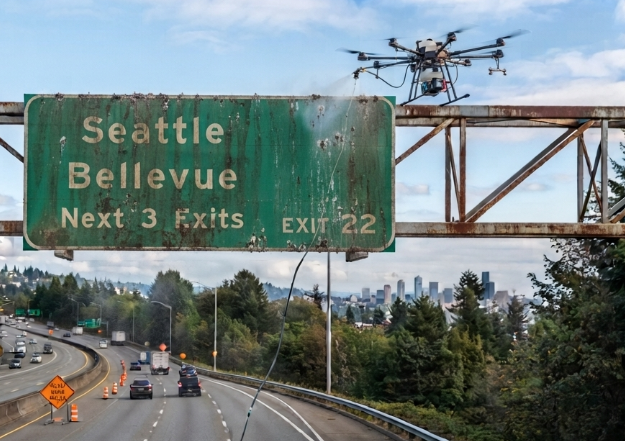
For elevated highway signs, overhead signs, large road signs, and other surfaces that are difficult to access directly, cleaning drones can be operated from the ground. Under suitable operating conditions, they can reduce the need for workers to directly approach elevated surfaces.
Compared with conventional work-at-height methods, cleaning drones may be particularly useful for certain elevated infrastructure cleaning tasks. However, they should not be considered a complete replacement for manual cleaning or truck-mounted equipment.
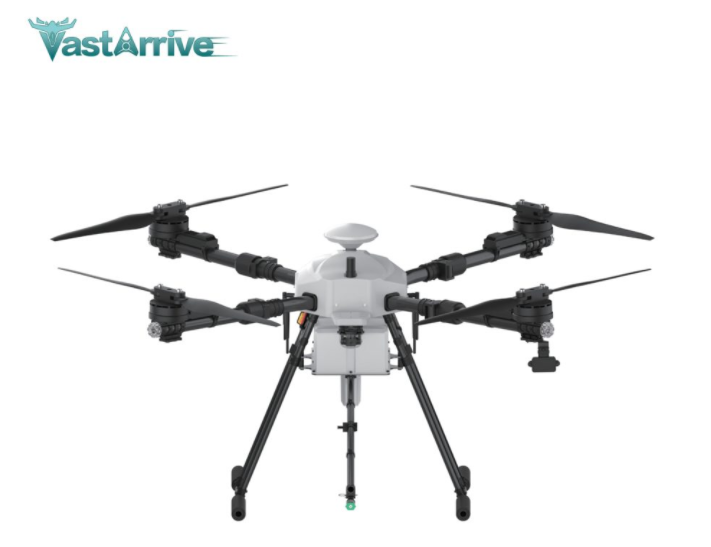
VastArrive D15R Cleaning Drone for Highway Sign Cleaning
VastArrive D15R is designed for high-altitude cleaning applications and can be used for elevated surfaces. For highway signs and other elevated infrastructure, its suitability can be evaluated based on actual site conditions and project requirements.
Actual application should be evaluated based on sign height, structure, size, contamination level, surrounding environment, and local regulations.
For highway authorities and infrastructure maintenance contractors, selecting the right cleaning method requires consideration of cleaning efficiency, worker safety, equipment requirements, and project cost, followed by a cleaning strategy based on actual site conditions.
Challenges of Traditional Highway Sign Cleaning
Traditional road sign cleaning methods have been widely used for highway and road infrastructure maintenance. However, when dealing with elevated, oversized, or difficult-to-access signs, conventional methods may present several challenges.
Working at Height
Some large highway signs are installed at considerable heights. Traditional cleaning methods may require aerial work platforms, boom lifts, ladders, or other work-at-height solutions.
Workers must physically approach the sign surface and perform cleaning operations at height, which means projects may require additional safety planning, protective equipment, and work-at-height procedures.
Traffic Management
When the sign is placed above lanes on the highway, adjacent to the shoulder, or in some other area where there is much traffic, then a work zone for the maintenance vehicle and staff to operate might be needed. Thus, appropriate traffic controls should be in place. Where the highway carries heavy traffic, it can be an operational problem to do cleaning without interrupting traffic.
Difficult-to-Reach Areas
Some large overhead signs, elevated signs, and structurally complex road facilities may contain areas that are difficult for conventional equipment to access directly.
When boom lifts or maintenance vehicles are restricted by road space, sign structures, or surrounding infrastructure, equipment positioning and cleaning operations can become more complicated and may require additional preparation.
Labor and Equipment Requirements
Traditional cleaning projects may require multiple personnel and types of equipment, including cleaning operators, traffic control personnel, lifting equipment, maintenance vehicles, water supply, and safety equipment.
For large highway networks that require regular maintenance, this can involve significant labor, vehicle, and equipment resources.
Therefore, improving overall maintenance efficiency while maintaining cleaning quality and worker safety remains an important consideration for road authorities and maintenance contractors.
Advantages of Using Cleaning Drones for Highway Signs
For certain elevated road signs, cleaning drones can serve as an additional tool alongside traditional cleaning methods.
Reduce the Need for Direct Work at Height
Cleaning drones can be controlled by operators from the ground, reducing the need for workers to physically climb or directly approach elevated surfaces.
This can be particularly useful for high-positioned road signs and other difficult-to-access structures.
Access Elevated Signs
Conventional ground-based equipment may be limited by height, available space, and road conditions.
Cleaning drones can be evaluated for specific elevated surfaces and may be suitable for applications such as:
- Highway signs
- Overhead signs
- Roadside structures
- Large traffic signs
- Elevated infrastructure
Potentially Reduce Traffic Disruption
Under suitable site conditions, cleaning drones may reduce the need for certain large ground-based equipment to enter the work area.
However, whether traffic disruption can actually be reduced depends on the road type, drone size, operating area, local safety requirements, and applicable regulations.
Improve Maintenance Flexibility
For maintenance teams responsible for large numbers of road infrastructure assets, cleaning drones can serve as a complementary tool.
They may be particularly useful in situations where a surface needs to be cleaned but conventional equipment cannot quickly or easily reach it.
What Equipment Is Used for Highway Sign Cleaning?
When selecting highway sign cleaning equipment, factors such as sign height, size, material, contamination type, and road environment should all be considered.
| Cleaning Method | Suitable Applications | Key Considerations |
| Manual Cleaning | Small, low-positioned signs | Labor requirements and cleaning efficiency |
| Pressure Washing | Large signs that are easily accessible | Water supply, pressure, and drainage |
| Boom Lift | Elevated highway signs | Work-at-height requirements and equipment access |
| Truck-Mounted System | Large-scale road maintenance projects | Vehicle access and available site space |
| Cleaning Drone | Elevated or difficult-to-access surfaces | Operation, safety, and site conditions |
For simple, low-positioned signs, traditional cleaning methods remain highly practical.
For elevated or difficult-to-access road signs, however, cleaning drones can be evaluated as a potential alternative or complementary solution depending on actual site conditions.
Highway Sign Cleaning: Best Practices
Regardless of whether you use conventional equipment, a truck-mounted cleaning system, or a cleaning drone, planning a good workflow is crucial.
A good cleaning procedure may increase the efficiency of the cleaning process and at the same time prevent any damage to sign surfaces and infrastructure.
Step 1: Check the Sign
Before starting to clean, inspect the road sign thoroughly regarding its sign state, surface material, type of dirt, mounting system, height, and surroundings.
An inspection of the real state of the sign will help assess the contamination level and the right choice of cleaning methods.
Step 2: Select the Suitable Cleaning Methods
Depending on the sign location, its size and height, as well as its contamination level, choose the suitable cleaning method.
Signs that are located low and have small sizes may be washed manually. Large signs located high above the ground can be cleaned using different options.
Step 3: Use Appropriate Cleaning Solutions
Apply appropriate cleaning techniques and cleaning agents, based on the nature of the material from which the sign is made.
Do not use any substances or devices that can harm the surface of the sign.
When working with signs having reflective sheeting or other surface coatings, it is important to avoid the use of too much friction or water pressure.
Step 4: Consider Traffic Conditions
Highways are dynamic traffic environments, so cleaning operations must consider both cleaning performance and personnel safety.
Before starting work, assess traffic flow, road speed, work zone, equipment position, operator safety, and local regulations. Appropriate work zones and safety procedures should then be established based on actual site conditions.
Step 5: Inspect After Cleaning
Once the cleaning process is over, the sign should be checked for visibility, surface integrity, reflective surfaces, and structural integrity.
Should there be any contamination, surface problems, or structural problems, further cleaning and maintenance can be arranged. This will help guarantee that the highway signs have continued good visibility and work in proper working condition.
Cleaning Drones vs. Traditional Highway Sign Cleaning
Cleaning drones and traditional cleaning methods should not simply be viewed as competing technologies where one replaces the other.
Depending on the highway section, sign height, sign type, and site environment, maintenance teams should select the most appropriate tools for each specific application.
The following table provides a more direct comparison between traditional cleaning methods and cleaning drones:
| Comparison Factor | Traditional Cleaning | Cleaning Drones |
| Low-positioned signs | Highly suitable and efficient for large-scale work | May not be necessary and could be excessive for simple applications |
| Elevated signs | May require aerial work platforms or workers to access the sign | Can be evaluated for direct access to elevated surfaces |
| Need for work at height | May be required in certain situations, creating additional safety considerations | Can significantly reduce the need for workers to directly access elevated surfaces |
| Dependence on ground equipment | Usually requires maintenance vehicles, lifting equipment, or water trucks | Can reduce reliance on heavy ground-based equipment in suitable applications |
| Traffic impact | Depends on equipment and work-zone requirements; may affect traffic | May reduce ground-level traffic interference under suitable conditions |
| Complex environments | Equipment mobility may be limited by terrain and surrounding infrastructure | Aerial mobility can provide greater flexibility in certain environments |
| Personnel requirements | Typically requires conventional equipment and maintenance training | Requires specialized drone operation skills and technical training |
| Large-scale maintenance | Mature and reliable primary solution | Currently better suited as a complementary solution for specific applications |
Therefore, the most effective highway sign cleaning solution is usually not based on a single piece of equipment.
Instead, maintenance teams can combine conventional truck-mounted equipment with cleaning drones according to road conditions, sign types, and site requirements to achieve an appropriate balance between safety, cost, and efficiency.
How to Choose a Highway Sign Cleaning Solution?
When selecting the right highway sign cleaning solution, cleaning performance should not be the only consideration. Sign height, size, surface material, contamination type, traffic conditions, and site accessibility should all be evaluated.
Sign Height
Sign installation height directly affects the choice of cleaning method. Low-positioned signs can usually be cleaned manually or with ground-based equipment. Elevated or overhead highway signs may require aerial work platforms, telescopic equipment, or cleaning drones.
Sign Size
Large highway signs generally have a larger surface area and therefore require consideration of cleaning coverage and operational efficiency.
For large signs, equipment that can provide stable and continuous coverage across the entire surface can be particularly valuable.
Surface Material
There can be various types of materials used on different types of highway signs. Thus, care must be taken to choose the right amount of water pressure, cleaning technique, and cleaning chemicals in order not to damage the sign surface and its ability to reflect light.
Dirt Type
Various types of dirt need different approaches to clean them. For instance, regular dirt may be easier to clean than mud, bird waste, oil contamination, and so on.
Site Accessibility
Site accessibility is another important factor when selecting equipment. If large vehicles, boom lifts, or other ground-based equipment cannot easily reach the work area, more flexible cleaning equipment, such as cleaning drones, may be evaluated.
Traffic Conditions
Most highways have heavy vehicular traffic, and the cleaning process requires consideration for vehicle movement, working zone, and the total occupied area of the road by the cleaning equipment.
In case of heavy traffic, the maintenance crew can think of working procedures that cause minimal disruptions but still meet all safety guidelines.
Safety Requirements
Safety is always a priority when choosing a cleaning process of highway signs.
Besides safety of workers, the equipment operating, traffic, infrastructure, and environment are other considerations within safety guidelines.
Conclusion
Highway sign cleaning is an important part of highway infrastructure maintenance. Regular cleaning helps maintain sign clarity and visibility, allows drivers to receive accurate road information, and helps keep transportation infrastructure in good condition.
Traditional methods such as manual cleaning, pressure washing, and truck-mounted cleaning systems remain practical and effective for many highway maintenance applications. However, for elevated, overhead, or difficult-to-access highway signs, cleaning drones can serve as a flexible complementary solution. Under suitable operating conditions, they can reduce the need for workers to directly perform certain work-at-height tasks.
Therefore, when selecting a highway sign cleaning solution, maintenance teams should consider sign height, sign size, surface material, contamination type, traffic conditions, site accessibility, and safety requirements.
By selecting the appropriate cleaning equipment and method for each specific operating environment, highway authorities and maintenance contractors can improve maintenance efficiency while maintaining appropriate safety and cleaning performance.