
How Long Can a Cleaning Drone Operate on a Single Battery? Understanding Real-World

When planning a building or facade cleaning project, one of the first questions is often how long a cleaning drone can operate before the battery needs to be replaced. However, the maximum flight time shown in specifications does not always represent the time available for actual cleaning. Takeoff, climbing, hovering, movement, water hose load, operating height, wind conditions, and cleaning equipment can all affect real-world endurance.
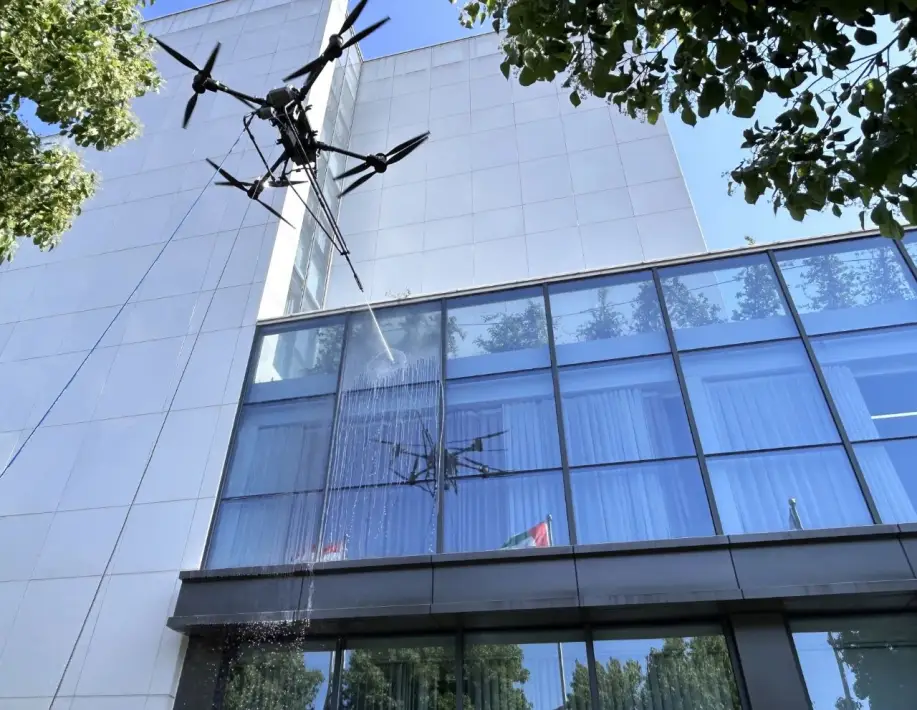
Understanding the difference between rated flight time and effective cleaning time can help operators estimate how many batteries they need and plan continuous cleaning operations more efficiently.
Table of Contents
What Is the Difference Between Rated Flight Time and Cleaning Operation Time?
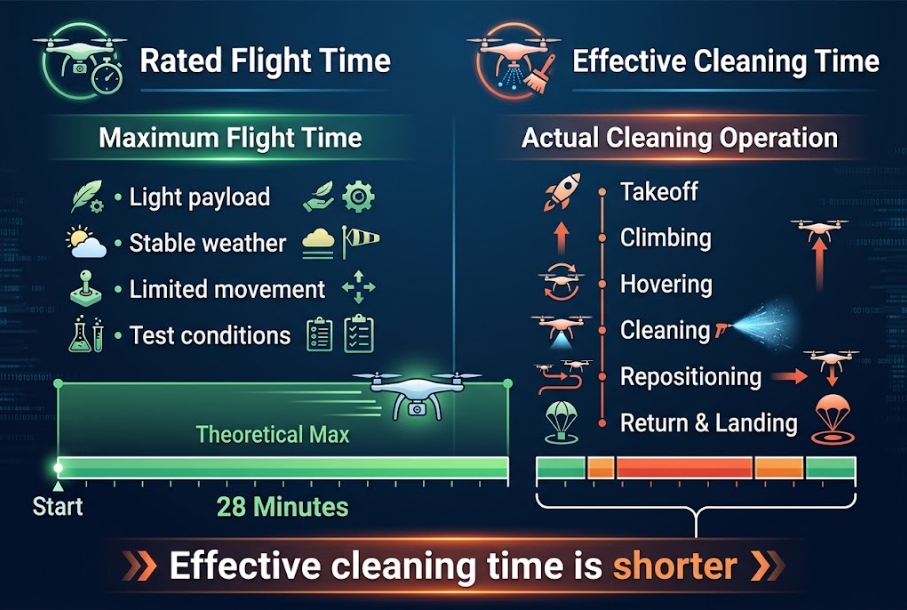
When evaluating a cleaning drone, it is important to distinguish between rated flight time and effective cleaning time. The two figures describe different aspects of drone operation and should not be treated as interchangeable.
Rated Flight Time
Maximum Flight Time or Flight Time generally refers to the maximum endurance measured under specified test conditions. These conditions may involve a relatively light payload, stable weather, and limited operational movement. It provides a useful reference for comparing drone performance, but it does not necessarily represent continuous cleaning time.
Effective Cleaning Time
Effective cleaning time refers to how long the drone can remain operational while performing actual cleaning work. During a cleaning cycle, battery power is also used for:
- Takeoff and climbing
- Positioning and hovering
- Moving between cleaning areas
- Returning and landing
As a result, the time available for actual cleaning is normally less than the rated maximum flight time.
For project planning, effective cleaning time is a more practical figure than maximum flight time, because it reflects how the drone performs under real operating conditions.
What Factors Affect Cleaning Drone Flight Time?
A cleaning drone’s actual flight time depends on more than its battery capacity. The equipment carried, hose configuration, operating height, weather conditions, and flight pattern can all affect power consumption. Understanding these factors is important when estimating cleaning drone battery life for a real project.
Cleaning Payload
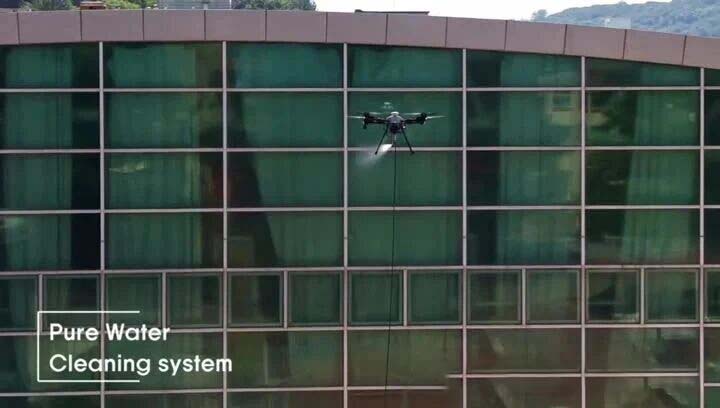
A cleaning drone equipped with full cleaning kits consumes power differently compared to flying with no load. Spray systems, nozzles, mounting brackets and other on‑board devices increase overall weight. Motors have to generate higher lift, which raises battery power draw.
Therefore, maximum flight time obtained under light‑load or no‑load conditions must not be used as expected cleaning duration. Project planning shall be based on the drone’s complete cleaning configuration and actual working payload.
Water Hose Length and Weight
Does a water hose reduce cleaning drone flight time? It can, depending on how the hose is configured and managed during operation.
The relevant factors include hose length, hose weight, the weight of water inside the hose, operating height, hose position, and movement caused by wind. A longer hose does not automatically mean a specific reduction in flight time, but additional hose load and drag can increase the effort required to maintain stable flight.
For high-rise cleaning, hose management therefore becomes an important part of estimating real-world operating time.
Operating Height
Operating at greater heights can affect building cleaning drone flight time because the drone may need to manage a longer hose and greater vertical load. Additional climbing, positioning, and stabilization may also increase energy consumption.
Higher façades can also expose the drone and hose to stronger or less predictable wind conditions. Therefore, battery planning for high-rise projects should consider operating height together with payload, hose configuration, and weather.
Wind Speed and Weather Conditions
Wind can significantly affect drone power consumption during outdoor cleaning. Headwinds and crosswinds may require additional thrust, while gusts can cause frequent position corrections. Maintaining a stable hover against wind can also consume more power than operating in calm conditions.
This means wind resistance and battery planning should be considered together, particularly for exposed façades and high-rise buildings.
Cleaning Mode and Flight Pattern
The way a drone moves during cleaning also affects energy consumption. Continuous hovering, vertical movement, horizontal passes, repeated repositioning, and frequent acceleration or deceleration can place different demands on the motors.
As a result, two cleaning operations with the same total flight time may not consume the same amount of battery. Actual cleaning efficiency and flight patterns should therefore be considered when estimating usable operating time for a project.
How Much Cleaning Time Can You Expect From One Battery?
The cleaning time available from one battery is usually shorter than the drone’s advertised maximum flight time. A practical estimate can be understood through four stages:
Rated Flight Time → Operational Flight Time → Effective Cleaning Time → Usable Cleaning Time With Battery Reserve
- Rated Flight Time: Maximum endurance under specified test conditions.
- Operational Flight Time: Time available after accounting for actual payload, hose, height, and weather.
- Effective Cleaning Time: Time spent performing the actual cleaning work.
- Usable Cleaning Time: Effective cleaning time after allowing a suitable battery reserve for safe operation and return.
For project planning, usable cleaning time is more meaningful than the theoretical maximum flight time. Battery requirements should therefore be estimated based on real operating conditions rather than the rated figure alone.
How Many Batteries Are Needed for Continuous Cleaning?
For projects that require several hours of operation, battery planning is just as important as flight time. The number of batteries required depends on the effective cleaning time per battery, project duration, cleaning efficiency, charging and battery replacement time, number of drones, weather conditions, and the required operating reserve.
How to Estimate Battery Requirements for a Cleaning Project?
A simple project-based calculation can help estimate battery requirements.
Step 1: Determine Project Area
Start with the total area to be cleaned, such as a 10,000 m² building facade.
Step 2: Estimate Cleaning Productivity
Determine the actual cleaning rate in m²/hour. This can vary with surface material, water pressure, contamination level, cleaning method, and operating conditions.
Step 3: Calculate Required Cleaning Hours
Project Area ÷ Cleaning Productivity = Required Cleaning Time
Step 4: Estimate Battery Cycles
Required Cleaning Time ÷ Effective Cleaning Time per Battery = Required Battery Cycles
Step 5: Add an Operational Reserve
Allow additional capacity for weather changes, battery replacement, positioning, unexpected interruptions, and return flight requirements.
The final estimated battery requirement should therefore be based on actual project conditions rather than the drone’s rated flight time alone.
Why Battery Quantity Is Not the Only Factor in Cleaning Efficiency
Having more batteries does not automatically mean higher cleaning productivity. Overall project efficiency depends on how effectively the drone, cleaning system, and operators work together.
Key factors include:
- Cleaning speed: How much area can be cleaned per hour?
- Water supply: Is water available continuously at the required pressure and flow?
- Hose management: Can the hose be managed without creating unnecessary load or drag?
- Battery replacement: How quickly can batteries be changed between operations?
- Charging infrastructure: Can batteries be recharged fast enough to support continuous work?
- Operator workflow: How efficiently are cleaning, battery changes, and repositioning coordinated?
- Weather conditions: Can wind or other conditions interrupt operations?
- Building height: Does the working height affect hose load, positioning, or operating time?
Therefore, a cleaning drone should be evaluated based on usable cleaning productivity and overall workflow—not battery flight time alone.