
Drone for Spraying Pesticides: How It Works, Benefits, and Applications

As modern agriculture continues to move toward smarter and more precise farming practices, agricultural drones are becoming an important tool for crop management. Among them, drone for spraying pesticides has attracted increasing attention from farmers, agricultural service providers, and commercial growers.
Compared with traditional backpack sprayers and ground-based machinery, agricultural drones can perform automated operations along pre-planned flight routes and use spraying systems to apply pesticides, herbicides, fungicides, foliar fertilizers, and other agricultural liquids to crops. For large-scale farmland, orchards, and areas with difficult terrain or limited access for ground equipment, spraying drones can provide a more flexible solution.
So, how does a drone for spraying pesticides work? What are its advantages? What crops can it be used for? And what specifications should you consider when purchasing one? This article will answer these questions in detail.
Table of Contents
What Is a Drone for Spraying Pesticides?
The agricultural sprayer drone is basically a kind of UAV that is built and specially modified for agricultural spraying purposes. The basic construction of such a drone involves fitting it with a tank for spraying liquids, liquid pumps, pipes, nozzles, and a control system for flow rate management.
Some of the key components of the drone include:
- Flight Controller: Controls the drone’s flight and attitude.
- Spray Tank: Stores pesticides, fertilizers, or other agricultural liquids.
- Pump System: Transfers liquid from the spray tank to the nozzles.
- Spray Nozzles: Break the liquid into droplets suitable for spraying.
- GPS/RTK System: Provides precise positioning and supports route-based flight.
- Battery System: Supplies power to the flight and spraying systems.
- Remote Controller: Allows operators to control and monitor the drone.
- Obstacle Avoidance System: Helps the drone detect and avoid obstacles in the operating area.
Unlike conventional camera drones, the primary purpose of a pesticide spraying drone is not aerial photography but efficient and consistent agricultural spraying.
How Does a Drone for Spraying Pesticides Work?
Agricultural drone spraying usually involves several key steps.
1. Fill the Spray Tank
First, prepare the spray solution according to the pesticide product label and local agricultural regulations, then fill the drone’s spray tank.
The tank capacity directly affects the area the drone can cover during a single operation. A larger tank can reduce the number of refills required, but it also increases the drone’s takeoff weight.
2. Plan the Flight Route
The operator can plan the flight route based on the field area, crop distribution, and terrain. Modern agricultural drones can use GPS or RTK positioning systems to follow predefined routes accurately.
During route planning, operators can consider:
- Flight altitude
- Flight speed
- Spray width
- Spray flow rate
- Operating area
- Obstacle locations
3. Take Off and Navigate
After completing the necessary checks, the drone enters the operating area and flies according to the preset route.
For large fields, automated flight routes can reduce overlapping operations and missed areas, making the spraying process more systematic.
4. Apply the Pesticide
During the flight of the drone, the pump system will provide the spray liquid into the nozzles in order to apply the spray liquid at the set flow rate.
The spraying process is influenced by many aspects such as the types of nozzles, flying altitude, flying speed, droplets size, weather condition, and crop canopy. Thus, people have to make the parameters based on the real situations.
5. Return, Recharge, and Refill
After completing an operating area, the drone can return to its takeoff and landing point.
If additional spraying is required, operators can replace the battery and refill the spray tank before starting the next operation.
What Can a Pesticide Spraying Drone Be Used For?
Agricultural spraying drones can be used not only for pesticide application but also for various agricultural operations, depending on the equipment and liquid products being used.
Crop Protection
This is one of the main applications of a drone for spraying pesticides. Drones can be used to apply certain insecticides, fungicides, and other crop protection products to support pest and disease management.
Herbicide Application
Agricultural drones can also be used to apply certain herbicides. By defining specific operating areas, drones can target areas that require treatment and potentially reduce unnecessary spraying.
Fertilizer Application
Some agricultural spraying drones support the application of liquid fertilizers and foliar fertilizers.
Compared with traditional ground equipment, drones can reduce direct contact with farmland and may offer advantages during certain crop growth stages.
Orchard Spraying
Orchards are an important application scenario for agricultural drones. Fruit trees are often planted in environments with complex row spacing, uneven terrain, and limited access for ground equipment. Drones can operate from above, providing a more flexible solution for orchard management.
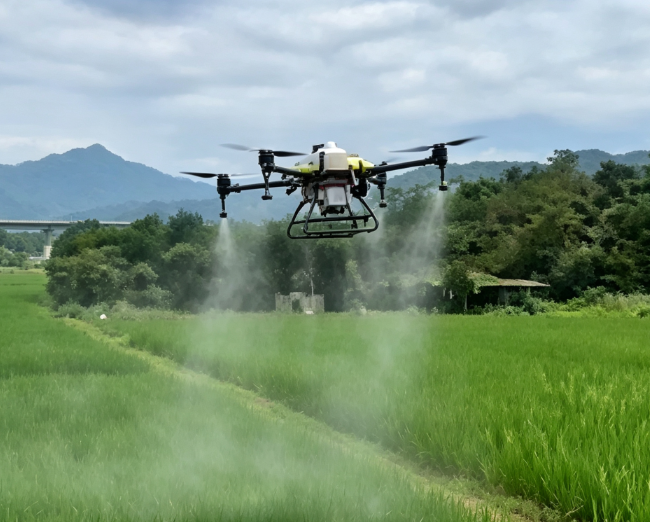
Rice Field Spraying
Rice fields may have muddy or waterlogged conditions that can limit the use of traditional ground machinery.
Therefore, an agricultural spraying drone can be an alternative for spraying rice and other crops under suitable conditions.
Large-Scale Farm Operations
For large farms, drones can use automated route planning and rapid deployment to perform continuous spraying operations.
The use of multiple batteries, several drones, or dedicated refilling equipment can further improve overall operational efficiency.
Benefits of Using a Drone for Spraying Pesticides
As the operational benefits of drone spraying become more apparent, farmers are increasingly interested in adopting drones.
1. Faster Field Coverage
In addition to their quick flights, agricultural drones are capable of covering a wide area in a field using the wide spray range. With efficient planning of the flight path, they may help avoid redundant actions and increase spraying efficiency.
2. Reduced Labor Requirements
Compared with manually operated backpack sprayers, agricultural drones can be controlled remotely from the ground. This reduces the need for workers to directly enter the spraying area and can lower dependence on manual labor.
3. Better Access to Difficult Areas
Drones do not depend on ground access conditions and can operate more flexibly in muddy fields, wetlands, slopes, orchards, and densely planted areas where ground equipment may have difficulty operating.
4. More Precise Application
Advanced spraying drones are usually installed with GPS/RTK, navigation, and flow control systems. They can be used to alter the flight pattern and spraying rates as required. The actual spraying rates must always comply with the pesticide label instructions and regulations.
5. Reduced Crop Damage
Because drones operate in the air, they do not require ground vehicles to drive through the field. This can help reduce crop damage caused by vehicle tires, particularly for certain crops during later growth stages.
6. Flexible Operation
Agricultural drones can adjust flight altitude, speed, spray flow rate, and flight routes according to crop and operating conditions, allowing them to adapt to different agricultural spraying tasks.
Drone Spraying vs. Traditional Pesticide Application
Drones do not necessarily replace traditional spraying equipment in every situation. Different crops, farm sizes, and terrain conditions require different spraying solutions.
Compared with traditional ground equipment, drone spraying offers advantages in flexibility, terrain adaptability, and digital operation. However, ground equipment can still be highly practical for certain large, flat farming areas.
| Comparison Factor | Spraying Drone | Traditional Ground Sprayer |
| Labor Requirements | Relatively low | Usually requires direct operator involvement |
| Terrain Adaptability | More flexible | Limited by ground access conditions |
| Crop Contact | Does not directly contact crops | May cause crop damage through tire contact |
| Route Planning | Supports digital route planning | Usually relies on manual driving |
| Complex Areas | Easier to access | May be restricted by terrain |
| Operational Flexibility | Relatively high | Depends on equipment type and field conditions |
In general, drone spraying is more applicable in situations where fast operation is required, hard terrain must be accessed, or there is little to no contact with the ground equipment.
It is therefore vital that when deciding on which agricultural spraying technique to use, one takes into consideration the nature of the crop, the size of the field, and other factors.
How to Choose a Drone for Spraying Pesticides?
When buying a drone for pesticide spraying purposes, do not be misguided by the maximum payload capacity. The performance of your purchase will depend on many different aspects that include spray tank capacity, flight time, spraying system, precision in positioning, and after-sales support.
1. Spray Tank Capacity
This is the capacity of the drone in terms of the volume of liquid it can hold in one session. A bigger tank may decrease the number of times you have to refuel, but there are other aspects that have to be considered.
2. Flight Time
Flight time directly affects the drone’s continuous operating capability. When comparing models, pay attention to actual flight performance under agricultural operating conditions, rather than only the maximum flight time stated in product specifications.
3. Spray Width
Spray width affects the amount of farmland that can be covered within a given period. A wider spray width can generally improve operating efficiency, but it should be matched with flight altitude, crop type, and nozzle configuration.
4. Flow Rate
Flow control is an important factor affecting spraying performance. A good spraying system should allow the flow rate to be adjusted according to different crops and operating requirements while maintaining relatively stable output.
5. GPS and RTK Positioning
With GPS and RTK positioning, drones may be able to fly steadily on their preset courses. The high accuracy positioning is especially important for those who have specific needs in terms of coverage or repeatability, or who operate in complex agricultural landscapes.
6. Obstacle Avoidance
In case your drone is going to operate primarily in orchards, forests, or other locations where there are a lot of obstacles, it is important to look into the performance of this function in the device.
7. Battery and Charging System
The agricultural drone needs to have continuous capability, which is dependent on battery capability, charging time, and battery exchange systems as well. It can be beneficial to have a fast battery exchange system that will help avoid downtimes and simplify operations.
8. Maintenance and After-Sales Support
In addition to performance characteristics, consider the future cost of maintaining the drone. Before buying a device, evaluate the ease of maintenance of such components as nozzles, pumps, spray tanks, batteries, availability of spare parts, and support from the manufacturer.
In general, in choosing an agricultural drone to apply pesticides, choose various devices depending on the size of the field, crops, and other operational requirements.
How Much Does a Pesticide Spraying Drone Cost?
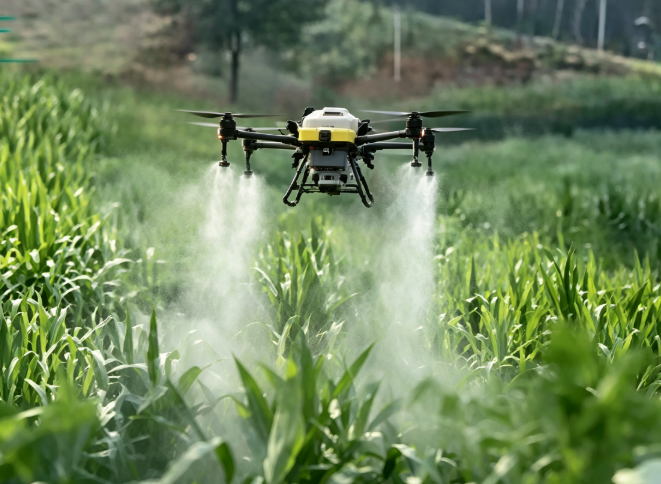
Agricultural spraying drone prices depend greatly on the payload capacity, spraying system, performance, and intelligence of the drones. In general, the entry-level spraying drone price may be estimated at $2,000–$5,000, professional-level spraying drones may have prices about $5,000-$15,000, while professional spraying drones with larger payload capacities and increased automation may cost $15,000-$30,000 and more.
What Affects the Price of a Pesticide Spraying Drone?
Some of the factors that will affect the cost include:
The capacity of the spraying tank, flight time, spraying system, pumping system, nozzle, and GPS/RTK system. The detection of obstacles, automatic flight route planning, battery capacity, remote control system, and after-sales and technical support may also affect the total price of the drone.
Hence, it is advisable not to base the comparison of drones purely on their buying cost. In the case of small farms, drones with a smaller payload capacity may be enough. However, for large farming practices, a drone with a bigger payload capacity, more flight hours, and better efficiency is preferable.
It should be noted that the prices mentioned above are only for reference purposes. Prices will differ according to the brand, specification, geographic location, order quantity, and whether batteries and other accessories are included. It would be better to evaluate the drone by taking into account the area and crops.
VastArrive Drone for Spraying Pesticides
VastArrive Drone for Spraying Pesticides consists of a drone flight platform and a professional spraying system for agricultural purposes, which can include pesticides, herbicides, fungicides, and some liquid fertilizers. In comparison to conventional ground-based spraying machinery, drones do not have to physically move through the field but can fly along predetermined flight paths, and they are therefore ideal for use on farmland, orchards, and difficult terrain in agriculture.
Advantages of VastArrive Spraying Drones
- Effective Operations: Properly planned flights can make it possible to optimize the spraying process over large agricultural zones.
- High Flexibility: Unmanned aircraft can work in muddy soil, wetland, sloping terrain, and places that cannot be reached by ground equipment.
- Minimum Impact on Crop: There is no need for ground machinery to move through crop cultivation zones.
- Precision of Application: Positioning, route planning, and fluid control can make it possible to change the parameters of spraying.
- Multi-Purpose: The equipment is appropriate for various spraying tasks in agriculture.
Are you looking for drones for pesticide application? We offer suitable agricultural drones at VastArrive, depending on the types of crops and other requirements.