
Wind Turbine Blade Inspection Drone: How to Choose the Right Inspection Solution?

With the rapid development of the global wind power industry and the continuous growth of wind turbine installations, turbine blades, as one of the most critical components, directly impact power generation efficiency and equipment safety. However, traditional manual inspection methods suffer from low efficiency, high costs, and significant safety risks. In recent years, wind turbine blade inspection drones have become a vital tool in the wind power O&M (Operations & Maintenance) industry, enabling faster, safer, and more precise blade inspections through high-definition imaging, thermal imaging, and AI-powered smart recognition technologies.
Here, we will detail the working principles, key advantages, detectable defects, core technologies, and procurement selection guide for wind turbine blade inspection drones.
Table of Contents
Why Traditional Wind Turbine Blades Inspection Methods Are Being Phased Out?
Prior to the advent of drones, there were only two ways of doing wind farm inspections:
Rope Access Inspection: Technicians use high-altitude rope access to conduct visual inspection and tap tests more than 100 meters above the ground.
Ground-level Inspection: Technicians erect tripods on the ground and take images of the blades with the help of telephoto lenses or powerful spotter scopes.
Extremely Unsafe and Extremely Complex Conditions: Rope access work is a very dangerous job, requiring extraordinary technical skills and putting technicians at risk due to sudden high winds at high altitudes.
Very Expensive Downtime: Manual inspection of one turbine usually requires 4 to 8 hours. During this time, turbines should be completely shut down, resulting in energy generation losses directly. In bad weather conditions, this process may continue for unlimited periods of time.
Blind Spots in Data Collection and Human Error: Ground level photography has low angles of visibility, occlusions, changing lighting, making it easy to overlook small defects in poorly lit areas such as the blade tips and roots. Also, data collected by hand (on paper) is not digitalized and cannot be used for trend analysis.
What Defects Can Wind Blade Inspection Drones Detect?
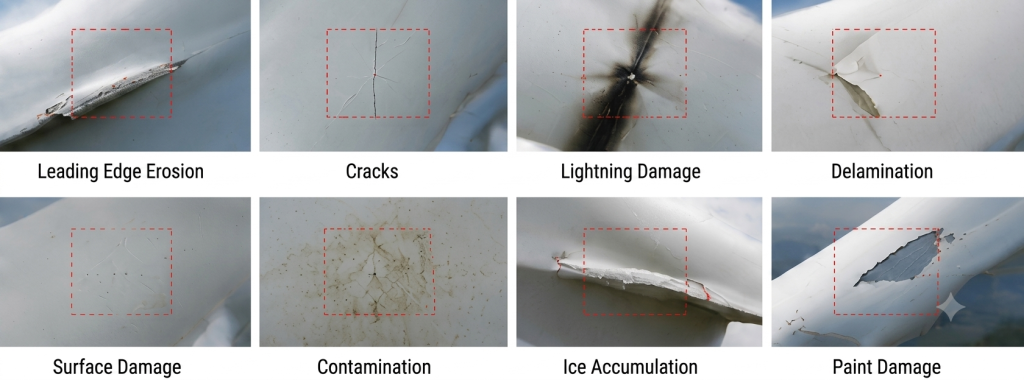
Unlike their predecessors, current inspection drones are capable of capturing images that reveal defects not only on the surfaces of blades, but also, in collaboration with thermal imagery and AI-based software, detecting various defects:
Leading Edge Erosion: Exposure to rain, sand, and hail leads to erosion at the leading edge, thereby reducing the blade’s efficiency and power production capacity.
Cracks in Surfaces: Untimely repair of surface cracks will lead to further damage to the blade structure.
Lightning Damage: Since wind turbines operate in open spaces and are highly vulnerable to lightning, drones are capable of detecting signs of lightning damage, such as ablation and punctures.
Gelcoat Failure: The peeling of the external layer of gelcoat allows for the deterioration of the internal composite structure.
Delamination: Delamination takes place within the internal composite structure. Even though there are no visible signs from the outside, it considerably weakens the blade. With the use of thermal imaging, internal problems become evident.
Contamination/Ice Build-up: Dust, oil, insect residue, or icing of blades affect the performance of turbines. Drones perform rapid inspection of blade surface.
Core Benefits of Drone Inspection for Wind Turbines
Utilizing automated wind turbine inspection drones fundamentally resolves the traditional O&M dilemma of efficiency, safety, and cost:
1. Ultimate Safety (Zero High-Altitude Risk)
Drone inspection achieves “ground-based piloting with zero high-altitude crew exposure.” This completely eliminates severe falling accidents and drastically lowers safety compliance costs and commercial insurance expenditures for wind farm O&M teams.
2. Over 70% Reduction in Downtime
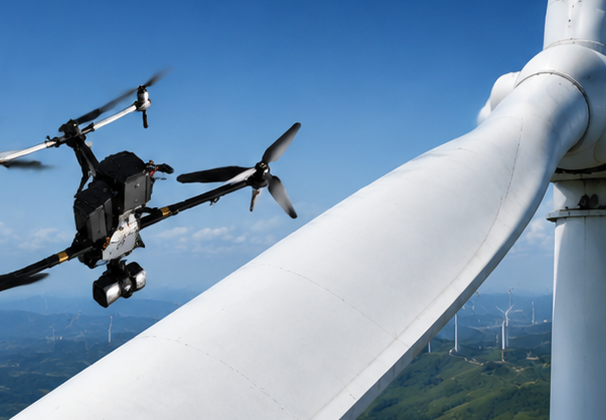
Industrial drones equipped with autonomous flight path planning and centimeter-level RTK positioning systems need only 15 to 30 minutes to complete a 360-degree scan of all 3 blades on a single turbine. Substantially reducing turbine downtime directly recovers potential electricity revenue.
3. Multi-Sensor Fusion: Uncovering “Invisible” Defects
Modern inspection drones are no longer restricted to single visual angles. Instead, they carry composite sensor payloads:
Ultra-HD RGB Cameras: Capture millimeter-level (and sub-millimeter) surface micro-cracks, pinholes, leading-edge erosion, and lightning burns.
Thermal Imaging Array Lenses: Rely on subtle surface temperature gradient changes to penetrate the outer layer, directly identifying invisible deep-layer anomalies like internal delamination, trapped water, and adhesive joint cracking.
4. Digital Asset Management & Predictive Maintenance
Massive HD image data collected by drones is automatically uploaded to a cloud platform. AI computer vision algorithms then perform automated defect detection, localization, categorization, and severity grading.
Wind farm managers can leverage the resulting 3D Digital Twin Model to track defect evolution over time, achieving early warnings for minor issues and early interventions for major ones, preventing small defects from escalating into catastrophic blade breaks.
Wind Turbine Blades Drone Inspection vs. Traditional Rope Access
| Assessment Metric | Traditional Rope Access | Drone Automated Inspection |
| Inspection Time (per turbine) | 4 – 8 hours | 15 – 30 minutes |
| High-Altitude Work Risk | Extreme (Suspended Personnel) | Zero High-Altitude Risk (Ground Control) |
| Data Coverage & Accuracy | Limited by angles; blind spots exist | 100% Blind-Spot Coverage + Millimeter Precision |
| Internal Defect Detection | Very Weak (Visual check / Tap testing only) | Strong (Combined Thermal / Acoustic Imaging) |
| Data Digitalization & Traceability | Paper / Scattered electronic reports; hard to compare | Cloud-based 3D digital models; full historical traceability |
Standard Operating Procedure for Drone Wind Turbine Blade Inspection (Step-by-Step)
An efficient, safe drone blade inspection is not just a simple “fly and shoot” operation. It is a standardized, closed-loop process integrating automated path modeling, multi-sensor acquisition, and AI digital analysis:
Step 1: Site Environment Analysis & Planning of the Inspection Flight Path
Designate dedicated flight inspection paths for the turbine using its specifications, including tower height, length of blades (such as blades of 80m or more in length), and GPS coordinates.
Make sure that wind velocity, visibility, and electromagnetic environment meet safe standards. Inform the wind farm controller regarding locking the turbine and feathering the blades (fixing the blades at specific angles).
Step 2: Autonomous Positioning & Execution
After takeoff, the drone uses onboard RTK high-precision positioning and LiDAR/Ultrasonic obstacle avoidance systems to rapidly lock onto the turbine hub and blade spatial positions.
Following the pre-set contours, the drone performs an automated, close-range scan along the leading edge, trailing edge, pressure side (windward), and suction side (leeward) of all 3 blades at equal distance and speed, without requiring manual flight control.
Step 3: Multi-Modal HD Data Capture
Ultra-HD industrial RGB cameras continuously capture blade exteriors with high image overlap to record millimeter-level details. Concurrently, thermal imaging lenses record surface temperature distributions to detect internal delamination or trapped moisture.
Each photograph automatically embeds real-time drone POS data (latitude, longitude, altitude, camera tilt/gimbal angle) to supply precise spatial positioning for downstream defect mapping.
Step 4: Cloud AI Defect Identification & Classification
After completion of inspection, the data is instantly uploaded to the cloud-based platform in one click. The AI-powered computer vision model reviews the huge amount of images within just a few seconds and automatically detects and tags cracks, leading edge erosion, peeling, and lightning strikes.
Based on the physical size (in terms of length/area and depth), the AI model classifies the severity of damage (for instance, Grades 1-5).
Step 5: Automated Digital Inspection Report Generation
The system outputs a full health assessment report with one click. The report explicitly marks the relative position of every defect on the blade (e.g., XX meters from the blade tip), provides high-resolution zoomed views, lists damage measurements, and suggests maintenance priority levels.
Step 6: Closed-Loop Maintenance & Predictive O&M
O&M teams execute tiered responses based on the report: minor issues are placed into a long-term observation database, while severe structural defects trigger work orders for ground maintenance crews to execute precise repair strategies.
Data from each inspection is automatically archived into the turbine’s 3D digital twin model, enabling year-over-year comparisons to predict defect progression and achieve true predictive maintenance.
How to Select the Correct Wind Turbine Blade Inspection Drone?
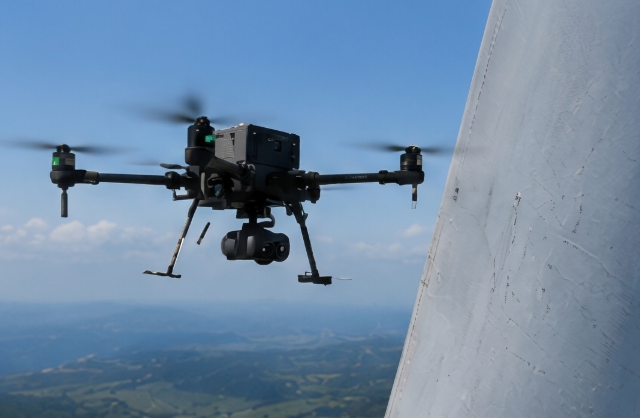
There are plenty of different industrial drones available on the market, yet not all of the available platforms have the capabilities to endure a tough working environment that is typical for a wind farm. Wind farm operators and their O&M service providers should pay attention to five major technical specifications during procurement:
1. Wind Endurance & Environment Adaptation
Wind farms (mostly mountain and offshore wind farms) constantly have strong winds and gusts. The equipment should have wind endurance capabilities of ≥12m/s (Force 6 strong breeze). For offshore inspection, it should have ingress protection rating of at least IP55 and salt-spray corrosion resistance.
2. Accurate Navigation & Safety Systems
The powerful electromagnetic interference around the turbine area might make traditional GPS signals deviate from their course. In this case, drones need to have an RTK module in order to ensure centimeter accuracy. Omnidirectional radar or visual sensors are necessary when working near the blades, usually at 3-10 meters, in order to avoid any collisions due to the operator’s mistake or winds.
3. Payload Capability & Image Resolution
To capture millimeter-level micro-cracks, select cameras with ≥40 Megapixels, large sensor sizes (e.g., 4/3-inch or Full Frame), and mechanical shutters to prevent rolling-shutter distortion during flight. Prioritize composite dual-payload systems supporting RGB HD + Thermal imaging to accomplish surface and internal defect scanning in a single flight.
4. Autonomous Flight & Software Ecosystem
Hardware is only the delivery vehicle; true efficiency depends on software algorithms. Premium inspection drones should be paired with mature, turbine-specific autonomous path planning software. Pilots simply select the turbine model on the ground, and the software automatically generates optimal scanning trajectories, enabling “one-key takeoff, automated scanning, and automated landing”, significantly reducing reliance on pilot experience.
5. Endurance & Battery Management
Flight endurance should be 35 minutes or more under actual operational payload conditions. Features like hot-swappable batteries or fast-charging systems allow a single operator to complete continuous turn-around inspections of 15–20+ turbines per day.
Recommended: VastArrive VA-FPVD13 Industrial Multi-Purpose Inspection Drone
As one of the leading China wind turbine blade inspection drone suppliers, VastArrive offers the VA-FPVD13 drone, a high-performance, multi-purpose drone platform engineered specifically for complex industrial environments. Built with a 13-inch 3K full carbon fiber frame and a high-thrust power setup, it combines incredible performance with high cost-efficiency ($780–$975), making it an ideal choice for wind blade inspections, powerline patrols, security monitoring, and emergency search & rescue operations.
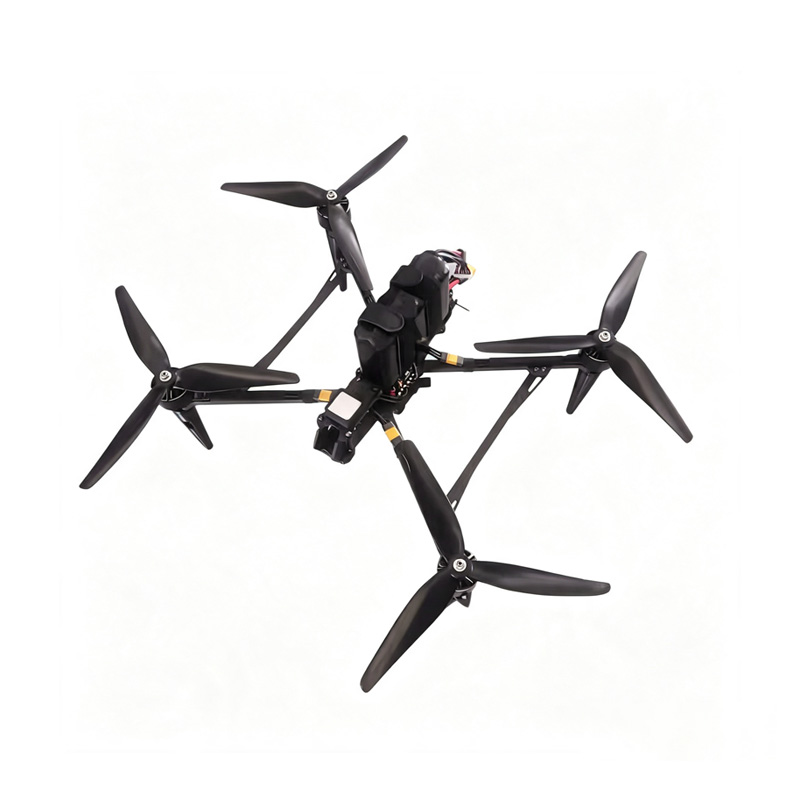
Key Features
Robust Power & Superior Wind Resistance: Equipped with 4218 360KV motors and 1310 glass-fiber nylon propellers, its high-thrust design maintains stable flight and hovering even under strong gusty conditions in mountainous, high-altitude, or coastal wind fields.
25–35 Min Extended Flight Time: Powered by an 8S 16,000mAh high-capacity battery, it delivers 25–35 minutes of hovering and a 10–30 km operating range, allowing a complete multi-angle scan of a wind turbine blade in a single flight.
Durable & Lightweight Industrial Build: Features a 593mm wheelbase 3K T300 full carbon fiber frame, offering structural toughness, vibration resistance, and lightweight agility.
Multi-Modal Expansion & Night-Vision FPV: Supports optional RGB HD cameras and thermal imaging payloads for precise detection of surface cracks and internal delamination. Outfitted with a 3W high-power VTX and an 1800TVL night-vision lens, it performs reliably even in low-light environments.
Versatile Platform with High ROI: Beyond blade inspections, it seamlessly adapts to powerline inspections, PV solar farm hot-spot detection, and emergency supply delivery, maximizing investment returns.
VastArrive is a supplier that deals with specialized drone solutions and industrial drone solutions. Apart from having multi-purpose inspection drones such as VA-FPVD13, the company also has other products including cleaning drones for photovoltaic modules, high altitude washing drones, spraying drones, and security patrol drones. If you need something special, get in touch with us at VastArrive.