How to Clean Solar Panels? 2 Effective Ways

With the global shift toward renewable energy, installing solar panels has become a primary strategy for households and businesses to slash electricity bills and achieve carbon neutrality. However, many owners overlook a critical fact: dirty panels can lead to a drop in power generation efficiency of 5% to 25%.
Here, we will provide a comprehensive guide on how to clean solar panels, covering everything from basic manual procedures to cutting-edge automated cleaning technologies, helping you squeeze every bit of value out of your system.
Why Regular Cleaning of Solar Panels is Critical?
Cleaning your solar panels regularly is not only for reasons of aesthetics; it is, in fact, for the correct management of your green technology investment in order to have excellent performance. The ins and outs of the necessity of doing the maintenance regularly are outlined hereunder:
1. Prevents “Shading Effect” for Maximum Power Production
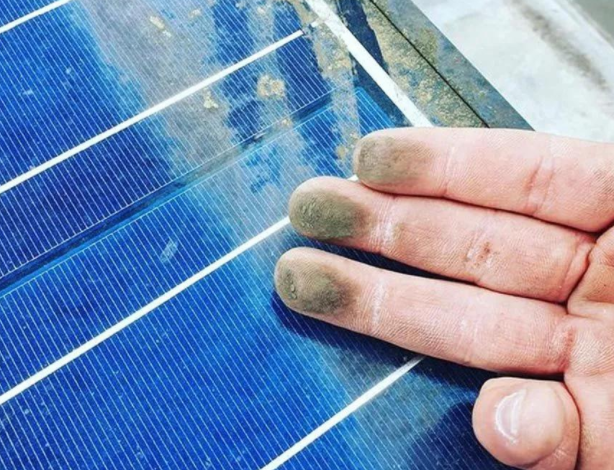
At the heart of solar panels are Photovoltaic (PV) cells, which generate electricity by absorbing photons. When the surface is covered with dust, pollen, industrial soot, or bird droppings, these impurities create a physical barrier that blocks sunlight from reaching the silicon wafers.
Efficiency Loss: Even a seemingly thin layer of dust can cause a drop in power output of 5% to 10%.
Cumulative Effect: In arid or windy regions, grime accumulates rapidly. If left uncleaned, these losses can soar to over 25%.
2. Shortening the Return on Investment (ROI)
Installing a solar system is a long-term investment. The payback period of the system depends directly on its total annual power generation.
The Financial Reality: If your system generates 15% less electricity daily due to dirt, a system that should have paid for itself in 6 years might take 7 years or longer.
Cleanliness = Revenue: Keeping your panels in peak condition means every ray of sunshine is converted into savings, maximizing your electricity bill reductions.
3. Preventing the Devastating “Hot Spot Effect”
This is the most overlooked risk. Localized accumulation of grime—especially hard, opaque bird droppings or thick mud spots—shades individual solar cells.
The Principle: The shaded cell stops generating electricity and instead becomes a “load” in the circuit, consuming energy produced by surrounding cells. This leads to intense localized overheating.
Long-term Consequences: This overheating (Hot Spots) can burn through the backsheet, cause the glass to crack, or even result in permanent cell damage, significantly shortening the lifespan of the entire module.
4. Warranty Compliance and Asset Value
Maintenance: The warranty document provided to their customers by many panel providers states that regular professional maintenance is a part of the contract. This can void the contract and zero the liability in case of system failure derived from exposure to greater heat over time due to negligence, no records being provided at the time of asking for maintenance. Therefore, always properly maintain the system.
Extended Life: Just as your car requires regular servicing to remove corrosive substances (such as acid rain residue or industrial chemical dust) that can slowly age the parts of the system.
Cleaning Tip: It is advisable to clean solar modules at least twice a year. However, in the case of heavy industrial exposure, constructs right on the coastline due to salt spray, or in the case of desert environments (which are dry and very dusty), owing to the wind, you should increase cleaning every quarter.
How to Clean Solar Panels? – 2 Methods
There are essentially two ways: manual and cleaning drone to clean solar panels. The manual system makes use of the traditional touch method of hand scrubbing every solar panel, while automatic drone cleaning sprays and brushes the building or the meadows swaths from the air, giving plenty of time, along with precision and safety, since the operator does not have to come into contact with the system.
Method 1. Using Traditional Manual Method to Clean Solar Panels
Step 1. Pre-Cleaning Preparation: Safety First
Before you pick up a hose, you must follow these professional safety protocols:
Shut Down the Power: The operator’s manual requires all users to turn off the PV system because it protects safety of the Direct Current (DC) system.
Choose the Optimal Time: The most effective time for cleaning activities occurs during early morning hours and late evening hours and overcast weather conditions. The panel surfaces reach their highest temperatures during midday which makes it dangerous to spray cold water because it will create micro-cracks in the glass through thermal shock.
Ground-First Principle: If you can reach the panels from the ground using an extension pole, do not climb onto the roof. If working at heights is unavoidable, ensure you wear professional fall-protection gear.
Step 2: Preliminary Dry Sweep
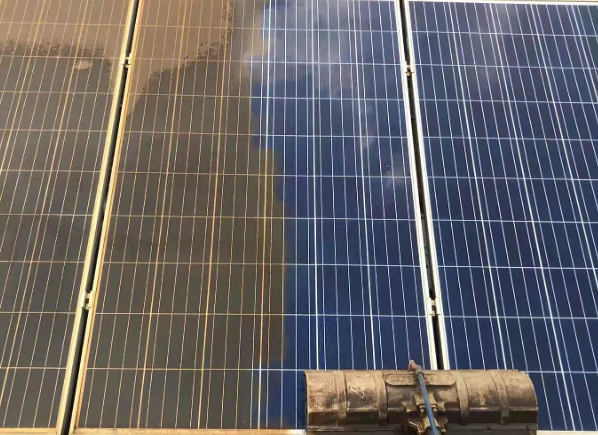
You should use a soft nylon brush or a microfiber brush head to remove loose leaves and twigs and surface dust. The anti-reflective AR coating needs protection from abrasive particles, which require light pressure during handling.
Step 3: Low-Pressure Rinse
You should use a standard garden hose with low pressure to wash the panels. The use of high-pressure washers must be completely prohibited because their powerful water streams will destroy the sealant that protects the module frames, which results in internal moisture entry.
Step 4: Gentle Scrubbing
For stubborn stains, prepare a bucket of lukewarm water with a tiny amount of mild, pH-neutral soap (such as dish soap). Use a sponge or a professional solar cleaning mop to scrub gently in circular motions.
Step 5: Thorough Rinsing
Rinse away all soap residue with clean water. If left to dry, soap residue forms a film that actually attracts dust more quickly.
Step 6: Squeegee Dry
In areas with hard water (high mineral content), it is advisable to use a rubber squeegee to remove excess water. This prevents the formation of limescale or white spots that can block sunlight.
Pro Tip: If you notice cracks or exposed wiring during the cleaning process, stop immediately and contact a professional technician. Never attempt to clean a damaged panel with water.
Method 2. Using Cleaning Drone to Clean Solar Panel
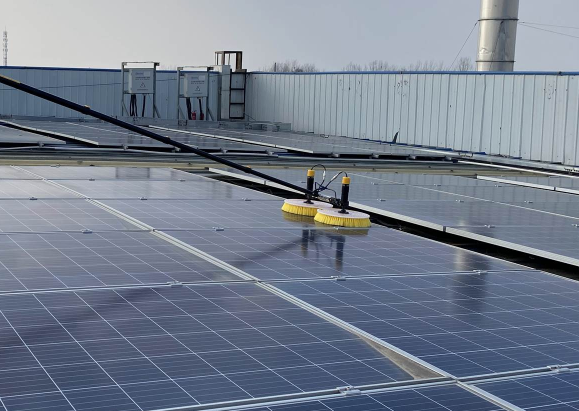
As the solar industry scales up, the demand for cleaning in complex scenarios has sparked smarter solutions. For commercial buildings, large-scale factories, or roofs with extreme pitches, traditional manual cleaning is both dangerous and inefficient. High-altitude cleaning drones are becoming the new favorites of the industry:
1. Zero Risk: Eliminating Fall Hazards
Traditional manual labor on roofs requires scaffolding or fall-protection ropes, exposing workers to significant safety risks. Drones are operated via ground-based remote control, achieving “human-machine separation.” This completely removes the need for personnel to climb, ensuring safety at its source.
2. High Efficiency: 5–10 Times Faster
Drones can operate in any environment because they can fly through all spaces, and their cleaning abilities exceed manual work by five to ten times.
A professional drone can clean hundreds of square meters, which it accomplishes within a single hour.
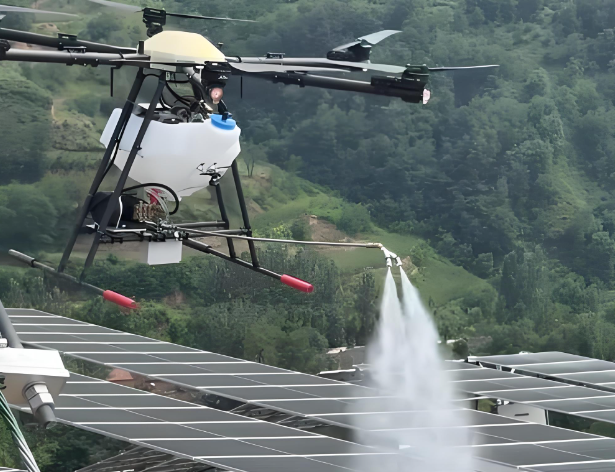
Through constant-pressure spray systems, drones achieve uniform spraying because the systems deliver water and cleaning agents to all panels without creating “missed spots” which occur during manual cleaning.
3. Precision Operation: Tackling Stubborn Stains
The power stations that operate in industrial areas or beside highway systems experience panel contamination from industrial soot, together with fine dust which sticks due to electrostatic forces, and from salt-spray crystals which create solid deposits.
Drones function as specialized agents by transporting high-concentration cleaning agents, which degrade quickly to specific points for their application.
The advanced models include suspended rotating rollers as their auxiliary brushes, which create a manual scrubbing effect to achieve deep decontamination through airflow control without any physical contact that could potentially harm the surface.
4. Automation and Digital Monitoring
Modern cleaning drones are often integrated with AI visual recognition technology:
Automatic Obstacle Avoidance: They can precisely identify lightning rods, cables, and mounting brackets.
Infrared Detection: While cleaning, drones use infrared cameras to scan the panels, identifying and flagging “Hot Spots” caused by grime in real-time and generating detailed maintenance reports.
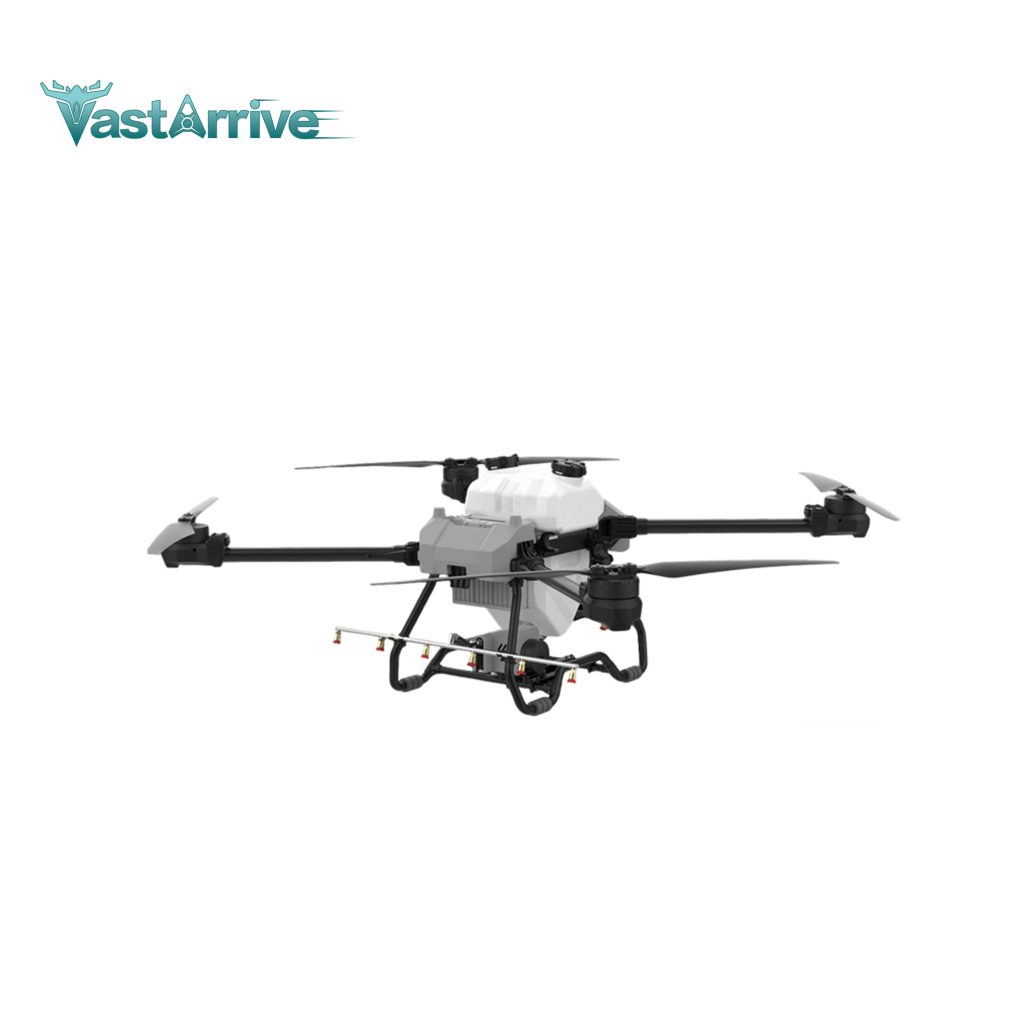
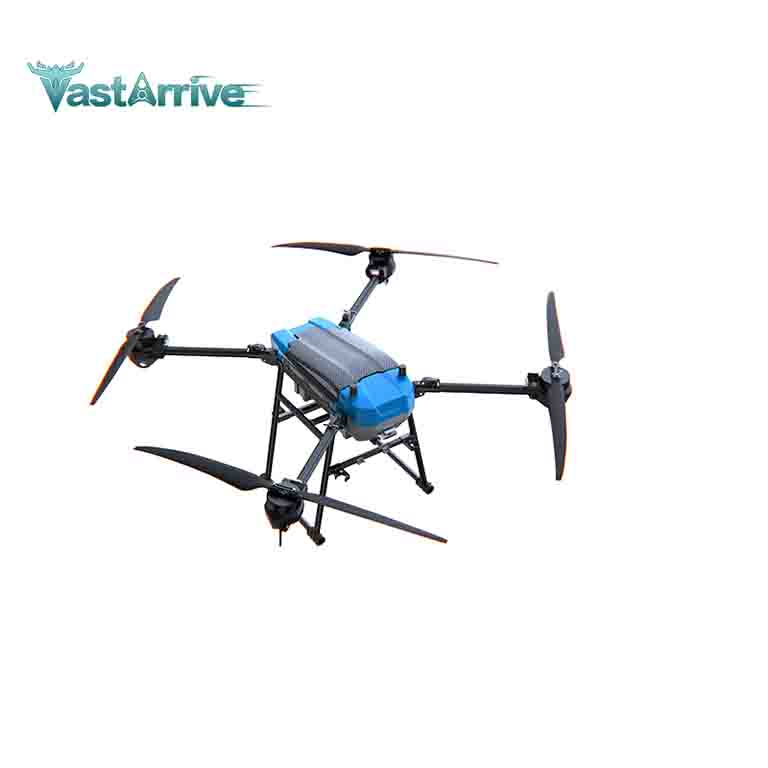
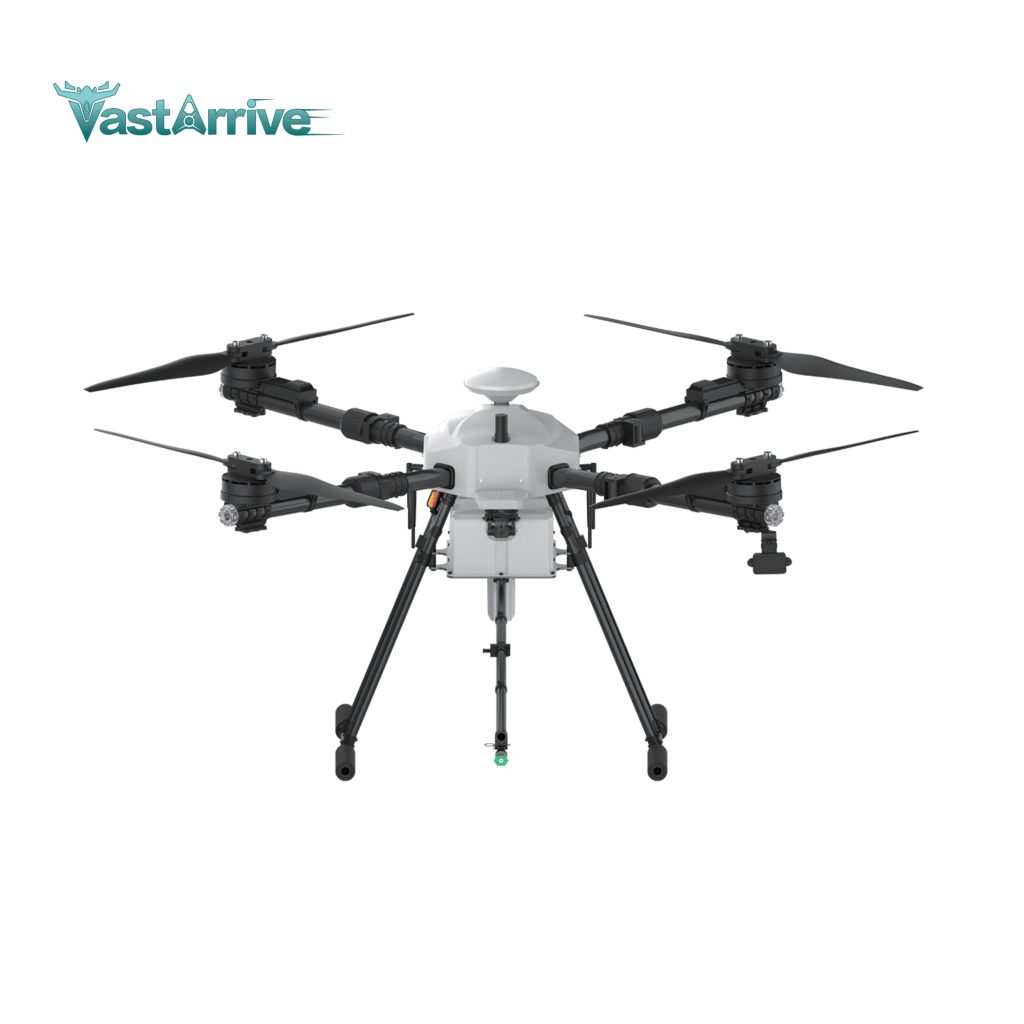
Industry-Leading Solution: VastArrive Intelligent Solar Cleaning Drones
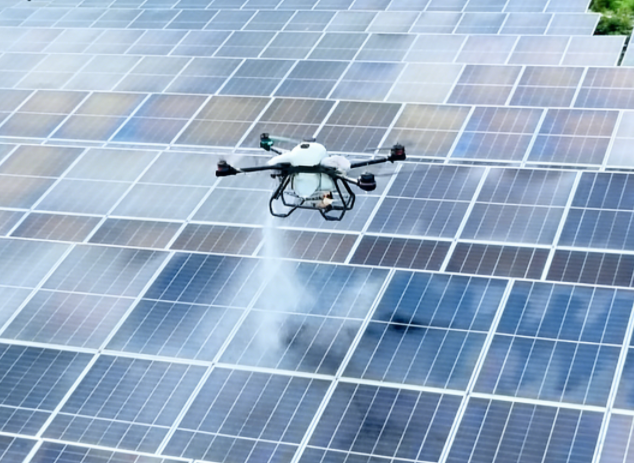
For large commercial rooftops, distributed industrial power stations, or high-tilt solar arrays, traditional ground-based cleaning is not only inefficient but also presents significant safety hazards. VastArrive Professional Cleaning Drone is specifically engineered to solve these pain points, representing the future of photovoltaic Operations and Maintenance (O&M).
Why Choose VastArrive Drones?
Efficient Non-Contact Cleaning: Utilizing high-pressure fine-mist spray technology, VastArrive removes stubborn grime without touching the panel surface. This perfectly preserves the delicate Anti-Reflective (AR) Coating of the PV modules.
Conquering Complex Terrain: Whether it is a steep factory roof or a remote mountainous power station inaccessible to manual crews, VastArrive ensures full-coverage cleaning through intelligent flight path planning.
Significant Reduction in Operating Costs: VastArrive drones can reduce the total project time by over 70 percent while at the same time reducing labor and insurance costs when juxtaposed with a traditional scaffolding or suspended platform.
Precision Spray System: The drone with an intelligent payload system can adjust cleaning agent doses according to the stain severity, to ensure maximum cleaning with the least amount of water to conserve this valuable resource.
Maintenance Taboos of Cleaning Solar Panels
When maintaining solar panels, certain mistakes are irreversible. To protect your expensive equipment, you must strictly avoid the following “Maintenance Taboos”:
1. No Abrasive Tools: Say No to “Violent” Cleaning
The surface of a solar panel features a highly precise Anti-Reflective (AR) Coating, which is only nanometers thick.
Strictly Prohibited: Steel wool, hard-bristle brushes, scouring pads, or any coarse fabrics.
The Consequences: These tools leave microscopic scratches on the glass surface. These scratches cause light to scatter rather than refract, leading to a permanent decrease in light transmittance. Furthermore, these grooves become magnets for stubborn grime to accumulate again.
2. No Strong Acids or Alkalis: Chemical Corrosion Risks
Cleaning hard water or heavy oils with the use of powerful yet toxic chemicals will sound like a great idea in the cleanup.
Nevertheless, under no circumstances should strong acids (like those of rust removers), strong alkalis (like those of high-concentration bleach), or highly corrosive solvents be used.
The implications are adverse as some of the chemicals will corrode the anodized aluminum frame of the panels, leading to inescapable structural integrity jeopardizing, putting an end to any pretence to the exterior seal; such invasion will thereafter cause dampness, oxidation, and electrical short-circuiting inside the panel.
3. Never Step on the Panels: The Threat of the “Invisible Killer”
This is the most common and dangerous mistake. Many people assume the tempered glass is strong enough to support human weight.
Strictly Prohibited: Standing, kneeling, or leaning directly on the panels for cleaning or repairs.
The Consequences: Even if the glass doesn’t crack, the weight causes the wafer-thin silicon cells inside to develop microcracks. These cracks are invisible to the naked eye but will disrupt current flow and create “Hot Spots,” eventually leading to the total failure of the module.
Tips: Always adhere to the principles of “gentle cleaning, long-distance operation, and non-contact maintenance.” This is precisely why using drones is a superior approach to solar upkeep.
Bottom Line
Due to the cleaning of solar panels, the most important steps for increasing energy efficiency and prolonging the life of the system. Whether you do this with traditional manual cleaning methods or use the latest system auto-cleaning drones, in which safety becomes an important consideration, followed straight away by robustness. This way, you can ensure that your solar system stays high-performing overall in delivering all the energy benefits that are otherwise clean to your home or commercial setup.
Related Products