Cleaning Drone vs Rope Access: Which is Better for Building Cleaning?
For decades, whenever we looked up at skyscrapers, we would see “spidermans”, high-altitude rope access technicians, suspended in mid-air, working tirelessly to clean vast expanses of polished curtain walls. However, with the rapid evolution of smart hardware and robotics, high-altitude cleaning drones are sweeping through the commercial cleaning market at an unprecedented pace.
For property managers, commercial real estate owners, and exterior maintenance companies, a very real question arises: when selecting high-altitude exterior wall and glass curtain wall cleaning services, should they stick with traditional rope access or embrace high-tech cleaning drones?
This article provides a comprehensive, hard-core comparison across multiple dimensions, including safety, operational efficiency, overall costs, weather adaptability, and application limitations.
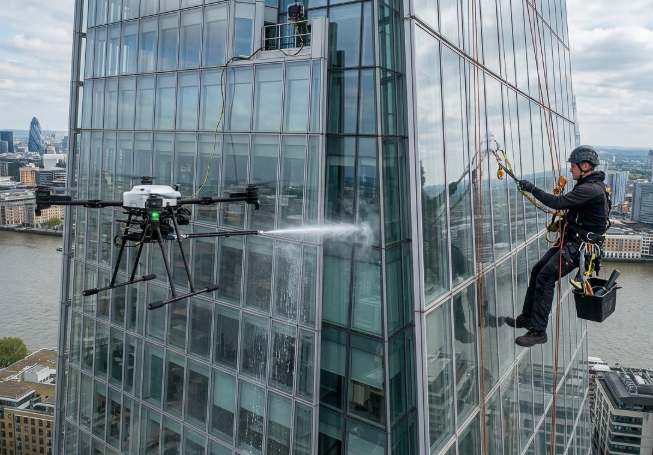
Table of Contents
What Are Cleaning Drones?
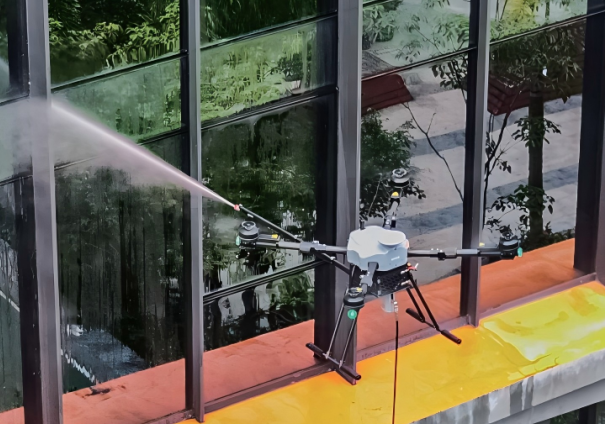
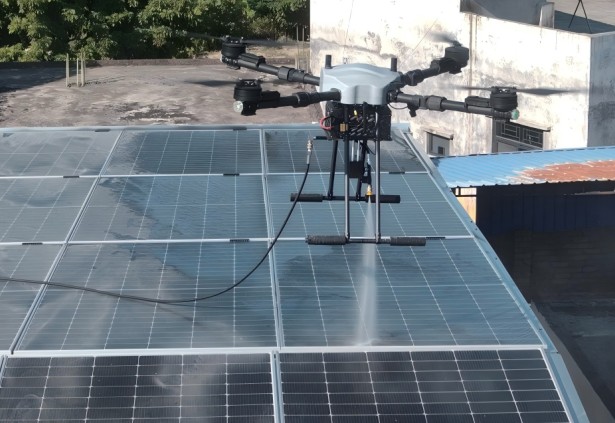
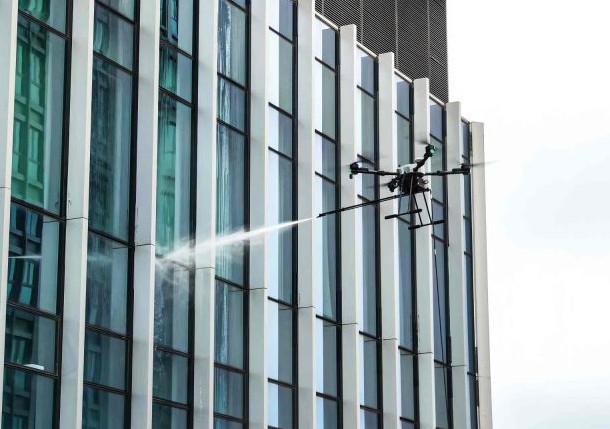
Cleaning drones are high-performance industrial flight equipment specifically engineered for cleaning high-rise building facades, large glass curtain walls, and complex, uniquely shaped architectural structures. Unlike consumer drones, commercial cleaning drones typically utilize advanced tethered systems:
Continuous Ground Energy & Water Supply:
Using an integrated composite line (transportation of electric power, water, etc.), power and liquid used for cleaning are pumped to high altitudes without interruption. This approach eliminates the problems associated with the operation time of traditional lithium batteries.
High-Pressure Deionized Water Spraying:
The drone is outfitted with a professional-grade high-pressure spray gun that sprays either deionized water or green detergents. Due to its lack of any minerals, deionized water will not cause any water spots on the surface being cleaned.
Millimeter-Level Smart Obstacle Avoidance:
Flown by licensed ground technicians along with an on-board LiDAR, ultrasonic sensors, and machine vision positioning system, the drone measures distance from the walls at all times, ensuring millimeter-level safety when flying close to the walls and cleaning uniformly.
What Is Traditional Rope Access?
Industrial rope access is the classic approach to building exterior maintenance and cleaning. Technicians performing this work must obtain international certifications from authoritative organizations such as IRATA (Industrial Rope Access Trade Association) or SPRAT (Society of Professional Rope Access Technicians).
Dual-Rope Safety Suspension System:
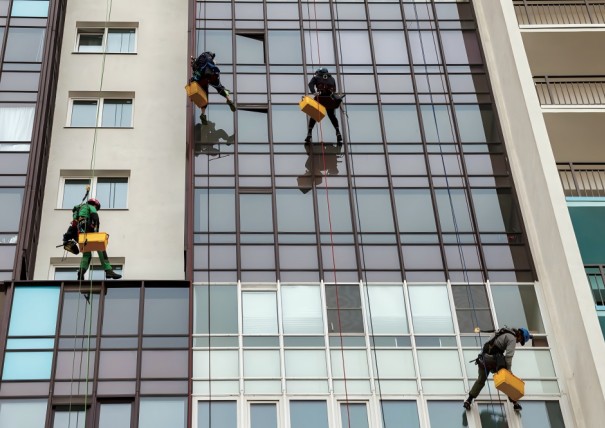
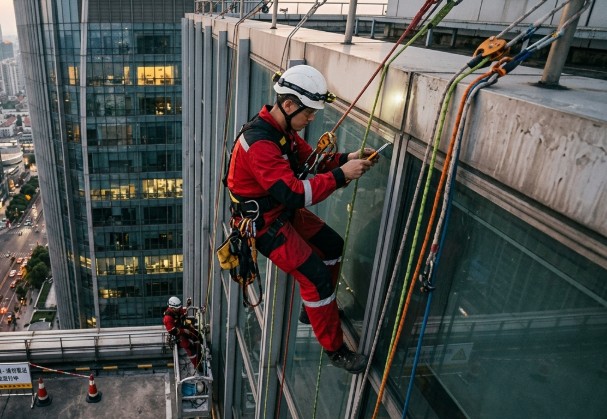
Technicians suspend themselves outside the building using a strictly regulated “dual-rope system” (one primary working line and an independent fall-arrest safety line), moving vertically using gravity and physical descenders/ascenders.
Detailed Manual Wiping:
Using technicians who are qualified with the necessary skills for using squeegees, long handled brushes and chemicals for cleaning, each and every inch of glass curtain walling, aluminum and stone corners is meticulously wiped clean.
Flexibility and Limitations:
While workers can flexibly handle various stubborn stains and complex corners on the fly, this remains a high-risk occupation. It demands strict weather conditions and carries inherent personal safety risks as well as higher overall labor costs.
Comprehensive Comparison: Cleaning Drone vs. Rope Access
When choosing a building cleaning solution, you cannot look at the equipment alone; you must consider the entire operational process. To help you evaluate more intuitively, we have compiled the following key dimension comparison table:
| Evaluation Dimension | Cleaning Drone | Rope Access |
| High-Altitude Hazard | Zero high-altitude fall risk (personnel operate completely on the ground) | Inherent risks of high-altitude falls and personnel injury/fatality |
| Deployment & Setup Time | Extremely fast (site setup and takeoff within 15–30 minutes) | Slower (requires finding anchor points, rigging safety ropes, and setting up perimeter lines) |
| Operational Efficiency & Speed | Extremely high (cleaning speed up to 3–5× that of manual labor) | Relatively slow (constrained by human stamina and manual movement speed) |
| Overall Labor Costs | Significantly reduced (requires only 1–2 ground operators/supervisors) | Higher (requires multiple certified, highly paid technicians and safety officers) |
| Weather Sensitivity | High (operations must stop in strong winds, heavy rain, or high electromagnetic fields) | Moderate (higher wind resistance than drones, but grounded during severe weather) |
| Cleaning Force on Complex Structures | Best suited for flat curtain walls, large glass surfaces, and inclined roofs | Excellent (can reach deep recesses, inner balcony areas, and intricate carvings) |
| Additional Maintenance Capabilities | Primarily cleaning, spraying, and high-altitude inspection | Can simultaneously perform caulking, seam sealing, glass replacement, and paint touch-ups |
Core Advantages of Cleaning Drones
As a smart upgrade in the field of high-altitude cleaning, cleaning drones significantly surpass traditional methods in safety, efficiency, and economy due to their unique automated and mechanized capabilities.
Game-Changing Safety (Safety First)
High-altitude work has always been a high-risk industry. With drone cleaning, all personnel remain safely on the ground. This not only completely eliminates the life-threatening hazard of falls from height, but also drastically reduces property owners’ insurance liability risks and safety compliance pressures.
Superior Cleaning Efficiency & Shortened Schedules
They are not confined by the limitations that humans have physically, as they are able to cover thousands of square meters of curtain wall area in an exceptionally short amount of time. This will be beneficial for places like hotels, office towers, and commercial buildings.
30%–50% Reduction in Total Operating Costs
By reducing the on-site crew size needed for high-altitude work and eliminating the immense costs associated with erecting scaffolding or building maintenance units (BMUs/cradles), drone solutions typically deliver 30% to 50% savings in overall costs on routine, large-scale flat curtain wall cleaning projects.
Irreplaceable Strengths of Rope Access
Despite the rapid development of drones, experienced “spidermans” remain irreplaceable in certain specific scenarios:
Detailed Deep Cleaning & Physical Stain Scraping:
In cases where there have been several years of tough stains due to hard water deposits, birds’ droppings, or paints, sometimes it may be difficult for a drone to use its high-pressure spray system to clean such spots.
Highly Complex Architectural Geometries:
Window frames with deep recesses, complex forms of cornices, or specially designed sunshades will restrict the ability of drones to spray, while rope access technicians can freely reach every corner.
One-Stop “Clean + Repair” Maintenance:
In cases where the maintenance is not only about cleaning but also checking for sealant aging and broken glass replacement, etc., rope access can take care of all of that.
Cleaning Drone vs Rope Access: Which Option Should Your Project Choose?
When approaching a specific exterior wall maintenance project, the choice of cleaning solution depends on the building structure, degree of staining, as well as budget and safety preferences. Below are concrete decision guidelines based on the ideal application scenarios for both technology solutions.
Scenarios Ideal for [Cleaning Drones]
Modern All-Glass Curtain Walls & High-Rise Residential Clusters: Buildings with high surface flatness and large continuous work areas best demonstrate the drone’s high-speed, continuous spraying advantages.
High-Frequency, Routine Maintenance: Ideal for quarterly or semi-annual routine exterior cleaning to handle everyday dust, superficial grime, and air pollution residue.
Large Projects with Tight Deadlines: When property owners require tens of thousands of square meters cleaned in a very short timeframe, drone efficiency far outpaces manual labor.
Properties with Strict Safety & Compliance Requirements: Commercial real estate or high-end parks aiming for “zero high-altitude injury” risks can eliminate high-altitude fall hazards right at the source by using drones.
Scenarios Ideal for [Rope Access]
Historic Buildings & Complex Irregular Landmarks: Buildings with intricate carvings, deeply recessed window frames, complex cornices, or numerous facade decorations allow human workers to flexibly adjust positions and avoid blind spots.
Treatment of Years-Old Stubborn Stains: Heavy encrustations, multi-year hard water spots, paint residue, or bird droppings in blind spots require manual scrapers and dedicated chemical agents for deep physical scrubbing.
Composite “Cleaning + Repair” Maintenance Tasks: Projects that require simultaneous curtain wall caulking and leak patching, glass pressure checks, or wall crack inspections during the cleaning process.
VastArrive Cleaning Drone Solution
Addressing the industry pain points of high risk, high cost, and low efficiency associated with traditional rope access, VastArrive has introduced a convenient high-altitude, high-pressure drone cleaning solution. By combining automated flight control with industrial-grade high-pressure washing technology, VastArrive provides a safer, more efficient modern cleaning experience for high-rise building facades, glass curtain walls, and photovoltaic power stations.
Key Features & Technical Highlights
Eliminating High-Altitude Risks (Safety First):
Equipped with dual-RTK centimeter-level positioning and wall-following/obstacle-avoidance radar, the drone achieves precise hovering and automated route flight. All cleaning operations are controlled remotely by ground pilots, completely replacing “spidermans” suspended at high altitudes and achieving zero risk of high-altitude casualties.
1000 m²/h Ultra-Fast Cleaning & Continuous Water Supply (High Efficiency):
Utilizing a ground-based continuous water supply tether system, combined with 20 MPa high-pressure washing and professional cleaning agents, the light cleaning efficiency reaches up to 1000 m²/h (17 m²/min), 3 to 5 times faster than manual wiping, dramatically shortening project schedules.
Modular Design & Multi-Angle Precision Spraying (Modular Design):
Supports two types of cleaning mounting brackets and an oscillating spray gun, equipped standard with four tool-free quick-connect nozzles. Pilots can quickly switch between four spray angles based on curtain wall materials and stain types, easily resolving hard-to-clean dead zones in traditional operations.
1 Minute Rapid Deployment & Extremely Low Operating Costs (Quick Deployment & Low Cost):
Featuring an all-carbon-fiber lightweight body (taking the flagship model VA-D15R as an example, the empty aircraft weighs only 13 kg), it supports effortless single-person operation. It can be deployed and launched within 1 minute of arriving on site. Compared to rope access, it significantly reduces specialized high-altitude labor and insurance expenses, lowering overall costs by 30%–50%.
As part of the maintenance of walls of industrial parks and cleaning of curtains of commercial buildings, the VastArrive system (such as VA-D15R and VA-D50R) takes advantage of intelligent flight path planning to tackle the issue of slowness and danger of manual wiping of complex skyscrapers.
If you are looking for an industrial drone solution for your building exterior cleaning project, feel free to contact VastArrive to discuss your specific application scenarios and equipment needs.
Conclusion: Cleaning Drones or Rope Access?
Cleaning drones and rope access each have their distinct strengths, and neither is a one-size-fits-all choice for every building:
Large, structurally regular exterior walls: Prioritize cleaning drones. They completely eliminate high-altitude risks and achieve standardized, highly efficient washing.
Complex facades, deep scrubbing, or repair-integrated tasks: Rope access remains irreplaceable, offering flexible, close-up manual scrubbing and maintenance.
For many large property projects, a “hybrid model”, routine drone washing combined with periodic rope access deep cleaning, is often the optimal strategy to balance safety, cost, and results. Enterprises are encouraged to select the combination that best fits their site conditions based on safety standards, operational efficiency, and budget.