
How Agricultural Drones Increase Crop Yield?
In traditional agricultural production, farmland management often relies on empirical judgment and extensive operations: uniform fertilizer spreading across entire fields leads to localized fertilizer burn or nutrient deficiency; by the time yellowing leaves are spotted with the naked eye, pests and diseases have already spread; and heavy tractors entering the fields to spray pesticides directly crush and damage a portion of the crops. These hidden losses are the key bottlenecks preventing modern farms from breaking through their yield ceilings.
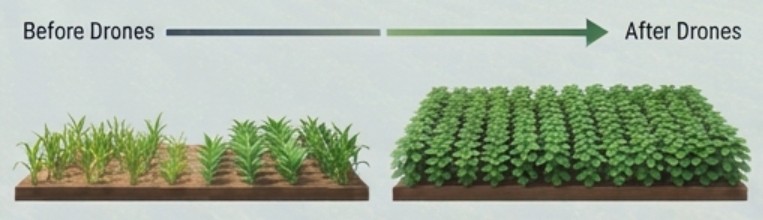
How are agricultural drones increase crop yields? The core lies in transforming “experience-based farming” into “data-driven precision agriculture.” Equipped with multispectral sensors and centimeter-level precision spraying systems, agricultural drones can provide early warnings of pests, diseases, and water stress 7–14 days in advance, apply pesticides and fertilizers variably on demand, and eliminate the physical crushing damage caused by ground machinery entering the fields. As a result, they help farms achieve a steady yield increase of 10%–20% while reducing agricultural input costs by 20%–30%.
This article will break down in detail how agricultural drones improve crop yields, providing you with a complete guide to precision agriculture yield enhancement.
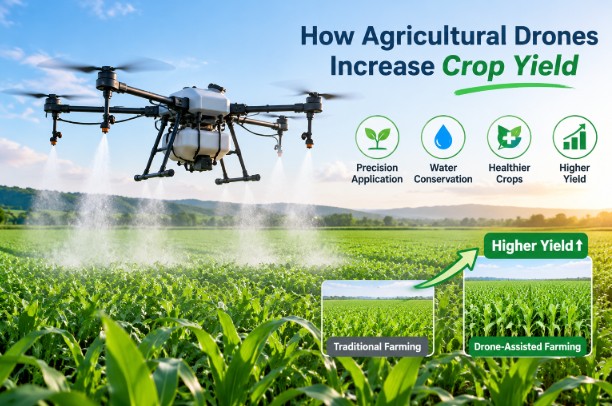
Table of Contents
Why Does Crop Yield Depend on More Precise Agricultural Management?
The yield of crops is determined not only by the quality of the seeds used, the quality of the soil, and the environment of the climate, but it is also highly dependent upon the field management practices during the entire life cycle of the crop. Despite similar conditions for the planting of the crops, the incidence of pests and diseases, nutrient content, and moisture in the soil may differ considerably from zone to zone.
The traditional way of agricultural production mainly uses field scouting, ground equipment, and experience judgments, and each one has its own problems in the large scale of agriculture:
Late detection of pests and diseases: Field scouting requires the inspection of fields one after another, and thus, it becomes impossible to keep track of the growth of crops. With pests and diseases spreading in some local areas, large crop loss may occur.
Uneven application of pesticides and fertilizers: The crop cultivation process and nutrient demand differ among the different regions within the field. Application of equal treatments will cause the problem of using too little treatment on one region and using too much treatment in other regions.
High time and labor demands for large-scale management: Especially in the field that has the complex terrain such as hilly land, mountainous land, paddy field, or large plantation, traditional ground machinery may not be able to move in the field freely.
Lack of timely field data support: Relying only on visual inspection will make it hard for farmers to record the changes in crop cultivation condition.
Agricultural drones offer a new technological solution to these challenges. Through aerial operations and data collection, farmers can gain a more comprehensive understanding of field conditions and take targeted measures at the optimal time.
How Do Agricultural Drones Help Increase Crop Yields?
Agricultural drones themselves do not increase crop yields; instead, they help to improve the conditions in which crops grow, as well as decrease the losses of yield that could have been prevented.
The following list shows the top five uses of agricultural drones in farming today.
Precision Spraying Enhances Crop Pest and Disease Control
During growth, crops are vulnerable to pests, fungi, and other pathogens. If control measures are not taken promptly, pests and diseases can impair leaf health, root development, and fruit formation, ultimately reducing crop quality and yield.
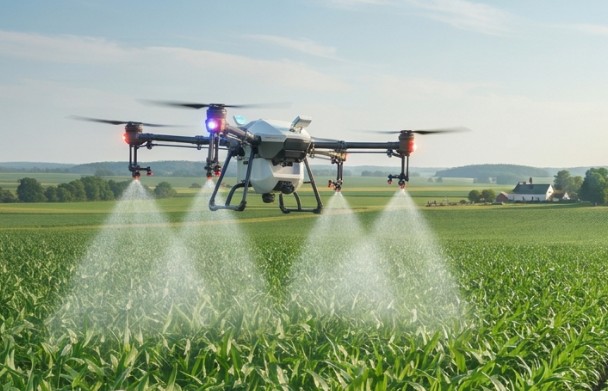
Agricultural spray drones equipped with special spraying systems can spray pesticides, fungicides, and some foliar fertilizers above the fields. Drones also decrease the need to have personnel enter the fields compared to manual knapsack sprayers, and they increase operational flexibility over large acreages.
The precision spraying capabilities of agricultural drones are reflected in the following aspects:
Targeted spraying: Customized spraying plans can be formulated based on field zoning and pest/disease distribution, prioritizing areas that require immediate treatment.
Improved operational efficiency: Pre-planned flight routes cover the farmland systematically, drastically reducing the time required for manual plot-by-plot spraying.
Better application uniformity: Proper configuration of nozzles, flow rates, flight speed, and flight altitude ensures a more consistent and even distribution of liquid droplets.
Reduced human exposure: Under safe operating standards, operators have significantly less direct contact with agricultural chemicals.
Timely and rational pest and disease control minimizes crop damage and creates better conditions for healthy growth. However, spraying effectiveness does not depend solely on the drone itself. Nozzle type, droplet size, chemical properties, crop canopy structure, flight altitude, and weather conditions all affect the final outcome. Therefore, actual operations must be adjusted according to agronomic requirements and pesticide label instructions.
Early Crop Monitoring Helps Detect Growth Issues Promptly
In traditional farming, growers typically walk the fields to visually inspect leaf color, plant height, and overall growth. For large farms spanning hundreds or even thousands of acres, relying purely on manual inspection is not only time-consuming but also makes it nearly impossible to track subtle changes across different zones.
Agricultural drones equipped with high-definition cameras or multispectral sensors can capture aerial imagery of farmland to help growers monitor crop health. Among these, multispectral monitoring is one of the most vital applications in precision agriculture.
Multispectral sensors capture reflectance data across different spectral bands and generate vegetation index maps through data analysis, such as NDVI (Normalized Difference Vegetation Index). This data helps farmers identify variations in vegetation vigor across different zones and spot potential growth anomalies.
Drone-based crop monitoring can assist in identifying:
Uneven crop growth: Spotting growth variations across different sections of the same field.
Potential water stress: Identifying moisture-deficient zones that require further inspection.
Nutrient anomalies: Combining imagery with other agronomic data to pinpoint areas potentially lacking nutrients.
Pest and disease-affected zones: Detecting abnormal areas through imagery shifts to guide targeted ground inspections.
Crop growth trends: Capturing imagery periodically to compare changes across different growth stages.
For instance, in large-scale corn cultivation, farmers can regularly collect field data using multispectral drones. If the vegetation index in certain areas is noticeably lower than in surrounding zones, growers can inspect those specific spots for insufficient irrigation, soil nutrient discrepancies, or pest/disease infestations.
It is important to note that vegetation indices like NDVI primarily reflect vegetation status and cannot serve as a standalone diagnostic basis for pests, diseases, or nutrient deficiencies. Drone data must be combined with ground scouting, soil testing, and agronomic expertise. Through more timely crop monitoring, farmers can detect potential issues earlier and intervene before severe damage occurs.
Precision Fertilization Improves Crop Nutrient Management
Fertilizer is a critical factor influencing crop growth and yield. However, soil nutrients, planting density, and crop vigor often vary across a field, meaning a one-size-fits-all fertilization plan is rarely optimal for the entire area. Under-fertilization starves crops of essential nutrients, while over-fertilization increases input costs, causes nutrient runoff, and burdens the environment.
Agricultural drones support more rational fertilizer management through aerial imagery collection and precision application technologies:
Identifying crop growth variations: High-definition imagery and multispectral data reveal how crops are performing across different zones, providing a reference for fertilization decisions.
Assisting in variable-rate zoning plans: Combining soil testing, crop growth stages, and agronomic advice allows fields to be divided into distinct management zones with tailored fertilization schedules.
Increasing application flexibility: For foliar fertilizers or granular fertilizers compatible with drone spreaders, targeted operations can be carried out based on equipment configuration, avoiding redundant applications.
Optimizing long-term nutrient management: Integrating drone-collected data with actual fertilization records enables farmers to continuously evaluate zone performance and adjust subsequent management strategies.
It should be emphasized that drone imagery alone cannot accurately determine all soil nutrient levels; precision fertilization still relies on soil testing, plant tissue analysis, and professional agronomic guidance. Rational nutrient management provides crops with ideal growing conditions while improving fertilizer use efficiency.
Increasing Field Efficiency to Capture Critical Farming Windows
Agricultural production is highly seasonal and time-sensitive. Whether it is pest control, fertilization, or growth monitoring, tasks must be completed within specific timeframes. Missing a critical operational window can result in irreversible yield losses, even if remedial measures are taken later.
Agricultural drones help farmers enhance operational flexibility, particularly in large-scale farms and complex terrains. Compared to ground machinery, drones offer several distinct advantages:
Fewer terrain restrictions: Drones can easily cover areas difficult for ground machinery to access, such as waterlogged paddy fields, hills, and slopes.
Reduced reliance on manual labor: Automated route planning and flight control minimize repetitive manual tasks.
Higher operational agility: Farmers can schedule spraying or monitoring missions flexibly based on field conditions and weather windows.
Zero soil compaction and crop crushing: Because drones operate from the air without entering crop rows, they eliminate physical crushing damage caused by ground machinery.
For large commercial farms and agricultural service providers, operational efficiency not only impacts daily operating costs but also determines whether management tasks are completed on schedule. By improving timeliness, agricultural drones help growers manage crops effectively and prevent losses caused by operational delays.
Assisting Water Management to Reduce Crop Water Stress Risks
Water is essential for the growth of crops. Water shortage and uneven distribution of moisture may hinder the normal growth of crops. Irrigation management is typically based on visual observation, soil moisture sensors and grower experience. It is difficult to monitor the real-time moisture status of each zone in a large farm.
Equipped with multispectral or thermal imaging sensors, agricultural drones collect aerial imagery to help farmers detect potential moisture anomalies:
- Analyzing vegetation growth differences across zones via multispectral imagery.
- Identifying potential water-stressed areas using thermal imaging data.
- Tracking crop status changes by periodically comparing imagery captured over time.
- Guiding ground checks to inspect irrigation infrastructure and soil moisture in targeted zones.
For large farms, these insights enable growers to troubleshoot irrigation systems and check soil moisture with precision, avoiding uniform irrigation based solely on guesswork. Note that drones serve as a monitoring and decision-support tool rather than a direct replacement for irrigation systems; effective water management still requires integrating soil moisture data, weather forecasts, crop types, and growth stages.
Which Crops Can Benefit from Agricultural Drone Applications?
Agricultural drones have a wide range of applications and are suitable for rice, wheat, corn, fruit trees, and other large-scale crops. Because different crops have distinct growth characteristics and management needs, drone application methods vary accordingly.
Rice Cultivation
Rice is typically grown in flooded paddy fields, which are not easy to access on the ground. Agricultural drones can spray pesticides, control pests and diseases, and fertilize foliage in paddy fields without workers wading into muddy fields. And aerial imagery allows farmers to check the vigor of rice in different plots and spot patchy growth early.
Wheat Cultivation
Wheat farming is usually in large contiguous fields that need to be managed for pests, diseases and growth in a timely fashion. Agricultural drones can spray crops quickly over a large area and growers can take periodic images to see how crops change at different growth stages. Drones are key to increased operational agility during peak pest and disease seasons.
Corn Cultivation
Corn has varying requirements for nutrients, water, and pest management across its growth stages. Agricultural drones can be used for crop monitoring, pesticide spraying, and foliar fertilization in cornfields. Through multispectral imagery, farmers can identify growth discrepancies across zones and combine these insights with ground scouting to formulate targeted management plans.
Orchard Cultivation
Orchards usually have more complex terrain and canopy structures than row crops. There are many orchards on hills or mountains where conventional ground sprayers have difficulty operating. With agricultural drones, crop protection missions can be performed according to the layout of trees and canopy characteristics, making orchard management more flexible.
But orchard spraying is a special case where internal canopy penetration and droplet coverage are critical and flying over the top of the canopy does not guaranty all leaves and fruits will be thoroughly covered. Practical applications need testing and calibration of operational parameters, depending on tree height, canopy density and spraying systems.
What Are the Differences Between Agricultural Drones and Traditional Farming Methods?
Although agricultural drones do not fully substitute conventional agricultural devices, they offer increased flexibility with regard to aerial operations and data collection. In comparison to conventional agricultural devices, there are significant differences in operation and application.
| Evaluation Dimension | Traditional Manual / Tractor Operations | Agricultural Drones (Precision Agriculture) | Direct Impact on Crop Yield |
| Pest & Disease Detection Timing | When symptoms are visible to the naked eye (relatively late) | 7–14 days in advance (via NDVI index early warnings) | Contains early outbreaks and prevents large-scale yield loss |
| Machinery Crushing Loss | ~2%–5% loss of growing crops | 0% (fully aerial, zero-contact operation) | Directly preserves 100% of effective harvestable plants |
| Chemical & Fertilizer Utilization | ~30%–40% (severe runoff and evaporation) | Increased to 75%–85%+ | Prevents localized fertilizer burn and ensures uniform crop vigor |
| Daily Operational Efficiency | Manual: ~10–20 mu (~1.6–3.3 acres) per day | Single drone: 300–600 mu (~50–100 acres) per day | Captures critical golden windows for pest control and fertilization |
| Complex Terrain Adaptability | Difficult to enter hills, paddy fields, and tall-stalk crops | Unrestricted by terrain or mud; full-terrain coverage | Eliminates management blind spots for balanced yield gains across the field |
What Factors Affect the Actual Yield-Increasing Performance of Agricultural Drones?
While agricultural drones improve farm management efficiency, not every farm will experience identical yield increases after adopting them. Actual results depend on crop types, management practices, drone configurations, and specific operating conditions.
Crop Type and Growth Stage
Different crops have distinct requirements for spraying, fertilization, and water management, for example, crop protection needs differ markedly between rice, wheat, and fruit trees. Operational plans must be tailored to the specific crop type, growth stage, and agronomic requirements.
Drone Payload and Spraying System
Payload capacity determines how much liquid or granular material a drone can carry per flight, while spray flow rate, nozzle type, and droplet size directly influence application performance. For commercial agricultural applications, buyers must look beyond maximum payload capacity to evaluate actual spraying quality and continuous operational capability.
Flight Planning and Operational Precision
Proper route planning ensures effective coverage of target fields. Factors such as flight altitude, speed, spray swath width, and route overlap all impact operational quality. Operators must calibrate flight parameters according to field layouts and equipment performance.
Weather Conditions
Wind speed, temperature, and air humidity significantly influence spraying effectiveness. Excessive wind can cause chemical drift, while high temperatures increase droplet evaporation risks. Therefore, drone operations must be scheduled around weather conditions and pesticide application guidelines.
Data Analysis and Agronomic Management Capabilities
Drones can collect vast amounts of field data, but this data only translates into effective management decisions when properly analyzed. For instance, after spotting a growth anomaly in aerial imagery, growers must inspect soil, moisture, pests, and nutrient status on the ground to determine the exact intervention required. Ultimately, the true value of agricultural drones depends not only on hardware performance, but on how effectively farmers integrate aerial insights into daily farm management.
How to Choose an Agricultural Drone Suited to Your Farm’s Needs?
For commercial farms, agricultural service providers, and equipment buyers, selecting the right agricultural drone requires a comprehensive evaluation of farm size, crop types, and specific operational tasks. Key factors to consider when choosing an agricultural drone:
Payload Capacity
If the drone is primarily used for large-scale crop protection, focus on its effective payload capacity and flight performance under full load. Consider the relationship between tank capacity and per-acre application rates for your specific crops.
Flight Endurance
Flight time dictates operational scheduling per battery cycle. Large farms and commercial service providers should evaluate real-world efficiency by considering battery or power systems, payload weight, flight speed, and return-to-home requirements.
Spraying Performance
The spraying system is the core of a crop protection drone. Examine nozzle configurations, flow rates, spray pressure, droplet size control, and canopy coverage to ensure the system matches your target crops and scenarios.
Operating Efficiency
Actual operating efficiency depends not only on flight speed, but also on spray width, refilling times, battery-swapping speed, route planning, and field geometry. Evaluate equipment based on real-world workflows rather than theoretical specs alone.
Terrain Adaptability
If your farmland includes hills, mountains, or other complex terrains, prioritize flight stability, obstacle avoidance capabilities, and terrain-following performance.
Maintenance and Technical Support
For long-term commercial deployment, ease of maintenance, spare parts availability, and technical support are crucial. Reliable after-sales service minimizes downtime and keeps agricultural production schedules on track.
VastArrive Agricultural Drones for Modern Farming Applications
For commercial farms and agricultural service providers seeking to boost crop protection efficiency and field management capabilities, choosing a drone tailored to real-world operational demands is essential.
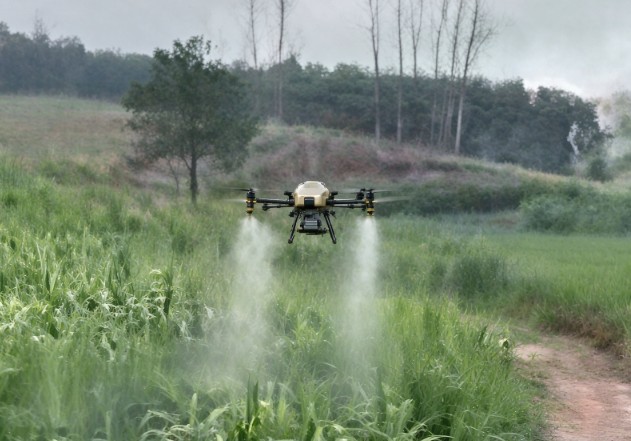
VastArrive specializes in industrial-grade drone solutions, providing professional UAV products for agriculture, cleaning, and other specialized applications. For agricultural use cases, users can select customized drone configurations based on farm scale, crop type, spraying requirements, and operating environments.
In agricultural production, the right drone must not only deliver the payload and endurance required for the job, but also feature a spraying system and flight performance matched to practical field applications. If you are looking for drones suited for commercial crop protection, farmland management, and agricultural service projects, contact VastArrive to explore product configurations and customized solutions.
Conclusion
Agricultural drones are no longer a futuristic concept, they are a proven, practical tool for yield enhancement validated across tens of millions of acres worldwide. If you are facing rising labor costs, hard-to-control pests and diseases, or a plateau in crop yields, consider starting with drone-based crop protection and field scouting solutions to achieve cost reductions, efficiency gains, and steady yield growth through precision data and agile operations.