How Inspection Drones Are Used in Power Line and Telecom Tower Inspection Workflows

In power grid and telecommunications infrastructure maintenance, inspection drones have become a standard tool in both power line inspection and telecom tower inspection workflows.
Under traditional manual inspection methods, the most time-consuming part of the process is often not the inspection itself, but gaining physical access to the structure. Public utility maintenance studies show that manual transmission line inspections typically require 1.5 to 3 hours per kilometer, while overall efficiency can drop by more than 40% in mountainous or complex terrain. Similar challenges are common in telecom tower maintenance, particularly in remote base station deployments and densely distributed tower networks.
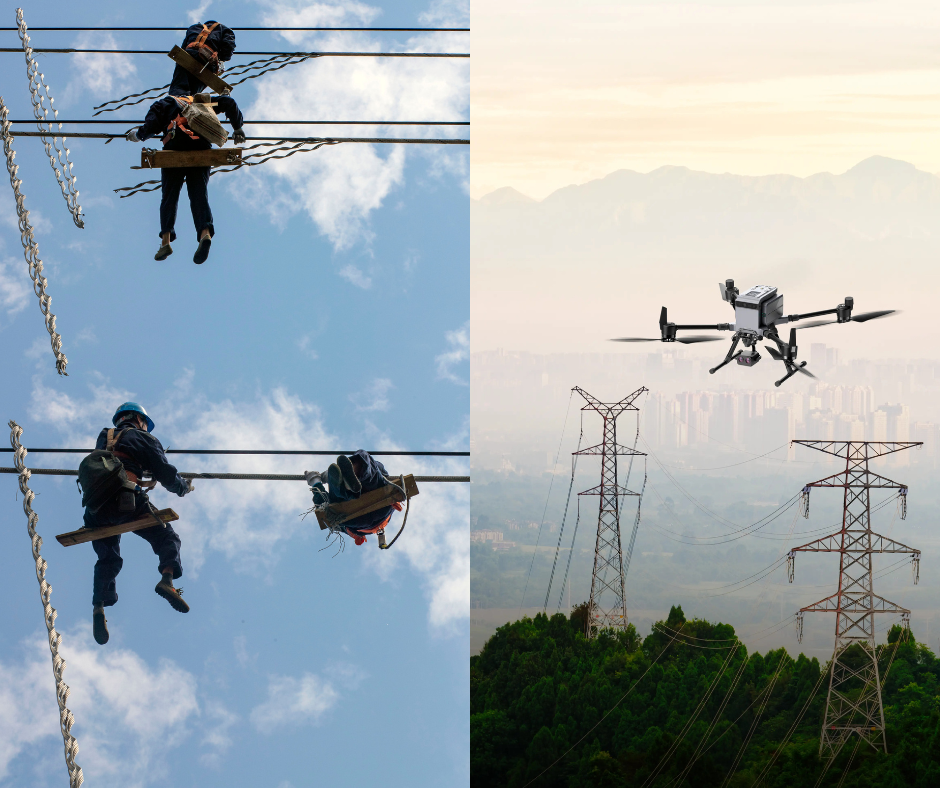
This is one of the primary reasons inspection drones have become increasingly common in high-altitude infrastructure inspection: they do not change the inspection logic itself, but fundamentally change how access to the structure is achieved.
Why Power Line and Telecom Tower Inspection Are Considered the Same Engineering Problem
Although power lines and telecom towers differ in physical form, their inspection workflows share several operational characteristics.
Both involve:
- Structures continuously exposed to high-altitude environments
- Distributed inspection points across wide or vertical spaces
- High time costs associated with manual access
- Strong dependence on weather and terrain conditions
This means the core challenge is not point-based detection, but continuous structural coverage.
In manual workflows, this coverage depends on human mobility and physical access. Inspection drones shift this process into spatial data collection through controlled flight paths.
How Inspection Drones Work in Real Inspection Operations
In practical industrial applications, both power line inspection and telecom tower inspection drone workflows generally follow five stages.
Mission Planning
The process begins by importing transmission line coordinates or tower location data, followed by route planning based on inspection objectives.
Transmission line inspections typically require linear flight paths, while telecom tower inspections rely on orbit-based or segmented vertical routes.
This stage determines whether data coverage will be complete and repeatable.
On-Site Deployment and Takeoff
Once deployed on site, the drone must verify environmental conditions, including:
- Wind speed
- Positioning stability
- Communication link integrity
Industrial inspection environments are often far more complex than standard commercial drone operating conditions. Transmission corridors may introduce electromagnetic interference, while telecom towers can generate RF signal instability.
Structural Approach and Data Acquisition
This is the most critical phase of the workflow.
During power line inspection, drones travel continuously along transmission routes while capturing data from insulators, fittings, conductors, and structural connections.
During telecom tower inspection, drones approach the structure layer by layer, collecting multi-angle imagery of antenna systems, support brackets, connection points, and tower-mounted components.
This stage determines whether the inspection result is complete and usable.
Data Transmission and Review
After collection, imagery and video data move into analysis workflows.
In real-world industrial operations, inspection failures are rarely caused by flight failure. More often, failure occurs at the data level, such as:
- Slight image vibration preventing crack recognition
- Missing inspection nodes
- Inconsistent capture angles preventing historical comparison
Operational field experience shows that 20% to 30% of repeat inspection flights are triggered by data quality issues rather than hardware malfunction.
How Power Line and Telecom Tower Inspection Workflows Differ
Although the workflow logic is similar, execution requirements differ between the two scenarios.
Power Line Inspection
Key characteristics include:
- Long-distance travel
- Continuously distributed inspection points
- Greater emphasis on route stability
The primary goal is maintaining continuous inspection coverage over extended distances.
Telecom Tower Inspection
Key characteristics include:
- Concentrated vertical structures
- Dense inspection nodes
- Higher requirements for close-range multi-angle capture
The priority is achieving detailed local coverage, which is why telecom tower inspection drones demand higher hover precision and tighter positional control.
Where Inspection Problems Usually Occur
In field operations, most inspection issues involve:
- Incomplete structural coverage
- Inconsistent capture angles
- Insufficient image quality
- Data unsuitable for long-term comparison
These may appear to be imaging problems, but in most cases they result from insufficient workflow standardization.
When flight paths cannot be consistently repeated, historical comparison loses value.
Why Data Consistency Matters More Than Flight Performance
Modern infrastructure maintenance increasingly depends on long-term trend analysis.
Examples include:
- Insulation degradation along transmission lines
- Corrosion progression on telecom support structures
- Small antenna alignment shifts over time
These issues often require months or years of comparative imagery.
If inspection drones capture data from inconsistent angles or routes, long-term analysis becomes unreliable.
This is why modern power line inspection and telecom tower inspection drone operations focus less on speed and more on producing stable, repeatable inspection data every time.
Inspection Workflows Are Changing
High-altitude inspection was once dominated by manual observation and field judgment.
Today, more of the process is shifting toward structured, data-driven analysis.
The role of inspection drones is not to replace engineering judgment, but to transform high-risk physical access into standardized digital data collection.
For power and telecom infrastructure maintenance, this shift represents more than operational efficiency. It creates the foundation for long-term asset tracking, repeatable inspections, and more reliable infrastructure analysis.
Related Products