Pressure Washing Drones: A Future Trend or An Industrial Gimmick?

From various data statistics and forecasts, it can be seen that the world pressure washing drones market will experience a sharp increase in the coming years. In 2025, the market value will exceed $5.46 billion, and the compound annual growth rate (CAGR) of 2025–2033 is expected to reach 5.39%.At present, by searching the Internet with “pressure washing drone,” one can find plenty of articles demonstrating how drones work efficiently in cleaning tall buildings, solar energy stations, and wind power devices. Nevertheless, the more publicity, the more doubts. Have these technologies really become mature enough, or do they stay in the “demonstrative” stage yet?
Market Growth and Application Scenarios
According to industry statistics, there is constant and consistent growth in the high-pressure cleaning drone industry. Nonetheless, this growth is not a result of mass adoption by consumers, but of selective demand by certain valuable industries that find conventional cleaning practices too expensive, dangerous, or ineffective.
The demands from present applications are mainly focused on the following sectors:
- Energy production sites (wind energy and photovoltaic plants)
- Heavy industry and manufacturing plants
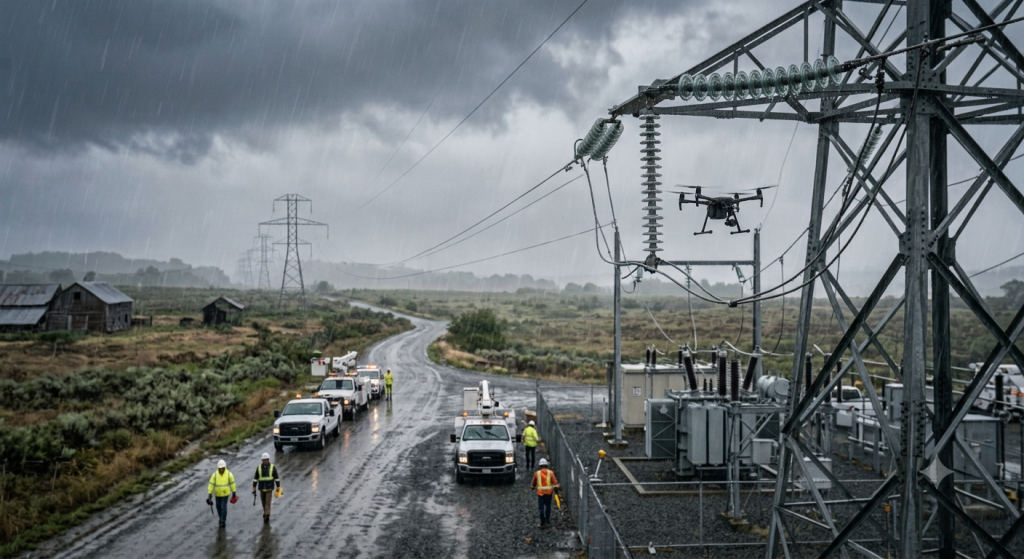
- Large civil infrastructures (bridges, tunnels, and utility lines)
- High-rise structures and complicated facades
However, this is not a universal cleaner that can be used by ordinary maintenance personnel. This is an industrial-level equipment designed for hazardous and challenging conditions at great heights.
Why Are More Companies starting to use Pressure Washing Drone?
The use of pressure-washing drones is far more than a mere improvement in technology or the introduction of new tools. It is in fact a change in the way that high-altitude cleaning tasks are being done and the associated cost and risk management. This is being driven by three key operational forces across many different industries:
The Need for Safer Alternatives to High-Risk Jobs
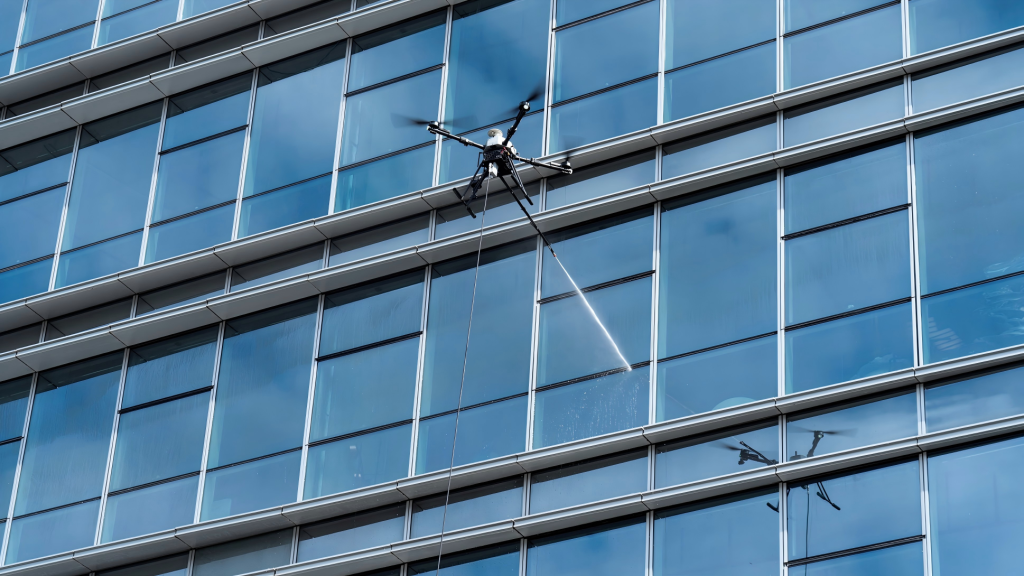
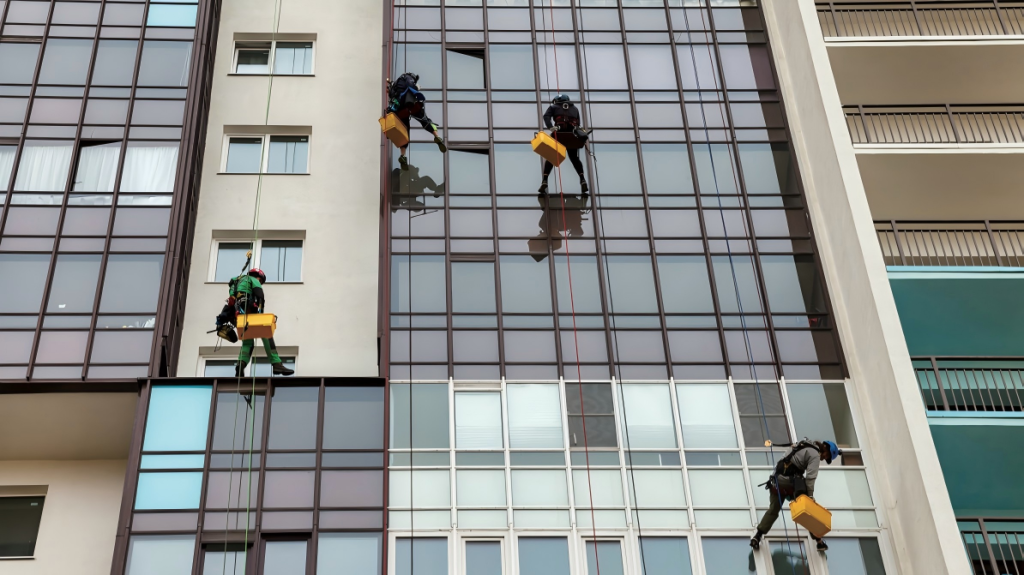
Traditional high-altitude cleaning typically uses three methods: rope hoisting, scaffolding, and aerial work platforms. These methods not only require highly experienced workers but also pose safety risks. This has prompted companies engaged in high-altitude cleaning services to seek safer and more efficient solutions. Drone cleaning perfectly meets the needs of these companies, maintaining work efficiency while removing workers from high-risk environments, thus reducing the risk of accidents at the source.
Structural Problems of High Cost and Complex Deployment
When large industrial equipment or skyscrapers require cleaning, traditional cleaning solutions necessitate long-term planning and extensive equipment setup; labor and equipment costs increase exponentially; complex on-site environments require adjustments based on the situation; and limited operating windows mean that the initial preparation costs often exceed the actual cleaning costs.
The emergence of industrial drones has addressed these concerns. Drones, with their rapid deployment and flexible operation, offer high efficiency and low cost, making them the preferred choice for most cleaning service companies.
Higher Requirements for Continuous Operation and Efficiency
The field of energy as well as some industries have many system equipment that entail high costs of machine idle time. The conventional approach to cleaning requires a lot of time, relies heavily on manual effort, and can result in equipment damage if not performed properly.
Against this backdrop, cleaning efficiency is no longer merely a matter of “speed.” Instead, it has become a critical variable that directly impacts asset profitability.
The adoption of industrial drones for cleaning operations by enterprises is fundamentally a decision based on the evaluation of risk, cost, and operational efficiency. This trend is not merely a “tool upgrade” within the cleaning industry, but rather a structural transformation in the operating model of high-altitude maintenance.
Classification of Pressure Washing Drones
High-pressure cleaning cannot rely on a single type of tool; instead, it requires a complete system-based solution. Different application scenarios require different types of pressure washing drones to be deployed accordingly.
High-altitude Curtain Wall Glass Cleaning
Cleaning high-rise building curtain walls and glass facades presents the following challenges:
- High operating height
- Complex urban environments
- High requirements for stability and operational precision
- Attention must be paid to the exterior glass.
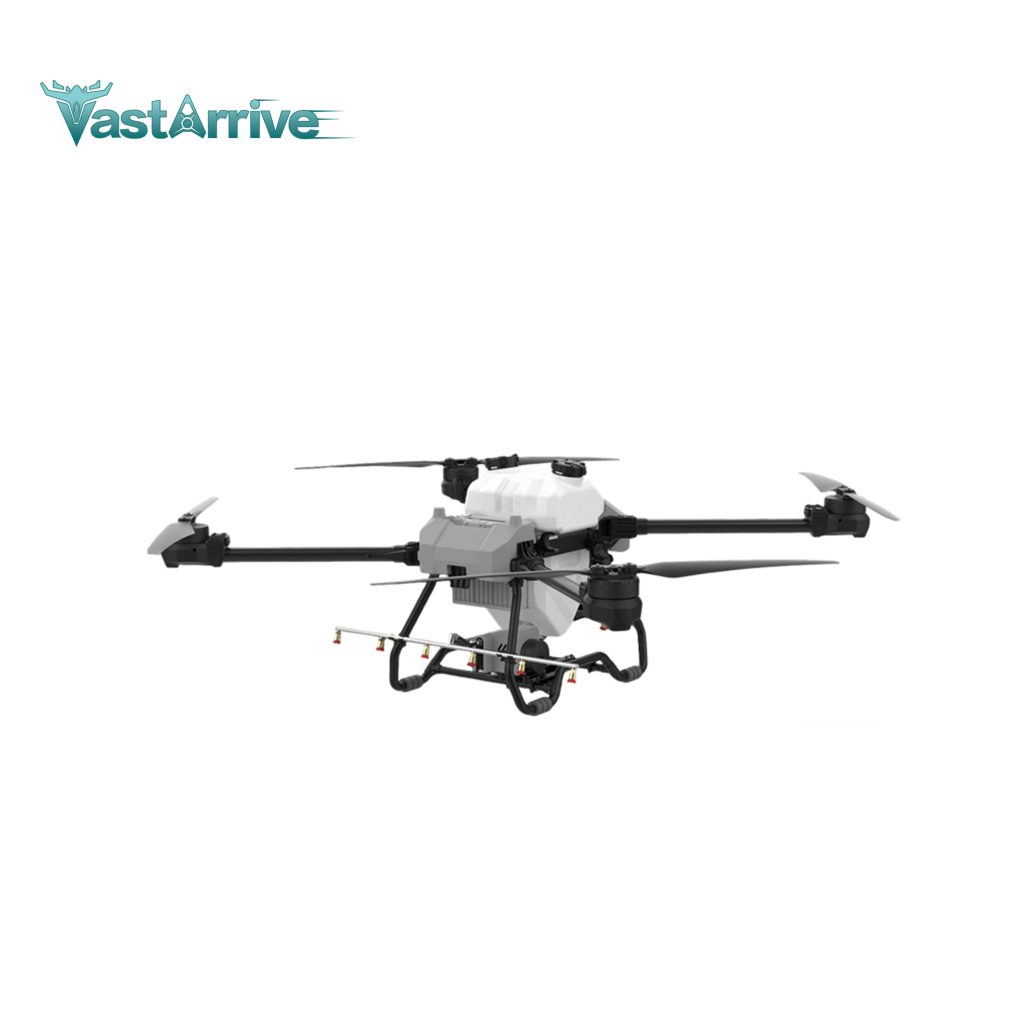
In such scenarios, lightweight, highly maneuverable cleaning drone systems are more suitable. For example, the VastArrive VA-D15R cleaning drone. The core advantages of this device are its high maneuverability, precise spray control, and rapid deployment. Our product’s core parameters are as follows:
- Flight speed: 10 m/s
- Engine: T15
- Wind resistance: Level 6
- Flight altitude: 120 m
- Control distance: 40 m
- Water pump pressure: 2900 PSI (instantaneous)
- Spray flow rate: 14 liters/min, maximum 15 liters/min
- Cleaning efficiency: Deep cleaning: 500 square meters/hour; Light cleaning: 1000 square meters/hour
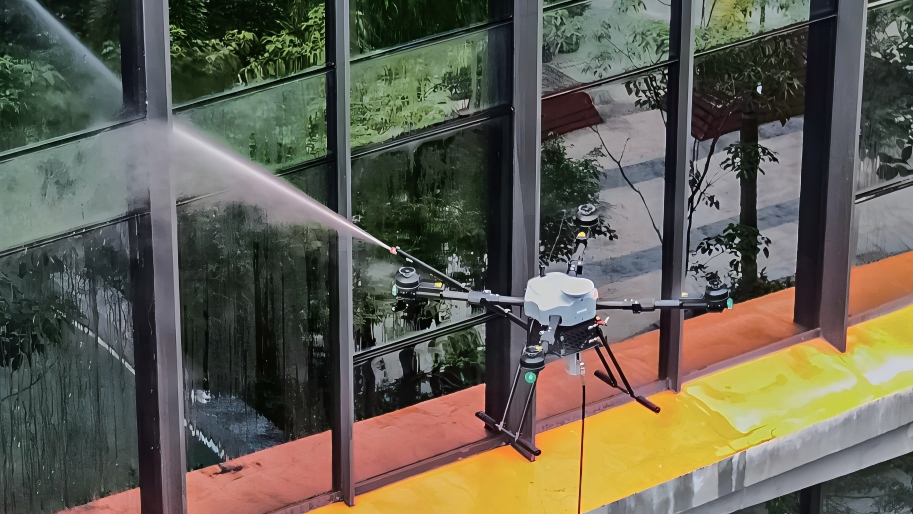
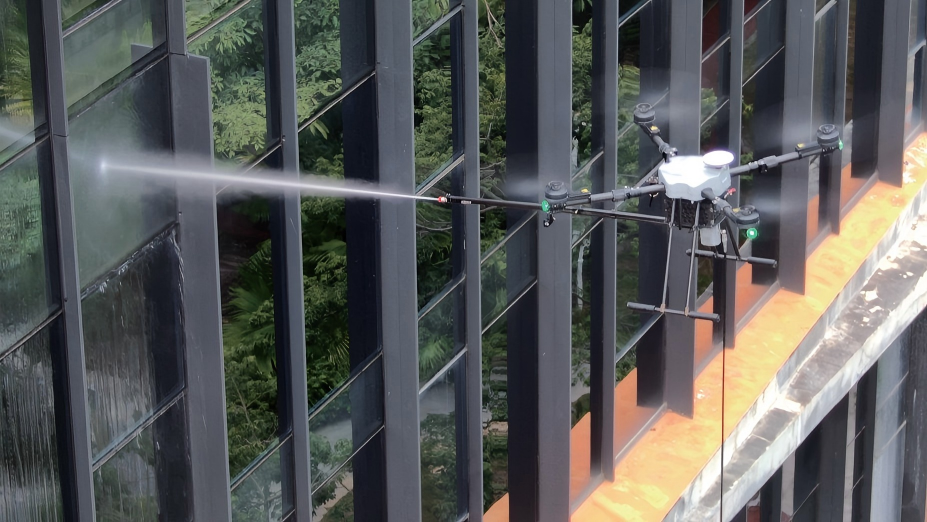
It is ideal for comprehensive cleaning of glass curtain wall materials in complex urban environments.
Photovoltaic Energy Cleaning
In environments like photovoltaic power plants, cleaning is not merely maintenance, but an operational action that directly impacts power generation efficiency. These environments are characterized by:
- Large area and wide distribution
- Long-term outdoor exposure, leading to dust and sediment accumulation that affects power generation efficiency
- Cleaning efficiency is directly related to ROI performance
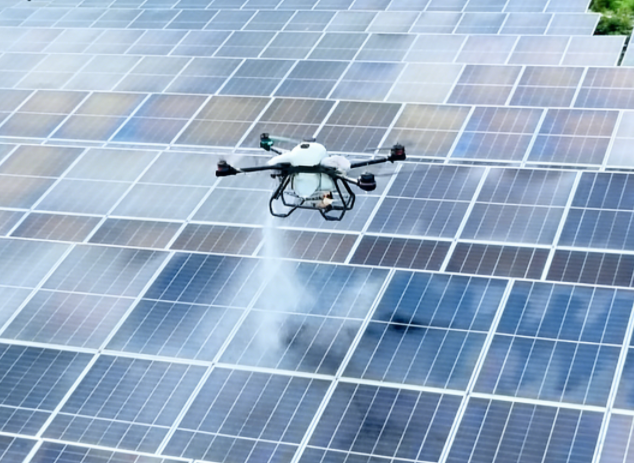
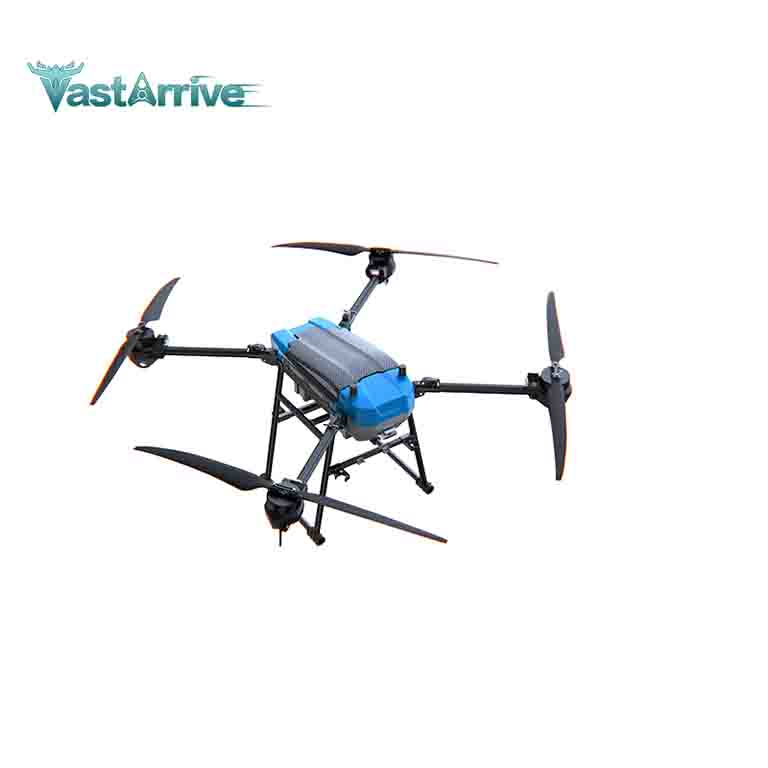
For these applications, VastArrive has launched the VA-D50R, specifically designed for the photovoltaic industry.
Our product achieves uniform cleaning coverage of photovoltaic panels, features a controllable water pressure system to avoid damaging the module surface, and improves cleaning efficiency per unit time.
Heavy Industrial Equipment Cleaning
In complex environments such as wind power plants, offshore platforms, and heavy industrial facilities, high-pressure cleaning tasks typically exhibit the following characteristics:
- High-risk operating environment
- Complex and inaccessible structures
- Higher requirements for equipment stability and load capacity
- More extreme operating conditions
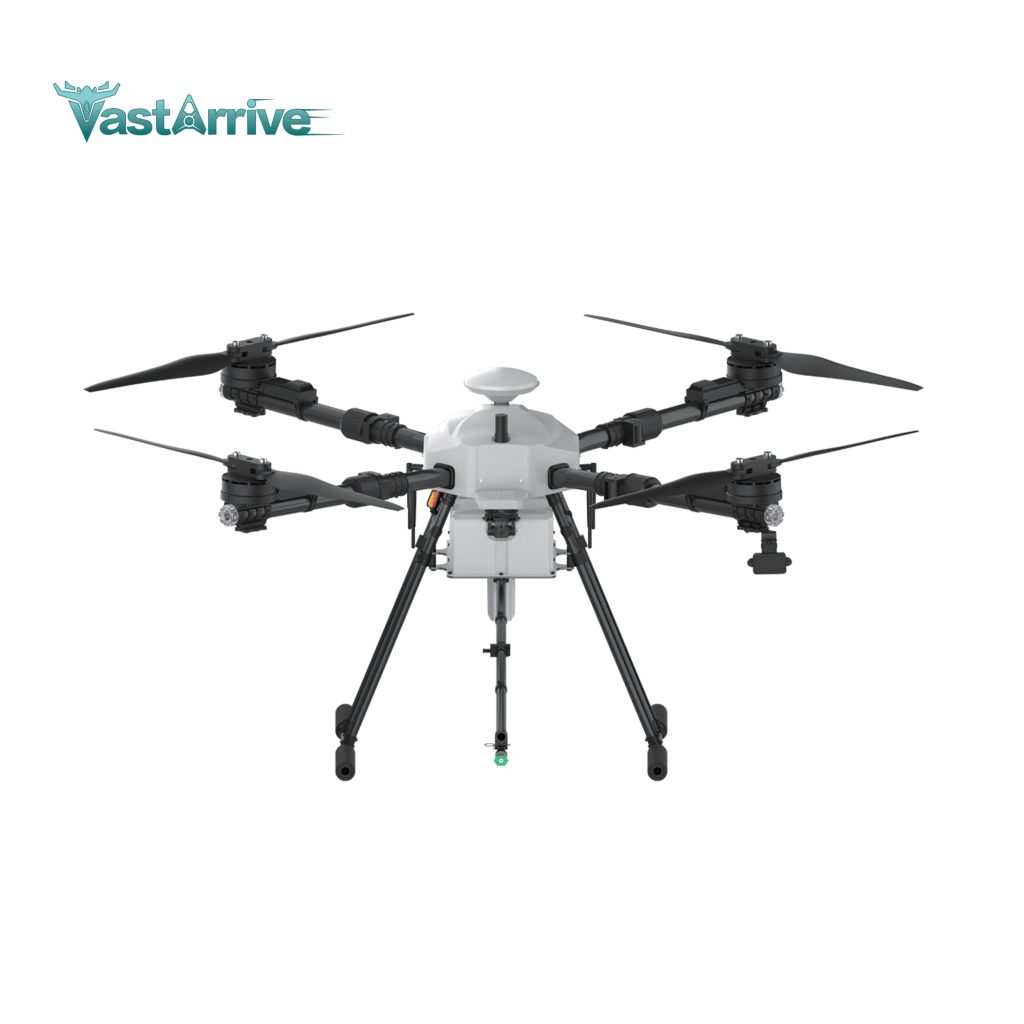
Therefore, a higher-level industrial-grade drone platform is needed to support complex system integration. VastArrive has launched the B100P multi-purpose heavy drone, which boasts high load-bearing capacity and wind resistance, can operate in open or offshore environments, and supports the integration of high-pressure cleaning modules. It is a reliable cleaning drone solution for high-risk, heavy industrial environments.
Why Didn’t It Erupt in Full Force?
Although considerable advancements have been made regarding the emergence of industrial cleaning drones, there hasn’t been any wide implementation yet. This is attributed to the fact that the drone industry is currently in its transitional period of growth.
Key limiting factors include:
- Relatively high initial investment, making it difficult to determine the return on investment for small or low-frequency projects;
- Strict regulatory requirements for urban and industrial airspace;
- The need for trained operators to control the flight and pressure cleaning systems;
- Different application scenarios require different system configurations, increasing deployment complexity and delaying large-scale standardization.
Therefore, industrial cleaning drones are currently primarily used in large-scale, high-risk, and high-value environments, rather than for general cleaning operations.
Related Products