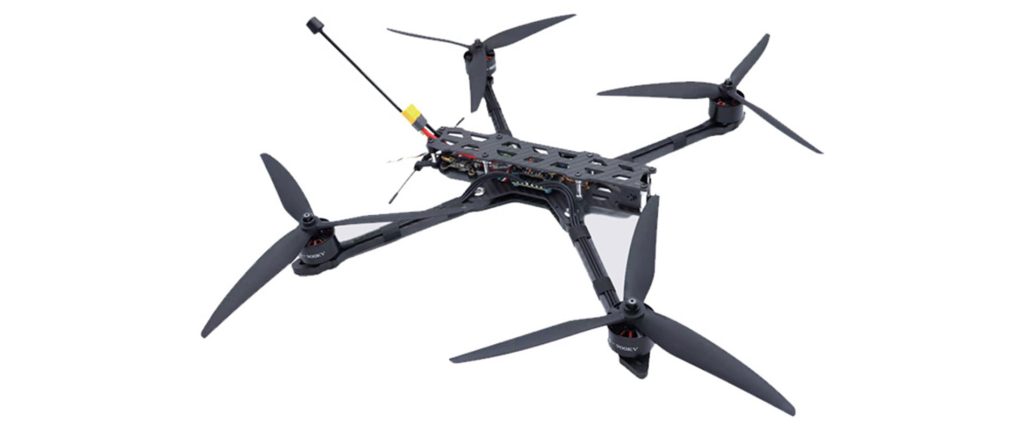
A Comprehensive Understanding of Building Cleaning Drones

The world has seen a surge in urban development during the last few years which has resulted in a greater number of skyscrapers and high-rise commercial buildings and industrial plants being constructed. The buildings need cleaning because they face continuous exposure to wind and sun. The conventional cleaning methods which depend on manual work and aerial work platforms and suspended baskets require extensive time to complete their tasks while creating dangerous conditions and generating high expenses over time. Building cleaning drones have emerged as essential maintenance equipment because of their development as industrial-grade drones which enable users to maintain their buildings efficiently.
What Is Building Cleaning Drone
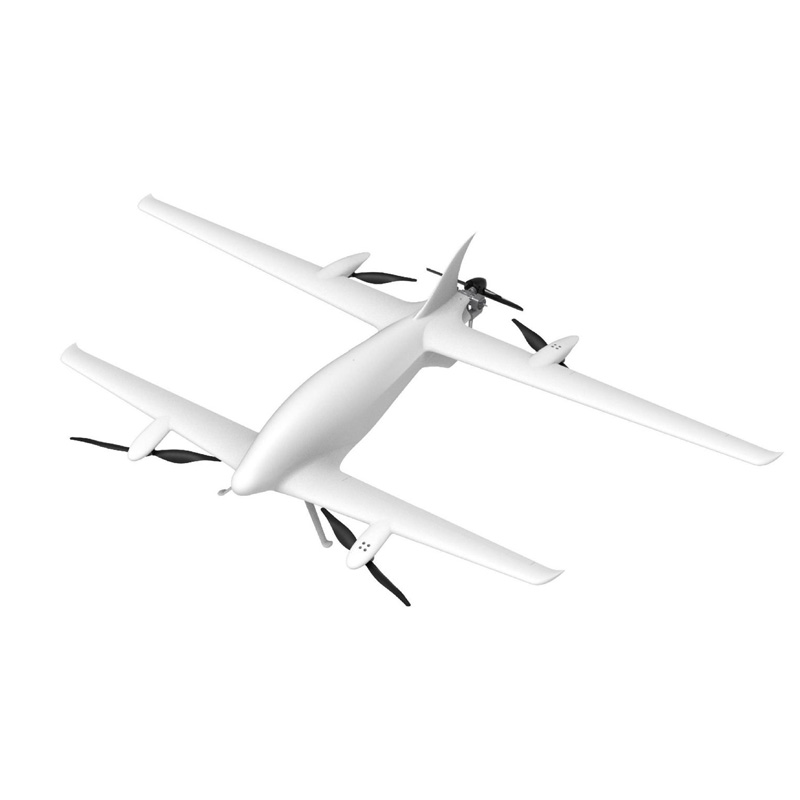
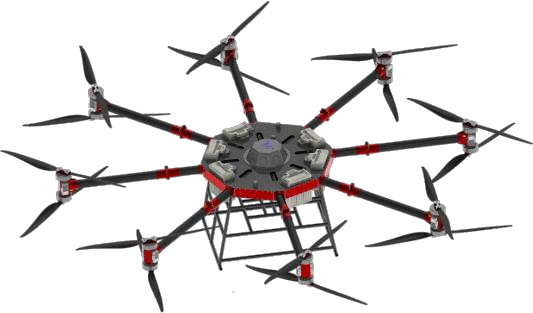
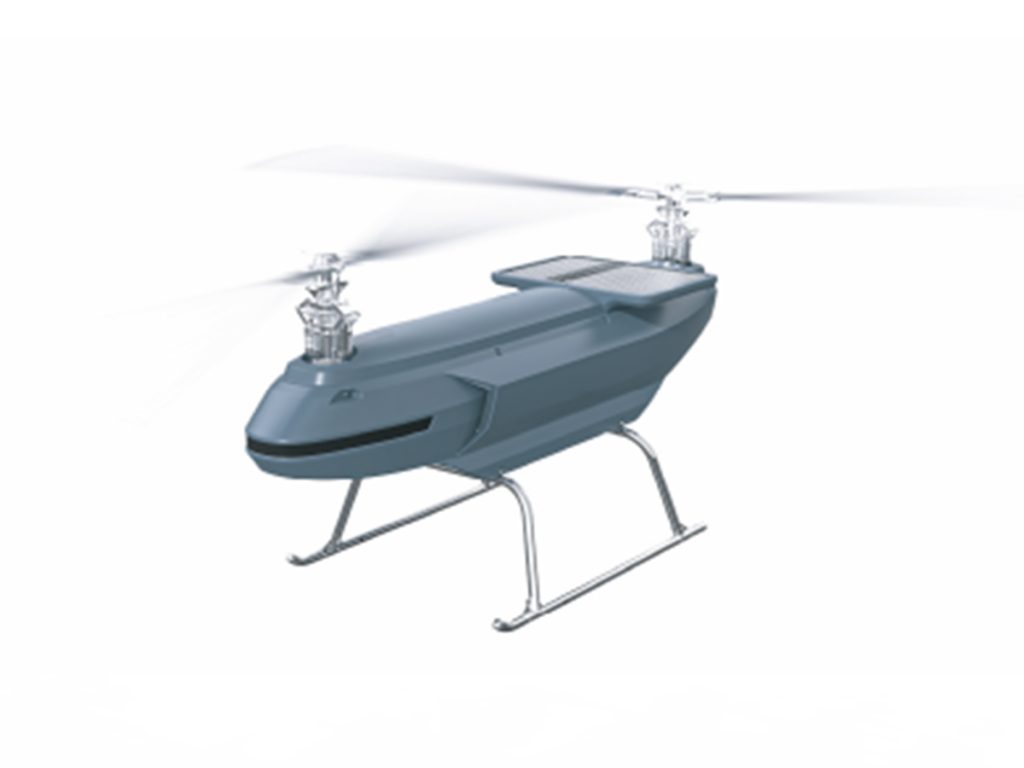
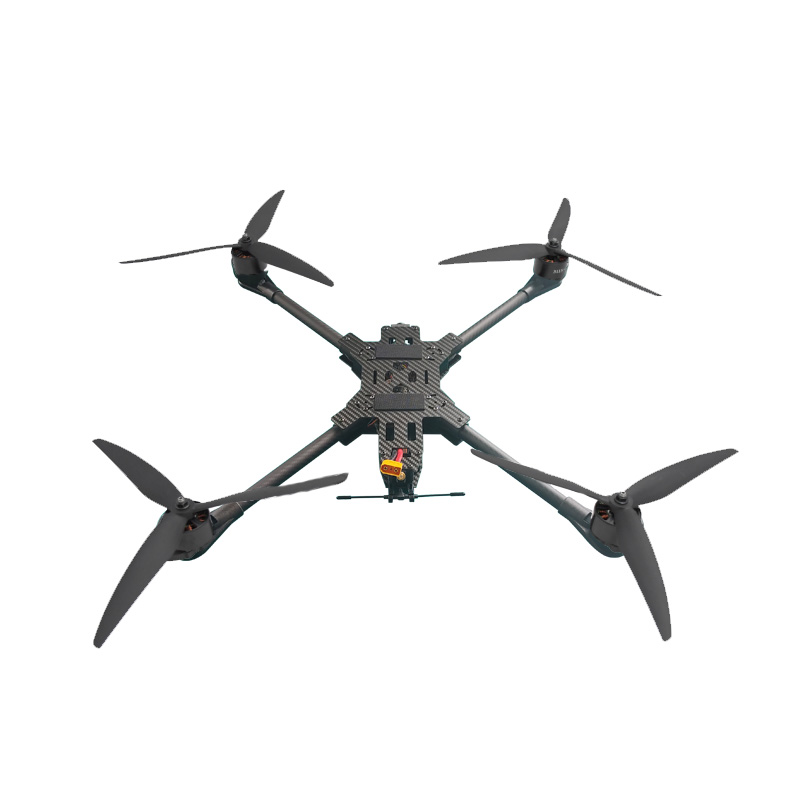
Building cleaning drones serve as specialized industrial drone systems which operate for the purpose of cleaning high-rise building exterior surfaces. The system achieves automatic or semi-automatic cleaning capabilities for glass curtain walls and metal surfaces and wall surfaces through its three cleaning devices which include a spraying system and high-pressure cleaning module and soft brush cleaning device.
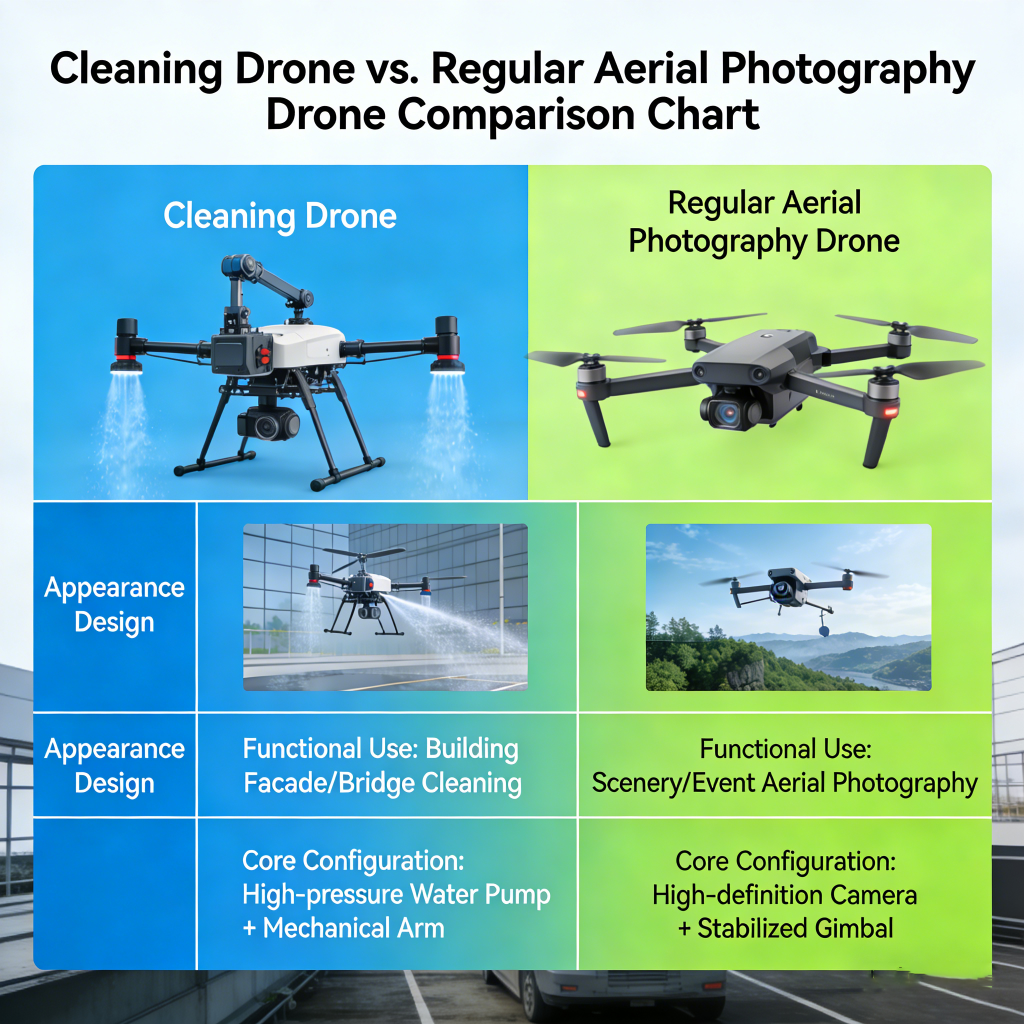
Building cleaning drones outperform standard aerial photography drones because they offer better load capacity and stability and wind resistance and continuous operation capability and precise control.
Core Structural Components of Building Cleaning Drones
| Core System | Subsystem / Component | Specific Parts | Function Description | Technical Requirements | Impact on Overall Performance |
| Flight Platform System | Airframe Structure | Carbon fiber frame, center plates, landing gear | Supports all onboard systems and provides structural integrity | High strength, lightweight, corrosion-resistant | Determines payload capacity and flight stability |
| Propulsion System | Brushless motors, propellers | Generates lift and thrust | High thrust-to-weight ratio, heat resistant, long lifespan | Directly affects lifting capability and stability | |
| Electronic Speed Control (ESC) | ESC modules | Controls motor speed and responsiveness | Fast response, high efficiency | Improves flight precision and smoothness | |
| Vibration Damping System | Dampers, anti-vibration mounts | Reduces vibration impact on sensors and flight controller | High vibration absorption | Enhances flight control accuracy | |
| Cleaning System | Spray System | High-pressure nozzles, spray boom | Sprays water or cleaning agents onto building surfaces | High pressure resistance, anti-clogging, corrosion-resistant | Determines cleaning effectiveness |
| Fluid Delivery System | High-pressure hoses, connectors | Transfers water or cleaning solution to spray system | Pressure resistant (5–20 MPa), durable | Ensures stable fluid supply | |
| Spray Control Module | Solenoid valves, flow controllers | Controls spray activation and flow rate | Precision control, reliable operation | Improves cleaning precision and efficiency | |
| Cleaning Tools (Optional) | Rotary brushes, soft brush modules | Removes stubborn dirt or industrial contaminants | Wear-resistant, durable | Enhances deep cleaning capability | |
| Water Supply System | Ground Water Supply Unit | High-pressure pump, water tank | Provides continuous water supply | Stable pressure output, reliable performance | Determines operational duration |
| Fluid Transfer System | High-pressure hoses, quick connectors | Delivers water from ground to drone | Wear-resistant, high-pressure tolerance | Ensures safe and reliable operation | |
| Pressure Regulation System | Pressure regulators, valves | Maintains stable fluid pressure | Precise pressure control | Protects equipment and ensures consistent cleaning | |
| Filtration System | Water filters | Removes particles to prevent nozzle blockage | High filtration efficiency | Improves system reliability | |
| Flight Control System | Flight Controller | Main flight control unit | Controls flight stability, positioning, and navigation | High processing power, reliability | Determines flight precision and stability |
| IMU Sensors | Gyroscope, accelerometer | Measures orientation and motion | High accuracy and fast response | Improves flight stability | |
| GPS Module | GNSS receiver | Provides positioning and navigation data | High positioning accuracy | Enables precise hovering and positioning | |
| Barometer | Pressure sensor | Measures altitude | High sensitivity and accuracy | Improves altitude control | |
| Positioning Assistance System | LiDAR, vision sensors | Measures distance from walls and obstacles | High precision and real-time feedback | Prevents collision and improves safety | |
| Power System | Flight Battery | Lithium battery (LiPo or Li-ion) | Supplies power to motors and onboard electronics | High capacity, high discharge rate | Determines flight time |
| Tethered Power System (Optional) | Power cable, power converter | Supplies continuous power from ground station | Stable power delivery, durable cables | Enables extended or unlimited operation | |
| Power Management Module | Voltage regulators, power distribution board | Distributes and regulates power supply | Stable voltage output | Ensures system reliability | |
| Power Protection System | Fuses, protection circuits | Prevents overload and electrical damage | High safety standards | Protects components and improves safety | |
| Control and Communication System | Remote Control System | Remote controller, receiver | Enables manual flight control | Long communication range, stable signal | Provides reliable operator control |
| Data Transmission System | Wireless data link modules | Transmits flight telemetry and system data | Stable, low-latency communication | Improves operational safety | |
| Video Transmission System | Camera, video transmitter | Provides real-time visual monitoring | High resolution, low latency | Enhances operational accuracy | |
| Ground Control Station | Control software, monitoring display | Monitors and controls drone operation | Reliable software and interface | Improves operational efficiency | |
| Safety System | Obstacle Avoidance System | LiDAR sensors, ultrasonic sensors | Detects obstacles and prevents collisions | High detection accuracy | Improves flight safety |
| Fail-safe Protection System | Return-to-home module, emergency logic | Prevents loss of control or flyaway incidents | Automatic response capability | Prevents operational accidents | |
| Redundant Propulsion System | Multi-motor configuration | Maintains flight if one motor fails | Redundant design architecture | Enhances operational safety | |
| Emergency Stop System | Emergency stop module | Immediately shuts down system if needed | Fast and reliable response | Ensures emergency safety |
Building for cleaning drones require five essential systems which include their flight system and their cleaning system and their flight control system and their water supply system and their power system. The five systems of the drone establish its payload capacity and stability and cleaning performance and flight precision and operational duration.
Working Principle of Building Cleaning Drones
The working principle of building cleaning drones essentially integrates multi-rotor flight control technology, high-pressure fluid delivery technology, and a precision positioning and control system into an aerial work platform, enabling stable, close-range cleaning of building facades and a controlled cleaning process. The entire process can be divided into five core stages:
1. Stable Flight and Surface Positioning
The flight control system of the construction drone uses information from GPS and visual sensors and LiDAR to determine the drone’s location and altitude and distance from the wall which enables the drone to maintain stable hovering and accurate position tracking. The design enables the drone to maintain stable flight in vertical wall-mounted workshops while its wind resistance capabilities provide protection against gusts that occur at high altitudes which results in successful and secure cleaning operations.
2. Power System
Most construction drones use tethered systems which maintain constant power delivery to the drone through ground equipment. The system allows the drone to operate without interruptions because it has unlimited power supply which enables continuous flight to complete work.
3. Pressurized Cleaning Mechanism
The drone starts its cleaning operation after it arrives at the assigned cleaning site because the ground-based high-pressure pump maintains a constant water supply through its high-pressure pipelines to the onboard nozzles which create a steady surface cleaning spray. The system provides unlimited onboard water supply which enables extended operational time and maintains consistent system performance. The drone uses three different cleaning methods which include high-pressure jets and soft water cleaning and precision nozzle spraying to achieve effective cleaning results while reducing water consumption.
4. Controlled Cleaning Path Execution
The drone can move gradually downwards from the top of the building, cleaning the facade in sections, either according to a preset path or under real-time operator control. The cleaning process uses three main paths which include vertical scanning and horizontal coverage and segmented area coverage to achieve complete surface cleaning. The flight control system controls the drone’s position and attitude during cleaning to keep a constant angle and distance between the nozzles and the building surface, which results in a uniform and efficient and consistent cleaning process.
5. Real-Time Monitoring and Feedback Control
The operators use the ground control station to track both the operational status of the drone and its cleaning performance in real time. The drone’s onboard camera system transmits live footage to the ground, which enables operators to watch cleaning performance and make adjustments to spray settings and flight paths in real time. The system provides immediate feedback which enables operators to maintain safe operation and stable flight control of the drone system throughout its missions while the system delivers dependable cleaning results.
Main Application Scenarios of Drones for Cleaning Buildings
Below are the most common and practical application scenarios:
1. High-Rise Commercial Buildings
High-rise buildings typically possess exterior wall space that exceeds 10000 square meters. The use of building cleaning drones enables safe and efficient high-rise building cleaning operations because they eliminate the need for scaffolding and suspended platforms which decreases both operational risks and workers expenses.
Typical buildings:
- Office buildings
- Skyscrapers
- Corporate headquarters
- Financial district buildings
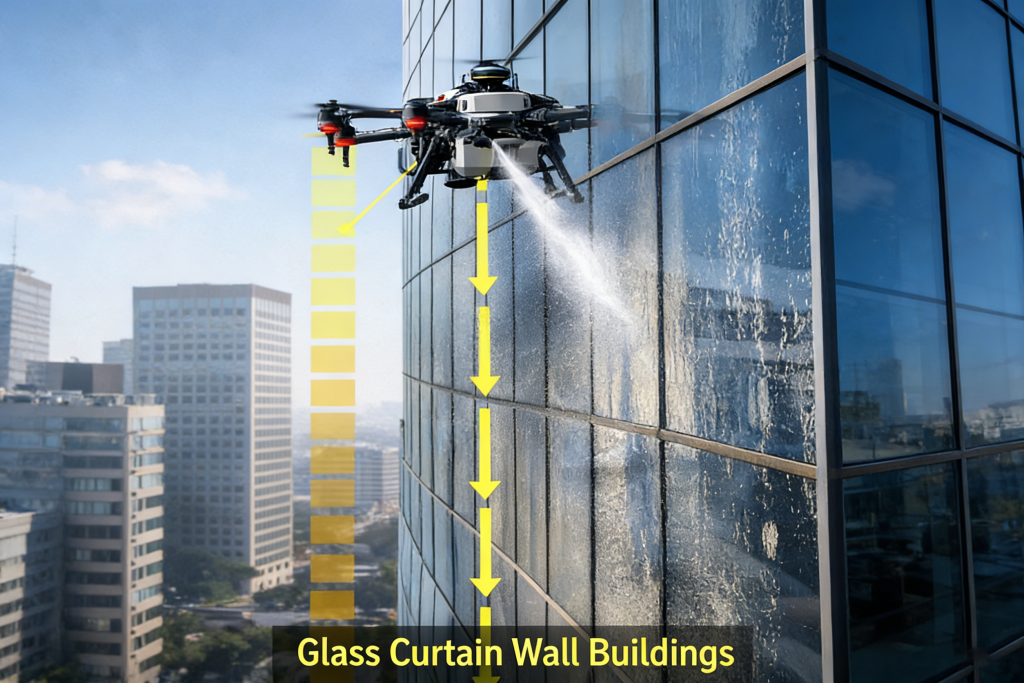
2. Glass Curtain Wall Buildings
Glass curtain walls easily accumulate dust and contaminants and water stains. The controlled distance cleaning drones maintain from glass surfaces together with their low-pressure gentle washing method makes them suitable for cleaning delicate glass surfaces.
Typical buildings:
- Modern Office Buildings
- Shopping Malls
- Hotels
- Airports
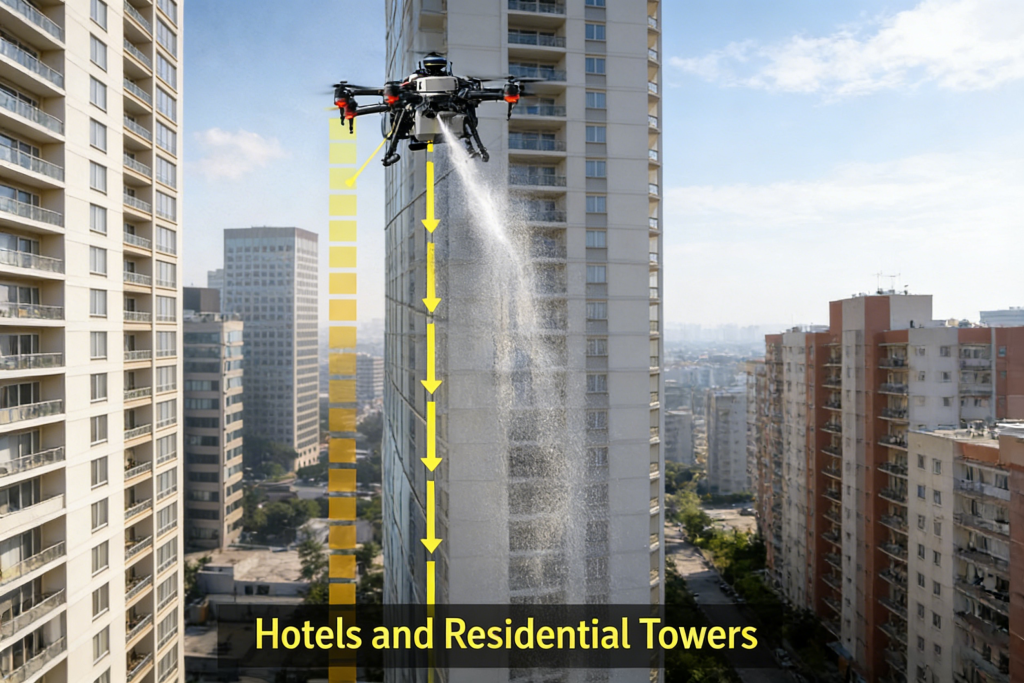
3. Hotels and Residential Towers
The buildings need exterior cleaning because their appearance and property value require permanent upkeep. Drones enable rapid cleaning processes which create little disturbance for both residents and visitors.
Typical structures:
- Luxury hotels
- High-rise apartments
- Condominium buildings
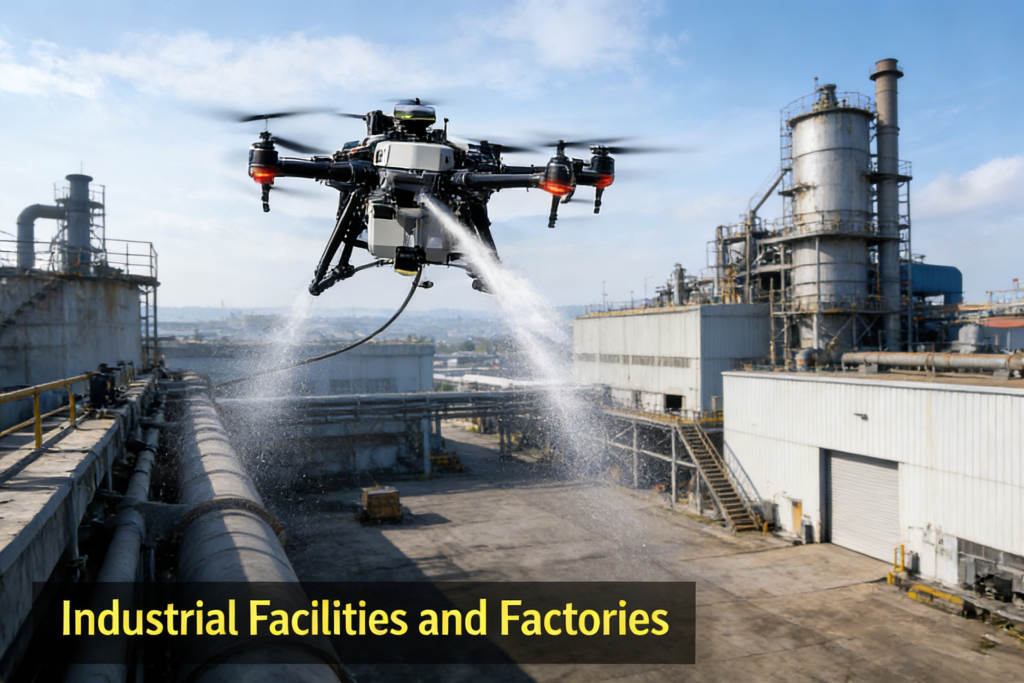
4. Industrial Facilities and Factories
Industrial buildings face constant risk because dust and chemical residues and oil stains and other contaminants continuously enter their premises. The construction cleaning drones can operate safely to clean both vertical surfaces and difficult-to-access spaces without stopping work.
Typical building types:
- Manufacturing plants
- Warehouses
- Industrial parks
- Storage facilities
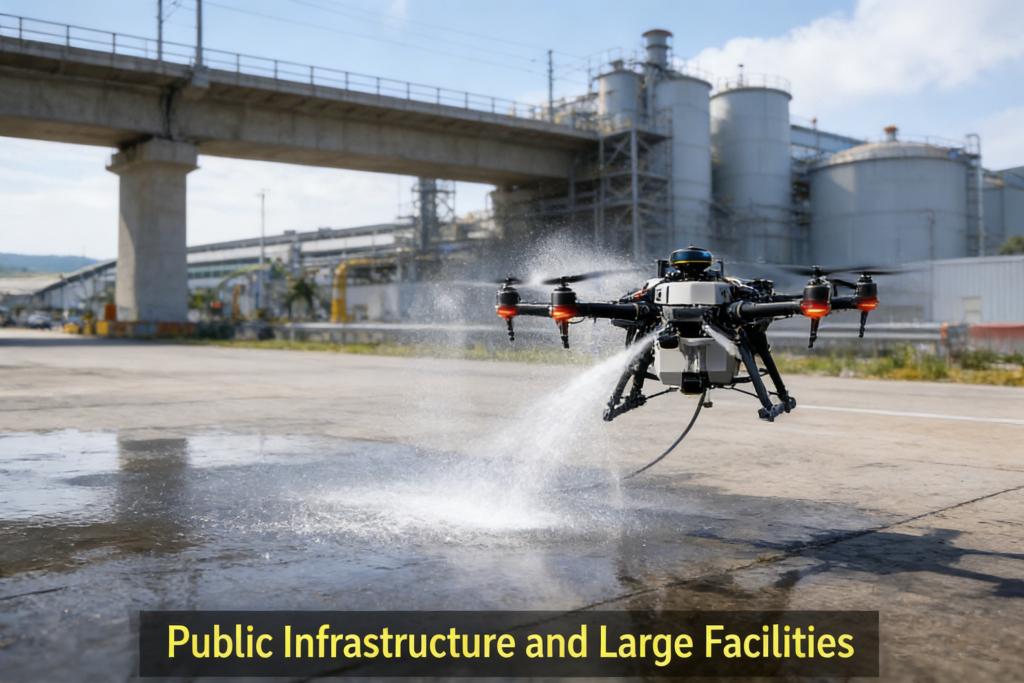
5. Public Infrastructure and Large Facilities
The buildings display extensive and intricate architectural features that cover their entire building envelope. The use of drones boosts operational efficiency while decreasing requirements for extensive cleaning personnel and operational machinery.
Typical structures:
- Stadiums
- Airports
- Exhibition centers
- Convention centers
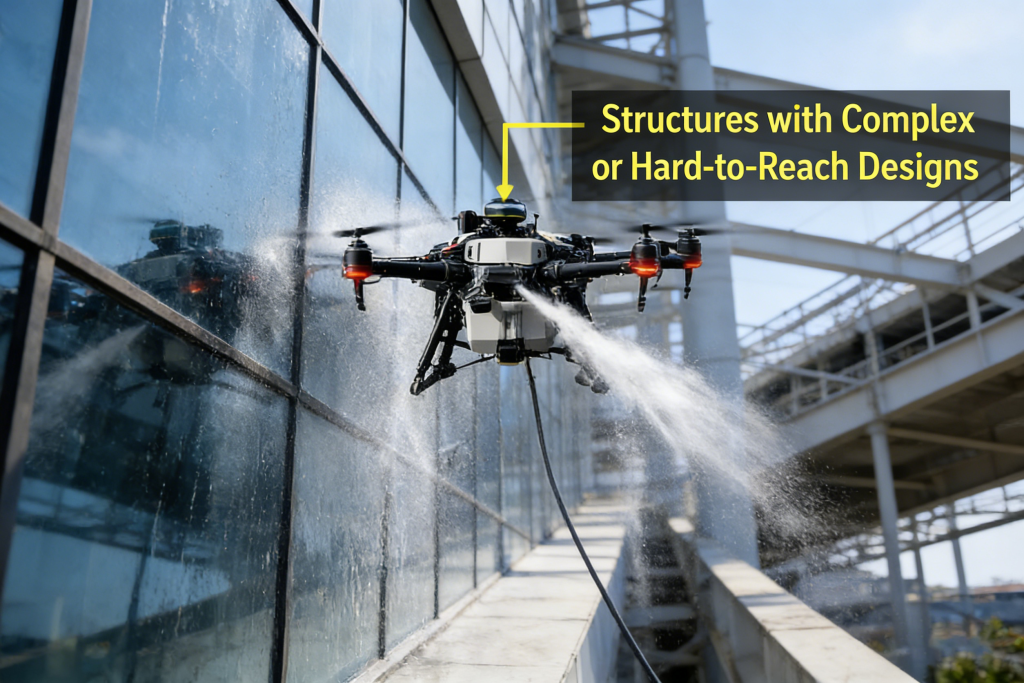
6. Structures with Complex or Hard-to-Reach Designs
Traditional cleaning equipment cannot access these areas because it lacks safe operational methods to reach them, but drones can navigate through these spaces to reach their existence which includes hard-to-access locations.
Typical structures:
- Buildings with curved facades
- Architectural landmarks
- Buildings with irregular geometry
7. Solar Panel Installations on Buildings
Solar efficiency decreases because dust and dirt accumulation. Drones can perform safe cleaning operations to clean solar panels which are installed on vertical and elevated surfaces without requiring human climbers to do the work.
Typical structures:
- Rooftop solar systems
- Solar-covered building facades
Building Cleaning Drones vs Traditional Manual Cleaning
| Comparison Item | Building Cleaning Drone | Manual Cleaning |
| Safety | Very high | High risk |
| Efficiency | High | Low |
| Cost | Lower in the long term | High |
| Coverage Range | Wider | Limited |
| Level of Automation | High | Low |
Summary
Construction cleaning drones are industrial unmanned aerial vehicle (UAV) systems that integrate flight control, high-pressure cleaning, and automated control technologies, specifically designed for cleaning high-rise building facades. The systems operate through their flight platform, cleaning module, water supply system, flight control system, and ground control station which enable them to conduct safe and effective high-altitude cleaning operations. Construction cleaning drones serve as an essential solution for modern building maintenance because the number of tall buildings worldwide keeps increasing and they provide a safer and more efficient method than traditional manual cleaning techniques.
Related Products